
I remember sitting in the bathroom, phone in hand, googling "period 3 days late but negative test" at midnight. My husband was asleep. I wasn't going to wake him for what was probably nothing. But my brain had already fast-forwarded through nine months of pregnancy, naming the baby, and panicking about whether we could afford it.
My period arrived two days later. Stress, apparently.
If you're reading this at some unreasonable hour with similar questions running through your head, here's the honest guide I wish I'd had — no vague platitudes, just the biology of what's actually happening in your body and how to know for sure.
Why It's So Hard to Tell the Difference
Here's the frustrating truth that nobody explains properly: PMS and early pregnancy are driven by the same hormone — progesterone — which is why the symptoms overlap so heavily.
After ovulation (roughly mid-cycle), your body produces progesterone regardless of whether conception has occurred. If you're not pregnant, progesterone drops after about 12–14 days, triggering your period. If you are pregnant, progesterone keeps rising to sustain the pregnancy (Yonkers et al., 2008).
A 2013 study confirmed this, finding that the severity of premenstrual symptoms was significantly associated with the severity of early pregnancy symptoms. Women who experienced worse PMS tended to also experience more intense early pregnancy symptoms, supporting the theory that some women are more sensitive to hormonal shifts across different reproductive phases (Sommer et al., 2013).
PMS vs Early Pregnancy Symptoms: What Overlaps and What Doesn't
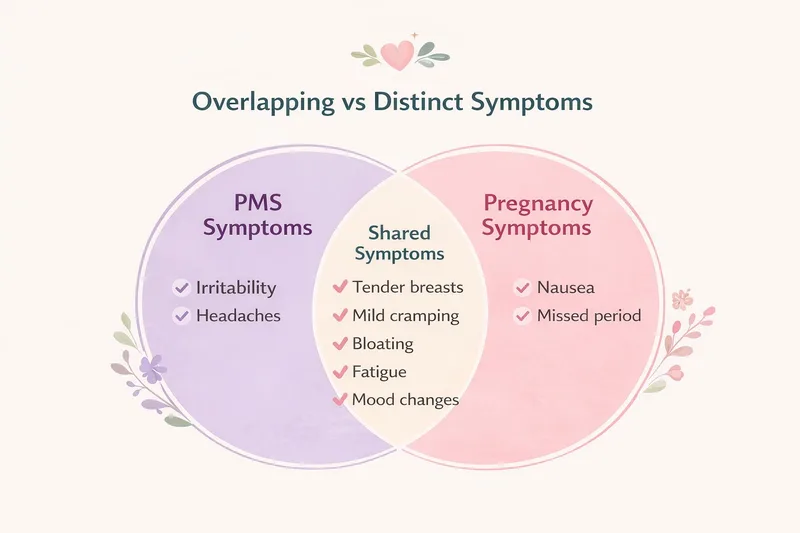
Symptoms common to both (not helpful for telling them apart)
Breast tenderness — Both PMS and early pregnancy cause swollen, sore breasts. With PMS, this tends to ease once your period starts. In pregnancy, the tenderness often intensifies and lasts longer — but you won't know that distinction until after your period is due.
Fatigue — Progesterone is a sedating hormone. You'll feel tired whether your period is coming or a baby is on the way. However, pregnancy fatigue is often described as more extreme — a bone-deep exhaustion rather than just feeling a bit sluggish.
Mood changes — Irritability, tearfulness, anxiety. Both conditions can cause these, and the overlap is almost total.
Cramping — Mild lower abdominal cramping can occur with both PMS and early pregnancy. PMS cramps typically intensify as your period approaches and then ease once bleeding starts. Pregnancy cramping tends to be milder and more intermittent.
Bloating — Progesterone slows digestion. Bloating is common in both scenarios.
Food cravings — PMS cravings tend toward carbohydrates and sugar. Pregnancy cravings can be more specific and unusual, but this difference isn't reliable enough to base a conclusion on.
Symptoms that lean more toward pregnancy
Nausea — This is the biggest differentiator. Nausea (with or without vomiting) is a hallmark of early pregnancy but is not a typical PMS symptom. If you're feeling genuinely queasy and your period is late, that's a meaningful clue. That said, nausea usually doesn't start until around 6 weeks of pregnancy, so you may not have it yet when your period is first late.
Implantation bleeding — Some women experience light spotting around 6–12 days after conception, when the embryo embeds in the uterine lining. This is typically pink or light brown, lasts hours rather than days, and is much lighter than a period. It can be mistaken for an early period, but the key difference is that it's far lighter and shorter.
Nipple changes — In pregnancy, the areola (the area around the nipple) can darken and the nipples may become more prominent. These changes don't typically occur with PMS.
A missed period — The single most reliable early sign. PMS produces symptoms before your period; pregnancy produces symptoms instead of your period.
When Can You Actually Take a Pregnancy Test?
Pregnancy tests detect a hormone called human chorionic gonadotropin (hCG), which is produced by the developing placenta after the embryo implants in the uterine lining.
Here's the timeline:
Implantation occurs on average 9 days after ovulation, with a range of 6–12 days. After implantation, hCG levels begin to rise — but initially they're extremely low.
hCG doubling time — In a healthy early pregnancy, hCG levels roughly double every 48–72 hours during the first weeks (NCBI StatPearls).
Home pregnancy tests detect hCG in urine at a threshold of around 20–25 mIU/mL. Most tests reach this sensitivity (Gnoth & Johnson, 2014).
Blood tests at your GP can detect hCG at levels as low as 5 mIU/mL, making them more sensitive for very early detection.
The NHS recommendation
The NHS advises that pregnancy tests are most reliable from the first day of your missed period. If you don't know when your period is due, test at least 21 days after your last unprotected sex.
Can you test early?
Some "early detection" tests claim to detect pregnancy up to 6 days before your missed period. One study found that the most sensitive home test (First Response Early Result) had an analytical sensitivity of 6.3 mIU/mL and could detect over 95% of pregnancies by the day of the missed period (Cole et al., 2005).
However, testing early comes with a real trade-off: a negative result doesn't mean you're not pregnant — it may simply mean hCG hasn't risen high enough yet. If you test early and get a negative, you'll need to retest after your period is actually late.
Tips for accurate testing
Use first morning urine — It's more concentrated, giving the test the best chance of detecting hCG.
Don't drink excessive fluids beforehand — Diluted urine lowers hCG concentration.
Wait the full recommended time — Read the result at the time specified in the instructions (usually 3–5 minutes). Checking after 10+ minutes can cause evaporation lines that look like faint positives.
A faint line is still a positive — Any visible second line, however faint, indicates hCG is present. You're almost certainly pregnant. Retest in 2 days — the line should be darker.
My Period Is Late but the Test Is Negative — What Now?
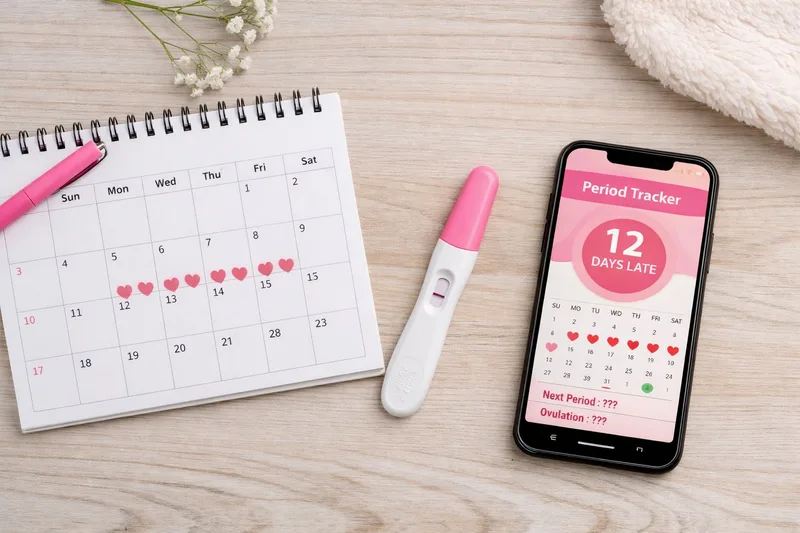
This is the most anxiety-inducing scenario, and it's incredibly common. There are two possibilities:
1. You're pregnant but tested too early
If you ovulated later than usual this cycle, implantation may have happened later, and hCG may not yet be at detectable levels. Wait 3–5 days and test again. If you're pregnant, hCG will have risen enough to produce a clear positive by then.
2. Your period is late for a non-pregnancy reason
A late period doesn't automatically mean pregnancy. The most common reasons your cycle might be delayed include:
Stress — Chronic or acute stress raises cortisol, which disrupts the hypothalamic-pituitary axis that governs your menstrual cycle. This can delay ovulation, which in turn delays your period. The period isn't "late" — ovulation was late, and the period follows accordingly.
Weight changes — Both significant weight loss and weight gain can disrupt hormonal balance. Low body fat reduces oestrogen production, while excess body fat increases it — both of which can interfere with regular ovulation (NHS: Stopped or missed periods).
Excessive exercise — Intense physical training, particularly combined with low calorie intake, can suppress the hypothalamus and delay or stop periods entirely (a condition called hypothalamic amenorrhoea).
Coming off hormonal contraception — After stopping the pill, injection, or hormonal IUD, it can take several months for your natural cycle to regulate. This is normal and doesn't indicate a fertility problem.
Polycystic ovary syndrome (PCOS) — One of the most common causes of irregular periods, PCOS affects between 5% and 10% of women of reproductive age. Key symptoms alongside irregular periods include acne, excess hair growth, and difficulty losing weight (NHS: PCOS symptoms).
Thyroid disorders — Both an underactive and overactive thyroid can affect menstrual regularity. Your GP can check this with a simple blood test.
Illness or medication — Recent illness, travel, jet lag, or certain medications (including antidepressants and some antihistamines) can all delay a cycle.
Perimenopause — If you're in your 40s (or occasionally earlier), irregular periods may signal the beginning of the transition toward menopause.
When to see your GP
The NHS recommends seeing your GP if:
- You've missed 3 or more periods in a row and you're not pregnant
- Your periods were regular but have become irregular
- Your periods stop for more than 90 days (unless you're pregnant, breastfeeding, or on hormonal contraception)
- You bleed between periods or after sex
- Your periods suddenly become very heavy or very painful
The Test Is Positive — What Happens Next?
First: a positive home pregnancy test is very rarely wrong. False positives are extremely uncommon because hCG is only produced during pregnancy (with rare medical exceptions like certain tumours or fertility medications containing hCG). If you see a line — even a faint one — you are almost certainly pregnant.
Your immediate next steps (UK)
1. Start taking folic acid — If you're not already, begin 400 micrograms daily immediately. This reduces the risk of neural tube defects. If you have diabetes, a BMI over 30, or take epilepsy medication, you may need the higher 5mg dose — check with your GP. See our Prenatal Vitamins UK guide for the full breakdown.
2. Self-refer for NHS maternity care — You don't need to see your GP first. In most areas of England, you can refer yourself directly to your local midwifery service. The NHS advises contacting them as soon as you find out you're pregnant so they can book your initial appointment (usually between weeks 8–10).
3. Use the NHS due date calculator — Based on the first day of your last period, this gives you an estimated due date. Your dating scan at around 12 weeks may adjust this.
4. Stop smoking and drinking alcohol — There is no known safe level of alcohol during pregnancy. If you smoke, the NHS offers free support through the Smokefree helpline.
5. Review your medications — Some medications are not safe during pregnancy. Don't stop any prescribed medication without consulting your GP or pharmacist, but do tell them you're pregnant so they can review your prescriptions.

Frequently Asked Questions
How late can a period be before I should worry?
A period that's 1–5 days late is very common and usually nothing to worry about — cycles naturally vary by a few days month to month. If you're more than a week late with negative pregnancy tests, consider the non-pregnancy causes listed above. If you miss three consecutive periods without explanation, see your GP.
Can stress really delay a period?
Yes. Stress directly affects the hypothalamus, which controls the release of hormones that trigger ovulation. If ovulation is delayed, your period will be delayed by the same number of days. This is one of the most common causes of a "late" period.
I got a very faint positive — am I definitely pregnant?
Almost certainly, yes. Any visible second line indicates hCG in your urine. Retest in 48 hours — the line should be noticeably darker as hCG levels rise. If the line doesn't darken or disappears on retesting, contact your GP as this could indicate a very early pregnancy loss (chemical pregnancy).
Could a late period mean I'm going through early menopause?
If you're under 40 and experiencing missed periods along with other symptoms like hot flushes, night sweats, or vaginal dryness, see your GP. Premature ovarian insufficiency affects approximately 1% of women under 40 and can be diagnosed with blood tests.
My period is 2 weeks late and all tests are negative — what's happening?
The most likely explanation is that you ovulated much later than usual this cycle, meaning your period isn't actually as "late" as it seems — it just hasn't been 14 days since ovulation yet. Alternatively, one of the non-pregnancy causes (stress, weight changes, PCOS, thyroid) may be at play. If this persists, see your GP for blood tests.
Are cheap pregnancy tests as accurate as expensive ones?
Largely, yes. A study comparing commercially available pregnancy tests found that most brands reliably detected hCG at 25 mIU/mL, which is sufficient for accurate results from the day of your missed period (Gnoth & Johnson, 2014). The main advantage of more expensive "early detection" tests is slightly higher sensitivity for testing before your period is due. Once your period is actually late, a basic test from the pound shop will give you the same answer.
Is it normal to feel cramping but no period?
Yes — both PMS and early pregnancy can cause cramping without bleeding. If the cramping is mild and you have a positive pregnancy test, it's likely the uterus stretching as the embryo implants and grows. If cramping is severe, one-sided, or accompanied by bleeding after a positive test, contact your GP or early pregnancy unit urgently, as this can indicate an ectopic pregnancy.
The Bottom Line
You cannot reliably distinguish between PMS and early pregnancy based on symptoms alone. The biology is working against you — both conditions are driven by progesterone, and the symptom overlap is almost total.
The only way to know for sure is a pregnancy test, taken at the right time. The right time, according to the NHS, is from the first day of your missed period. If the test is negative and your period still hasn't arrived after another week, test again or see your GP.
Try not to spiral into symptom-spotting. I know that's easier said than done at midnight in the bathroom with your phone. But the test will give you the answer your symptoms can't.
Medical disclaimer: This article is for informational purposes only and does not constitute medical advice. If you're concerned about a missed period, a positive pregnancy test, or any unusual symptoms, please consult your GP or midwife.
Last reviewed: March 2026 | Next review: September 2026
Related articles: