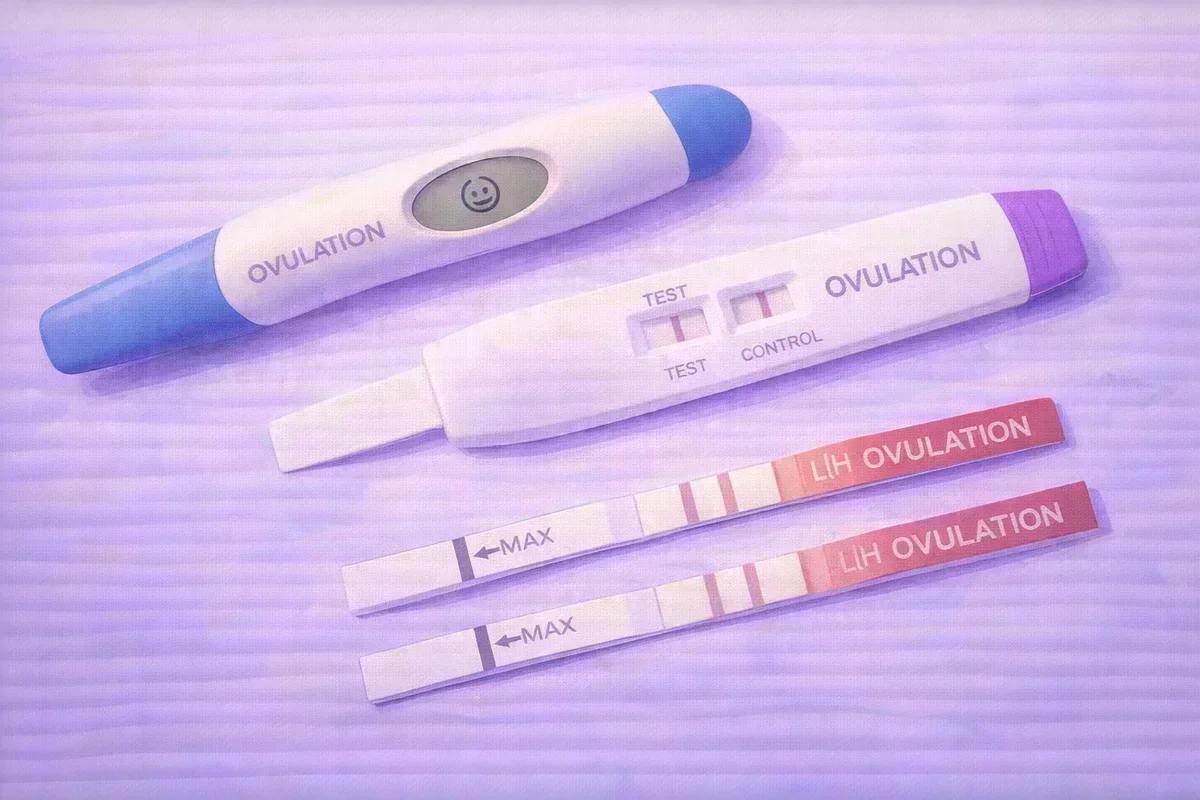
When you're trying to conceive (TTC), ovulation predictor kits—commonly called ovulation tests or OPKs—are one of the most reliable ways to pinpoint your fertile window. These tests detect the surge in luteinising hormone (LH) that happens 24-36 hours before ovulation, giving you advance warning of your most fertile days.
But walk into any Boots or browse Amazon UK, and you'll face dozens of options at wildly different price points. Digital tests costing £20-30 for a week's supply. Budget strips at £5 for 50 tests. Premium monitors costing over £100. So which ovulation tests are actually worth buying?
We've tested and reviewed the most popular ovulation tests available in the UK to help you choose the right one for your needs and budget.
How Ovulation Tests Work (Quick Recap)
Ovulation tests work by detecting luteinising hormone (LH) in your urine. When LH surges—typically 24-36 hours before you ovulate—the test shows a positive result. This tells you your most fertile window is opening, so it's time to have sex if you're trying to conceive.
There are two main types:
Line tests (traditional): You compare the intensity of two lines. When the test line is as dark as or darker than the control line, you're about to ovulate.
Digital tests: These give you a clear digital result—usually a smiley face or "yes/no" readout—so there's no line-reading guesswork.
Both types are highly accurate (99%+ when used correctly) at detecting the LH surge. The difference is in ease of use, cost, and features.
For a complete guide on when and how to use ovulation tests, see our article: How to Track Ovulation When Trying to Conceive.
What to Look for in an Ovulation Test
Before diving into specific products, here's what matters when choosing an ovulation test:
Accuracy: All major brands claim 99%+ accuracy. In practice, they're all very reliable at detecting LH surges when used correctly.
Ease of use: Can you read the results easily? Digital tests remove guesswork; line tests require you to compare line darkness.
Sensitivity: Measured in mIU/ml (milli-international units per millilitre). Most tests detect LH at 25-30 mIU/ml, which works for most women. Some budget tests are less sensitive (40 mIU/ml) and may miss subtle LH surges.
Cost per test: Premium brands cost £2-4 per test. Budget options cost £0.10-0.30 per test. If you're testing for several months, this adds up quickly.
Availability: Can you buy it at your local pharmacy or supermarket, or do you need to order online?
Number of tests: Premium brands typically sell 7-10 tests per pack. Budget brands sell in bulk (20-100 tests), which is better value if you have irregular cycles or need to test for multiple months.
Best Ovulation Tests UK: Our Reviews
1. Clearblue Digital Ovulation Test
Type: Digital
Price: £18-25 for 10 tests (Boots, Superdrug, Tesco)
Cost per test: £1.80-2.50
Sensitivity: 25 mIU/ml
Display: Digital smiley face
What it does:
Clearblue Digital is the UK's most popular ovulation test. It gives you a clear digital smiley face when your LH surge is detected—no line-reading required. The display is easy to read and stays visible for 8 minutes.
How to use:
Test once daily (or twice if you want to catch the surge earlier). The test stick goes directly in your urine stream or can be dipped in a cup. Results appear in 3 minutes.
Pros:
- No guesswork—digital readout is crystal clear
- Reliable and accurate (99% at detecting LH surge)
- Widely available at UK pharmacies and supermarkets
- Good for first-time users who want simplicity
- Easy to read even if you've never used ovulation tests before
Cons:
- Expensive compared to line tests (£2+ per test)
- Only 10 tests per pack—not enough if you have long or irregular cycles
- Can't test twice daily without buying multiple packs
- Not reusable (test sticks are single-use)
- Battery-powered holder (though batteries last for many cycles)
Best for: First-time users, women with regular cycles who only need to test for 7-10 days per month, anyone who wants foolproof results.
Where to buy: Boots, Superdrug, Tesco, Sainsbury's, Amazon UK
Our verdict: ⭐⭐⭐⭐ (4/5)
Excellent for beginners and peace of mind, but the cost adds up if you're testing for multiple cycles or need more tests per month.
2. Clearblue Advanced Digital Ovulation Test
Type: Advanced digital with fertility monitor
Price: £25-35 for 10 tests + monitor holder
Cost per test: £2.50-3.50
Sensitivity: Detects both estrogen and LH
Display: Flashing smiley (high fertility) and solid smiley (peak fertility)
What it does:
This is the premium version of Clearblue Digital. It tracks two hormones—estrogen and LH—to give you a wider fertile window. You get "high fertility" days (flashing smiley) when estrogen rises, then "peak fertility" (solid smiley) when LH surges.
How to use:
Same as standard Clearblue Digital, but you get more fertile days identified (typically 4-5 days vs 2 days with LH-only tests).
Pros:
- Identifies more fertile days than LH-only tests
- Tracks your unique cycle patterns
- Digital display—no line reading
- Maximises your chances by giving you a wider window
- Reusable holder (just buy refill test sticks)
Cons:
- Most expensive option (£3+ per test)
- Only 10 tests per pack
- Overkill if you just need to know when LH surges
- Requires consistent daily testing to track patterns
Best for: Women trying to maximise their fertile window, those with irregular cycles who want more information, couples who want to plan sex over several days rather than pinpointing one day.
Where to buy: Boots, Superdrug, Amazon UK
Our verdict: ⭐⭐⭐⭐ (4/5)
Great if budget isn't an issue and you want maximum information, but standard LH tests work just as well for most people.
3. First Response Ovulation Test
Type: Line test
Price: £12-18 for 7 tests
Cost per test: £1.70-2.60
Sensitivity: 25 mIU/ml
Display: Two pink lines (compare darkness)
What it does:
First Response is a trusted brand for pregnancy tests, and their ovulation tests are equally reliable. These are traditional line tests—you get two pink lines, and when the test line is as dark as or darker than the control line, you're about to ovulate.
How to use:
Test once or twice daily. Hold the stick in your urine stream for 5 seconds or dip in a cup. Results appear in 3-5 minutes.
Pros:
- Accurate and reliable (99% at detecting LH surge)
- Well-known, trusted brand
- Available in most UK pharmacies
- Good instructions included
- Wider stick is easier to handle than thin strips
Cons:
- Requires line-reading (can be ambiguous for beginners)
- More expensive than budget strips
- Only 7 tests per pack (may not be enough for long cycles)
- Not as beginner-friendly as digital tests
Best for: Women comfortable reading line tests who want a trusted brand without paying for digital.
Where to buy: Boots, Superdrug, Tesco, Amazon UK
Our verdict: ⭐⭐⭐½ (3.5/5)
Solid choice if you're comfortable with line tests, but budget strips offer the same accuracy for a fraction of the price.
4. One Step Ovulation Tests (Amazon Budget Option)
Type: Line test strips
Price: £5-8 for 50 tests
Cost per test: £0.10-0.16
Sensitivity: 25 mIU/ml
Display: Two lines (compare darkness)
What it does:
One Step is a budget brand that sells thin test strips in bulk packs. They work exactly like premium line tests—detect LH surge, show two lines—but cost pennies per test.
How to use:
Dip the strip in a cup of urine for 5-10 seconds, then lay flat and read results in 3-5 minutes.
Pros:
- Extremely cheap (£0.10 per test—20x cheaper than Clearblue)
- Bulk packs mean you can test twice daily without worry
- Same 25 mIU/ml sensitivity as premium brands
- Great for irregular cycles or multiple months of testing
- Compact and easy to store
- Can test liberally to catch the exact moment of LH surge
Cons:
- Thin strips can be fiddly to handle
- Requires dipping in a cup (can't use mid-stream)
- Line-reading can be ambiguous for beginners
- No fancy packaging or branding
- Takes practice to read confidently
Best for: Budget-conscious TTC couples, women with irregular cycles who need to test frequently, anyone planning to test for several months, women who want to test twice daily.
Where to buy: Amazon UK (search "One Step ovulation tests")
Our verdict: ⭐⭐⭐⭐⭐ (5/5)
Best value for money. Works just as well as premium tests at a fraction of the cost. Our top recommendation for most women trying to conceive.
5. Easy@Home Ovulation Tests
Type: Line test strips
Price: £8-12 for 50 tests
Cost per test: £0.16-0.24
Sensitivity: 25 mIU/ml
Display: Two lines (compare darkness)
What it does:
Similar to One Step—budget line test strips sold in bulk. Easy@Home is a popular brand in the TTC community and pairs with a free smartphone app (Premom) that can read and track your test results.
How to use:
Dip strip in urine for 5 seconds, read in 3-5 minutes. Optional: photograph the test in the Premom app, which analyses line darkness and tracks your cycle.
Pros:
- Cheap (£0.20 per test)
- Pairs with free Premom app for automatic test reading
- App tracks your results and predicts ovulation
- Bulk packs for long-term use
- Same sensitivity as premium brands
- Good instructions included
Cons:
- Thin strips (same handling challenges as One Step)
- Requires cup for dipping
- App is helpful but not essential
- Line-reading still required if you don't use the app
Best for: Tech-savvy TTC women who want an app to track results, budget-conscious buyers who want good instructions, anyone who likes the idea of photo-logging tests.
Where to buy: Amazon UK
Our verdict: ⭐⭐⭐⭐½ (4.5/5)
Excellent budget option, especially with the app integration. Slightly more expensive than One Step but the app adds value.
6. Boots Pharmaceuticals Ovulation Test
Type: Line test
Price: £10-13 for 7 tests
Cost per test: £1.40-1.85
Sensitivity: 30 mIU/ml
Display: Two lines (compare darkness)
What it does:
Boots' own-brand ovulation test. Standard line test at a mid-range price point.
How to use:
Standard line test protocol—dip or hold in urine stream, read lines after 3 minutes.
Pros:
- Available in Boots stores nationwide
- Trusted pharmacy brand
- Cheaper than Clearblue/First Response
- Convenient if you need tests urgently
Cons:
- More expensive than budget strips for the same functionality
- Only 7 tests per pack
- Slightly less sensitive (30 mIU/ml vs 25 mIU/ml)
- No real advantage over budget strips from Amazon
Best for: Last-minute purchases if you need tests immediately and Boots is nearby.
Where to buy: Boots stores and boots. com
Our verdict: ⭐⭐⭐ (3/5)
Fine in a pinch, but you're paying extra for the Boots brand name. Better value available elsewhere.
Comparison Table: Which Ovulation Test Should You Buy?
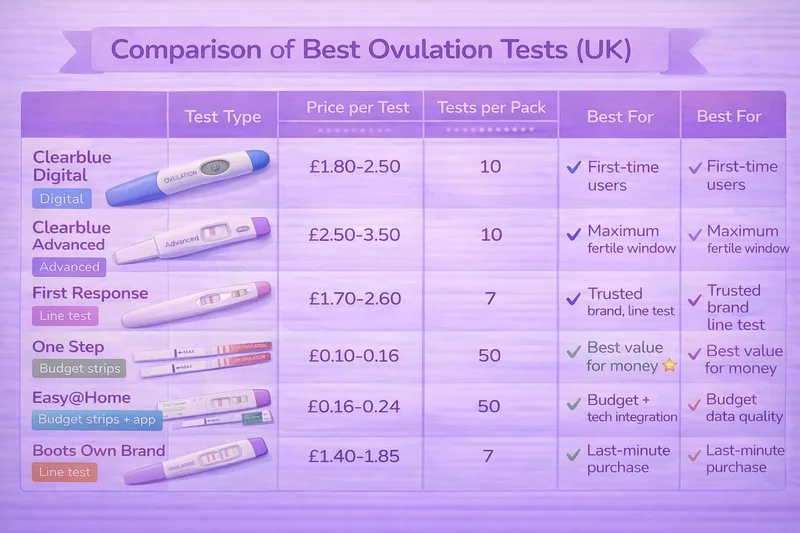
| Test | Type | Price per Test | Tests per Pack | Best For |
|---|---|---|---|---|
| Clearblue Digital | Digital | £1.80-2.50 | 10 | First-time users |
| Clearblue Advanced | Advanced Digital | £2.50-3.50 | 10 | Maximum fertile window |
| First Response | Line test | £1.70-2.60 | 7 | Trusted brand, line test |
| One Step | Budget strips | £0.10-0.16 | 50 | Best value for money ⭐ |
| Easy@Home | Budget strips + app | £0.16-0.24 | 50 | Budget + tech integration |
| Boots Own Brand | Line test | £1.40-1.85 | 7 | Last-minute purchase |
Our Top Picks by Category
🥇 Best Overall: One Step Ovulation Tests
Why: Same accuracy as premium tests at 10% of the cost. You can test twice daily without breaking the bank, which actually increases your chances of catching the LH surge.
🥈 Best for Beginners: Clearblue Digital
Why: Zero ambiguity. The digital smiley face tells you exactly when you're about to ovulate. Worth the premium if you're new to ovulation testing.
🥉 Best with Tech: Easy@Home + Premom App
Why: Budget price plus smart app integration. The app reads your tests, tracks patterns, and predicts ovulation. Great for data-driven TTC couples.
💰 Best Budget: One Step (again)
Why: At £0.10 per test, you get 50 tests for the price of 3 Clearblue tests. Bulk packs mean you're covered for months.
🎯 Best Premium: Clearblue Advanced Digital
Why: If money isn't a concern and you want maximum information, this tracks both estrogen and LH for a wider fertile window.
How to Choose the Right Ovulation Test for You
If you're just starting TTC and want simplicity:
→ Clearblue Digital (no line-reading, crystal clear results)
If you have a tight budget or irregular cycles:
→ One Step or Easy@Home (bulk strips, test as often as you need)
If you have regular 28-30 day cycles:
→ Clearblue Digital or First Response (7-10 tests is enough)
If you have long or irregular cycles (35+ days):
→ One Step or Easy@Home (you'll need 15-20+ tests per cycle)
If you want to test twice daily to catch the surge precisely:
→ One Step or Easy@Home (cheap enough to test liberally)
If you want an app to track everything:
→ Easy@Home + Premom app (photo-logs tests and analyses results)
If you want maximum fertile window information:
→ Clearblue Advanced Digital (tracks estrogen + LH)
If you need tests right now:
→ Boots, Superdrug, Tesco (buy any brand in stock, switch to budget strips online later)
Tips for Using Ovulation Tests
1. Start testing at the right time
Don't start too early or you'll waste tests. Calculate: average cycle length minus 17 days = day to start testing.
Example: 30-day cycle → start testing on day 13
2. Test with afternoon urine, not first morning urine
LH surges typically happen in the morning, so afternoon urine (between 2-8pm) is more likely to detect it.
3. Don't drink excessive fluids before testing
Diluted urine can make LH harder to detect. Hold off on drinking large amounts of water for 2 hours before testing.
4. Test at the same time each day
Consistency helps you catch the surge. Set a phone alarm if needed.
5. Test twice daily if you keep missing the surge
LH surges can be brief. Testing morning and evening increases your chances of catching it.
6. Know when to have sex
Once you get a positive test, have sex within the next 12-36 hours. Your most fertile days are the 2-3 days before ovulation and the day of ovulation itself.
7. Don't panic if you miss the surge
If you're having sex every 2-3 days throughout your cycle, you don't need to pinpoint ovulation exactly. Sperm can survive for up to 5 days.
For more detailed guidance, see our complete ovulation tracking guide: How to Track Ovulation When Trying to Conceive
Frequently Asked Questions
How accurate are ovulation tests?
All major brands claim 99%+ accuracy at detecting the LH surge when used correctly. In practice, they're very reliable—the challenge is using them at the right time of day and cycle.
Can ovulation tests give false positives?
Rare, but possible. PCOS can cause persistently elevated LH, leading to constant positive results. Some medications (fertility drugs containing hCG) can also interfere. If you consistently get positive results, speak with your GP.
Do I need digital tests or are strips fine?
Strips work just as well—they're the same technology. Digital tests just remove the guesswork of reading lines. If you're comfortable comparing line darkness, strips are a much better value.
How many ovulation tests do I need per month?
Most women need 5-10 tests per cycle if they have regular cycles. Irregular cycles may require 15-20+ tests. Budget strips let you test as much as needed without worrying about cost.
Can I use ovulation tests if I have PCOS?
PCOS can cause elevated LH levels, making ovulation tests less reliable. You may get frequent positive results even when you're not actually ovulating. Speak with your GP about alternative tracking methods (BBT, ultrasound monitoring).
Are expensive tests more accurate than cheap ones?
No. Sensitivity and accuracy are similar across brands (most are 25-30 mIU/ml). You're paying for digital displays, branding, and packaging—not better detection.
When should I take an ovulation test?
Afternoon or early evening (2-8pm) is best. Avoid first morning urine—LH surges typically happen in the morning, so afternoon urine is more likely to detect the surge.
What if I never get a positive ovulation test?
If you test consistently and never see a positive result, you may not be ovulating regularly. Speak with your GP, who can run blood tests to check your hormone levels and confirm ovulation.
Where to Buy Ovulation Tests in the UK
High street pharmacies:
- Boots: Clearblue, First Response, Boots own brand
- Superdrug: Clearblue, First Response
- Tesco: Clearblue (often on offer)
- Sainsbury's: Clearblue
- Asda: Clearblue
Online (best value):
- Amazon UK: One Step, Easy@Home, bulk strips (best prices)
- Boots. com: Clearblue, First Response, Boots own brand
- Superdrug. com: Clearblue, First Response
Pro tip: Buy premium tests in-store for first-time use, then switch to bulk strips online for ongoing testing.
Our Final Verdict
Best ovulation test for most women trying to conceive:
One Step Ovulation Tests (£5-8 for 50 tests on Amazon UK)
Why: Same accuracy as premium brands at 10% of the cost. Bulk packs mean you can test twice daily, catch the LH surge precisely, and have enough tests for multiple cycles. The only downside is line-reading, which takes practice but becomes easy after a few cycles.
If budget isn't a concern and you want foolproof simplicity:
Clearblue Digital (£18-25 for 10 tests)
If you want tech integration:
Easy@Home + Premom App (£8-12 for 50 tests)
Ovulation tests are one of the most powerful tools when trying to conceive. Choose a test that fits your budget and comfort level, then use it consistently. Most couples who time intercourse to their LH surge conceive within 3-6 months.
And remember: the "best" ovulation test is the one you'll actually use consistently. Whether that's a premium digital test or a 10p strip from Amazon, what matters is catching your fertile window—and all of these tests will do that reliably.

Related Articles
- How to Track Ovulation When Trying to Conceive: Complete UK Guide 2026(
- How Long Does It Really Take to Get Pregnant? (The Truth About TTC)
- Ovulation Timing Myths: When Can You Actually Get Pregnant?
Disclaimer: This article provides independent reviews and information about ovulation tests available in the UK. We are not sponsored by any brands mentioned. Some links may be affiliate links, which means we may earn a small commission if you purchase through them (at no extra cost to you). This article is not medical advice. If you have concerns about your fertility, please speak with your GP.