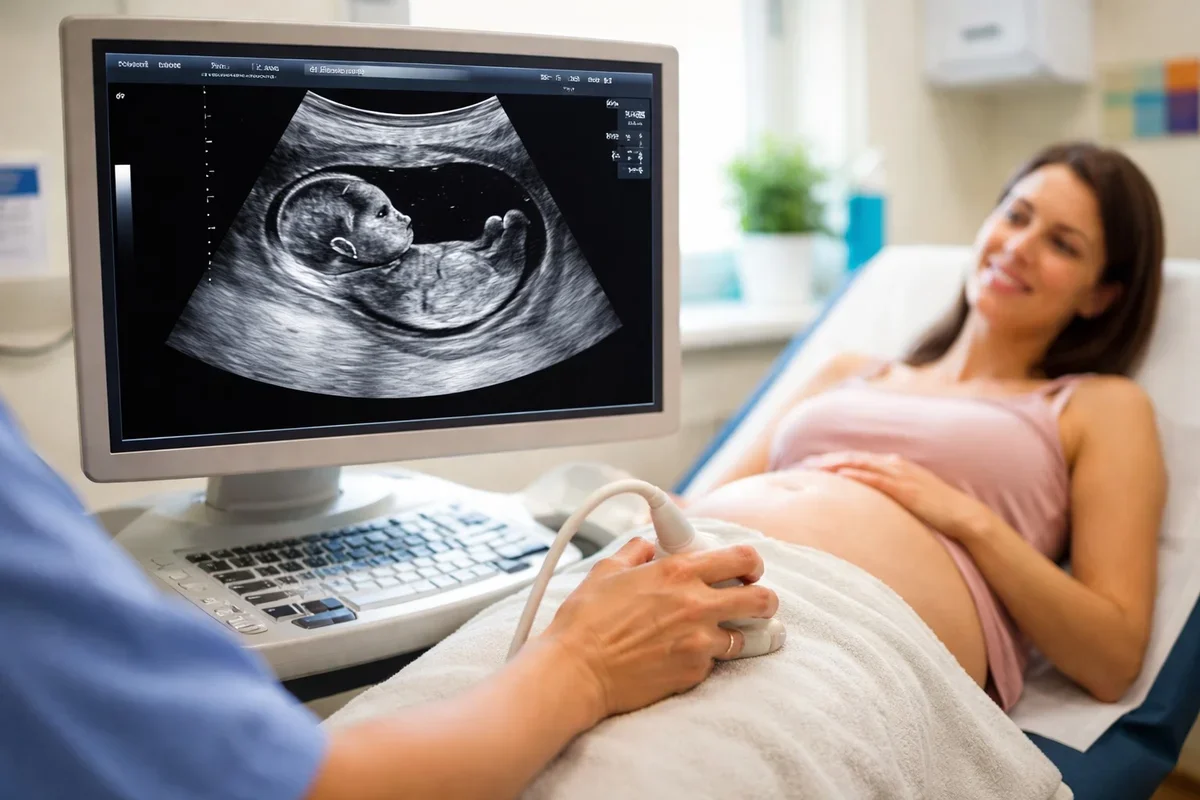

Nothing stops your heart quite like seeing blood on the toilet paper when you know you're pregnant. I remember freezing in the bathroom at 7 weeks, staring at a smear of pink on the tissue, absolutely convinced it was over. My husband found me crying on the floor five minutes later. Two days later, an early scan showed a perfectly healthy heartbeat.
That's the cruel paradox of first-trimester bleeding: it's extremely common, it's usually harmless, and it's utterly terrifying every single time. This guide explains what's actually happening, when you genuinely need to worry, and when you can take a breath.
How Common Is First-Trimester Bleeding?
More common than most people realise. Vaginal bleeding occurs in 15–25% of all recognised pregnancies during the first trimester (PMC, 2014). A large community-based study of 4,539 pregnancies found that approximately one in four women reported some bleeding or spotting during the first 12 weeks (Hasan et al., 2010).
And here's the reassuring part: the majority of women who bleed in early pregnancy go on to have healthy babies. A prospective study of 370 women with first-trimester bleeding and a confirmed live fetus on ultrasound found that almost 90% of pregnancies continued to viability — the overall miscarriage rate was 11.1% (Poulose et al., 2006).
That said, not all bleeding is the same. The type, amount, timing, and accompanying symptoms matter enormously.
Types of Bleeding: What the Differences Mean
Spotting vs light bleeding vs heavy bleeding
Spotting — A few drops of blood on your underwear or when wiping. Usually pink, light red, or brown. Doesn't fill a pad or liner. This is the most common type and the least concerning.
Light bleeding — More than spotting but less than a period. May need a panty liner. Often intermittent.
Heavy bleeding — Similar to or heavier than a period. Soaking through a pad. May involve clots.
The distinction matters clinically. The large "Right From the Start" study found that spotting and light bleeding of short duration did not increase miscarriage risk compared with women who had no bleeding at all. However, heavy bleeding nearly tripled the risk (OR 3.0, 95% CI 1.9–4.6), particularly when accompanied by pain (Hasan et al., 2009).
Colour matters too
Pink — Often implantation bleeding or light cervical bleeding. Generally least concerning.
Bright red — Fresh blood. More concerning if heavy or sustained.
Brown or dark red — Older blood that's taken time to leave the body. Often less concerning than bright red — it typically indicates bleeding that's already stopped.
Watery and dark brown — Can be associated with ectopic pregnancy, though it can also occur with other causes (NHS: Ectopic pregnancy symptoms).
Common Causes of First-Trimester Bleeding
Implantation bleeding (weeks 3–4)
When the embryo burrows into the uterine lining, some women experience light spotting. This typically occurs around 6–12 days after conception — roughly when your period would be due, which is why it's often mistaken for a light period.
What it looks like: Pink or light brown spotting, lasting hours to 1–2 days. Much lighter than a period. No clots.
Should you worry? No. This is a normal part of early pregnancy and doesn't indicate any problem.
Cervical changes
Pregnancy increases blood flow to the cervix, making it more sensitive and more prone to bleeding after minor disturbance. Common triggers include sex, a cervical smear, or a vaginal examination.
What it looks like: Light bleeding or spotting shortly after sex or an internal examination. Usually stops quickly.
Should you worry? No, unless it's heavy or doesn't stop.
Subchorionic haematoma
A subchorionic haematoma (SCH) is a collection of blood between the placenta (chorion) and the uterine wall. It's the most common cause of first-trimester bleeding in women between 10–20 weeks and is found in roughly 1.7–3.1% of the general obstetric population, rising to around 20% in women presenting with threatened miscarriage symptoms (Archives of Medical Science, 2021).
A systematic review and meta-analysis of over 92,000 pregnancies found that SCH was associated with an increased risk of miscarriage (OR 2.14), particularly when diagnosed before 7 weeks or when the haematoma was large (greater than 25% of the gestational sac) (NCBI StatPearls: Subchorionic hemorrhage; Tuuli et al., 2011).
However: The majority of pregnancies with SCH still result in live births. Many subchorionic haematomas are reabsorbed by the body without treatment.
What it looks like: Variable — can be anything from light spotting to a heavier bleed, sometimes with dark or old-looking blood.
What happens: Usually diagnosed on ultrasound. Management is typically expectant (monitoring) unless there are other complications. Rest may be advised, though there's limited evidence that bed rest improves outcomes.
Miscarriage
Miscarriage (pregnancy loss before 24 weeks in the UK) is the outcome many women fear when they see blood. Around 1 in 8 recognised pregnancies end in miscarriage, with the vast majority occurring in the first trimester.
What it looks like: Bleeding that starts light and becomes progressively heavier, often with cramping that intensifies. May include tissue or clots. The bleeding is typically heavier than a period.
Important context: Not all bleeding leads to miscarriage. And not all miscarriages present with heavy bleeding — some (known as "missed miscarriages") have no bleeding at all and are discovered on a routine scan.
If you're worried: Contact your GP, midwife, or local Early Pregnancy Unit. They can arrange an ultrasound scan to check for a heartbeat and assess whether the pregnancy is viable.
Ectopic pregnancy
An ectopic pregnancy occurs when the fertilised egg implants outside the uterus — most commonly in a fallopian tube. It affects approximately 1 in 80 pregnancies and can be life-threatening if not diagnosed early (NHS: Ectopic pregnancy; RCOG).
Warning signs:
One-sided abdominal pain — Sharp or stabbing, often on one side of the lower abdomen
Vaginal bleeding — Often dark, watery blood that looks different from a period
Shoulder-tip pain — Pain at the very tip of your shoulder (where the shoulder meets the arm). This is caused by internal bleeding irritating the diaphragm and is a red flag requiring emergency attention
Pain when going to the toilet
Feeling faint, dizzy, or collapsing — Signs of internal bleeding. Call 999 immediately.
Most ectopic pregnancies are suspected between 6 and 10 weeks of pregnancy (NHS Inform).
This is a medical emergency if the tube ruptures. Do not wait — go to A&E or call 999 if you have severe pain, shoulder-tip pain, or feel faint.
Molar pregnancy
A rare condition (affecting about 1 in 600 pregnancies in the UK) where abnormal placental tissue grows instead of or alongside a normal embryo. Symptoms include bleeding and sometimes abnormally high hCG levels. Diagnosed by ultrasound and treated with a procedure to remove the tissue.
When to Seek Help: A Clear Guide
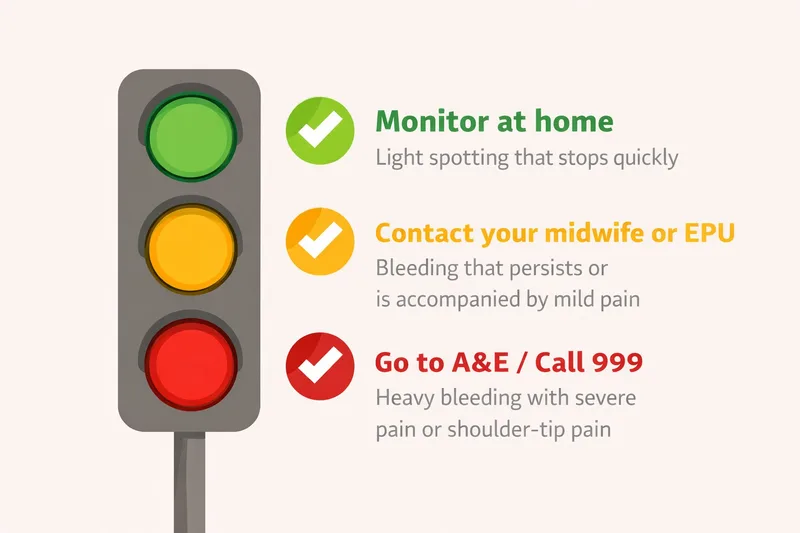
Monitor at home (but mention to your midwife at your next appointment)
Light spotting that lasts less than a day, with no pain
Pink or brown discharge after sex
Very occasional drops of blood when wiping
Contact your GP, midwife, or Early Pregnancy Unit
Bleeding that soaks a panty liner or continues for more than a day
Any bleeding accompanied by mild cramping
Repeated episodes of spotting
Bleeding at any point if you've had a previous ectopic pregnancy or miscarriage
Any bleeding that concerns you — your instinct matters
Go to A&E or call 999
Heavy bleeding — soaking through a pad in less than an hour
Severe abdominal pain, especially if one-sided
Shoulder-tip pain (sign of internal bleeding)
Feeling faint, dizzy, or collapsing
Passing large clots or tissue
What Happens at the Early Pregnancy Unit
If you're referred to an Early Pregnancy Unit (EPU) — also known as an Early Pregnancy Assessment Unit — here's what to expect:
Ultrasound scan — Usually transvaginal (an internal scan), which gives a clearer picture in early pregnancy than an abdominal scan. The sonographer will look for a gestational sac, check the pregnancy is in the correct location (inside the uterus), look for a heartbeat (usually visible from around 6 weeks), and check for any haematoma.
Blood tests — hCG levels may be measured. If it's very early pregnancy and nothing is visible on the scan, you may be asked to return in 48–72 hours for repeat hCG levels to see if they're rising normally (roughly doubling every 48–72 hours in a healthy pregnancy).
Assessment — The team will explain what they've found and discuss next steps. This may include a follow-up scan, ongoing monitoring, or reassurance that everything looks normal.
Important: If it's before 6 weeks, a scan may not show anything visible yet — this doesn't necessarily mean something is wrong. It may simply be too early. You'll usually be offered a repeat scan in 1–2 weeks.
You can find your nearest Early Pregnancy Unit at aepu.org.uk.
The Emotional Side
Let's be honest: even when you're told "it's probably nothing," first-trimester bleeding is emotionally devastating. You're in a constant state of hypervigilance — checking your underwear every time you go to the bathroom, analysing every twinge, terrified to move in case it makes things worse.
What doesn't help: People telling you "it's really common" (even though it is). Being told to "just relax" (as if relaxation prevents miscarriage, which it doesn't). Dr Google at 3am.
What might help: Talking to your partner, a friend, or a family member about how you're feeling. Calling the EPU for reassurance — they'd rather you called unnecessarily than stayed at home worrying. Remembering that most women who bleed in the first trimester go on to have healthy babies.
If you experience pregnancy loss, the Tommy's website offers comprehensive support, and your GP can refer you for counselling. The Ectopic Pregnancy Trust provides specialist support for ectopic pregnancy.
Frequently Asked Questions
I had spotting at 6 weeks — does this mean I'll miscarry?
Most likely not. A large study found that spotting and light bleeding in the first trimester did not increase miscarriage risk (Hasan et al., 2009). The vast majority of women with light first-trimester bleeding go on to have healthy pregnancies.
I bled after sex — is the baby OK?
Almost certainly. The cervix has increased blood supply during pregnancy and is easily irritated. Post-sex bleeding is very common and not harmful. If it's heavy or doesn't stop, mention it to your midwife.
Should I go on bed rest if I'm bleeding?
There's no strong evidence that bed rest prevents miscarriage. Current NICE guidance does not recommend bed rest for threatened miscarriage. Continue with normal daily activities unless your doctor specifically advises otherwise.
How long after bleeding stops should I wait before having sex again?
There's no set rule. Most clinicians suggest waiting until the bleeding has completely stopped and you feel ready. If an ectopic pregnancy has been ruled out and your scan is normal, sex is safe.
I'm bleeding and have passed a clot — does that mean I've miscarried?
Not necessarily, but this warrants urgent assessment. Small clots can occur with subchorionic haematomas or cervical bleeding. Larger clots or tissue may indicate miscarriage. Contact your EPU or go to A&E.
Will bleeding affect my baby's development?
Light bleeding itself doesn't harm the baby. However, the underlying cause of heavy bleeding (if identified) may need monitoring. One study found that women with first-trimester bleeding had slightly higher rates of preterm birth and placental complications later in pregnancy, so your team may offer additional monitoring (PMC, 2025).
The Bottom Line
First-trimester bleeding is frightening, common, and — in the majority of cases — not a sign that anything is wrong. Light spotting and brief episodes of bleeding, particularly without pain, are very often harmless.
But some bleeding is a warning sign that needs urgent attention. Heavy bleeding, severe pain (especially one-sided), shoulder-tip pain, and feeling faint are all reasons to seek emergency care without delay.
When in doubt, call your midwife, GP, or Early Pregnancy Unit. They will not judge you for seeking reassurance, and early assessment can catch the rare but serious causes that need prompt treatment.
And if you're reading this in the bathroom at 2am with your heart in your throat — you're not alone. Most of us have been there.
Medical disclaimer: This article is for informational purposes only and does not constitute medical advice. If you are experiencing bleeding during pregnancy and are concerned, contact your midwife, GP, local Early Pregnancy Unit, or call 999 in an emergency.
Last reviewed: March 2026 | Next review: September 2026
Related articles: