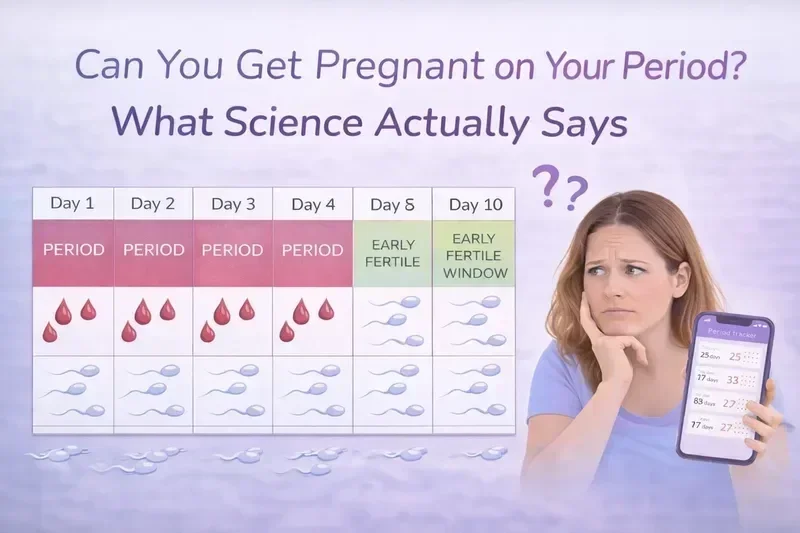
"You can't get pregnant on your period - everyone knows that!"
This was my mate's confident assertion when we were discussing contraception over wine one Friday night. She'd been having unprotected sex during her period for years, convinced it was a foolproof natural contraceptive.
"Are you absolutely certain about that?" I asked, remembering something I'd read about cycle variability.
"Obviously! You ovulate two weeks after your period, and sperm only live for like 24 hours. So period sex is completely safe."
Except... that's not remotely how any of this works.
Here's what the actual science says about getting pregnant during menstruation - and why this widespread myth could lead to some very unexpected positive pregnancy tests.
The "Safe Period Sex" Myth
Let's start with the most common version of this myth: "You can't get pregnant if you have sex during your period because you're not ovulating."
Technically speaking? The first part is correct. You're not ovulating during your period - ovulation typically occurs around the middle of your cycle, not while you're actively menstruating.
But here's where the logic falls apart: conception doesn't require you to be ovulating at the exact moment of intercourse.
Why? Because sperm can survive in your reproductive tract for days after sex. This is where things get interesting - and where landmark research from the New England Journal of Medicine completely changes the game.
The Science: How Long Sperm Actually Survive
In 1995, researchers Wilcox, Weinberg, and Baird published groundbreaking research tracking 221 women who were planning to become pregnant. They measured urinary hormone levels daily to pinpoint ovulation, and recorded every instance of intercourse.
Their findings? Conception occurred only when intercourse took place during a six-day period that ended on the day of ovulation.
That six-day window means sperm from intercourse up to five days before ovulation can still be hanging around when your egg is released. The study found that the probability of conception ranged from 10% when intercourse occurred five days before ovulation, up to 33% on the day of ovulation itself.
Think about that. Sperm can survive for up to five days (and some research suggests up to seven days in optimal conditions) in your reproductive tract, patiently waiting for an egg to show up.
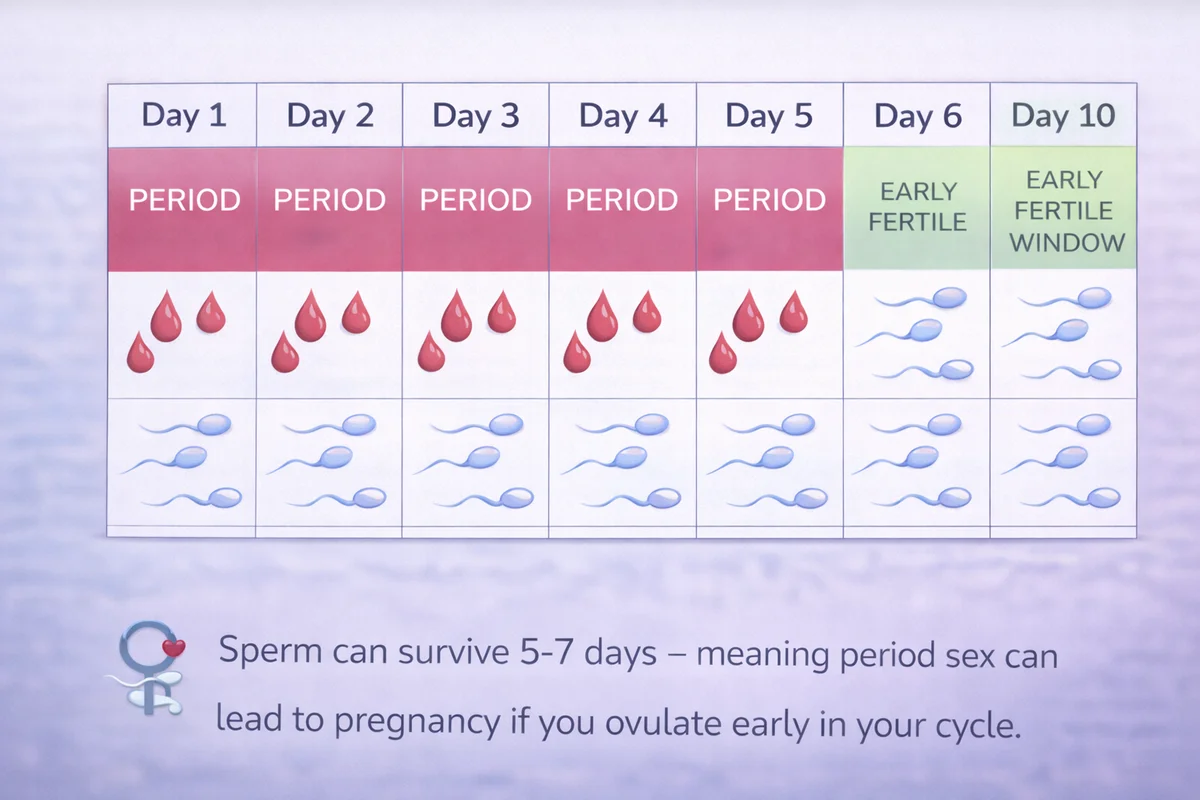
So the real question isn't "Are you ovulating during your period?" It's "Could you ovulate soon enough after your period that sperm from period sex could still be viable?"
And for some women, the answer is absolutely yes.
When Period Sex CAN Lead to Pregnancy
Here's where cycle length becomes critical.
If you have a "textbook" 28-day cycle with ovulation occurring on day 14 and a period lasting 5 days, then no - you're very unlikely to get pregnant from period sex. The maths simply doesn't work out.
But - and this is a big but - most women don't have textbook cycles.
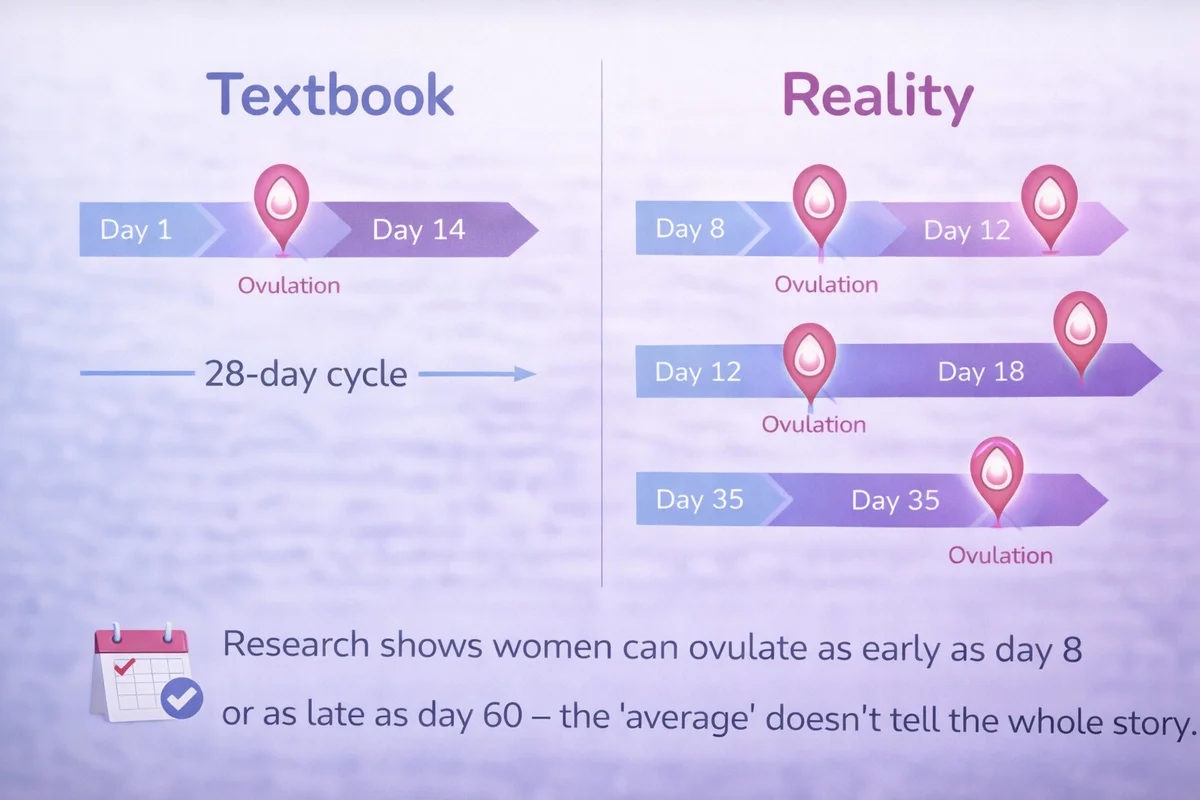
Research published in the British Medical Journal in 2000 (Wilcox et al.) analysed 696 menstrual cycles and found something remarkable: only about 30% of women have their fertile window entirely within the "textbook" days of 10-17 of their cycle.
The study found that women had at least a 10% probability of being in their fertile window on every single day between days 6 and 21 of their cycle. Some women ovulated as early as day 8, others as late as day 60.
The Short Cycle Scenario
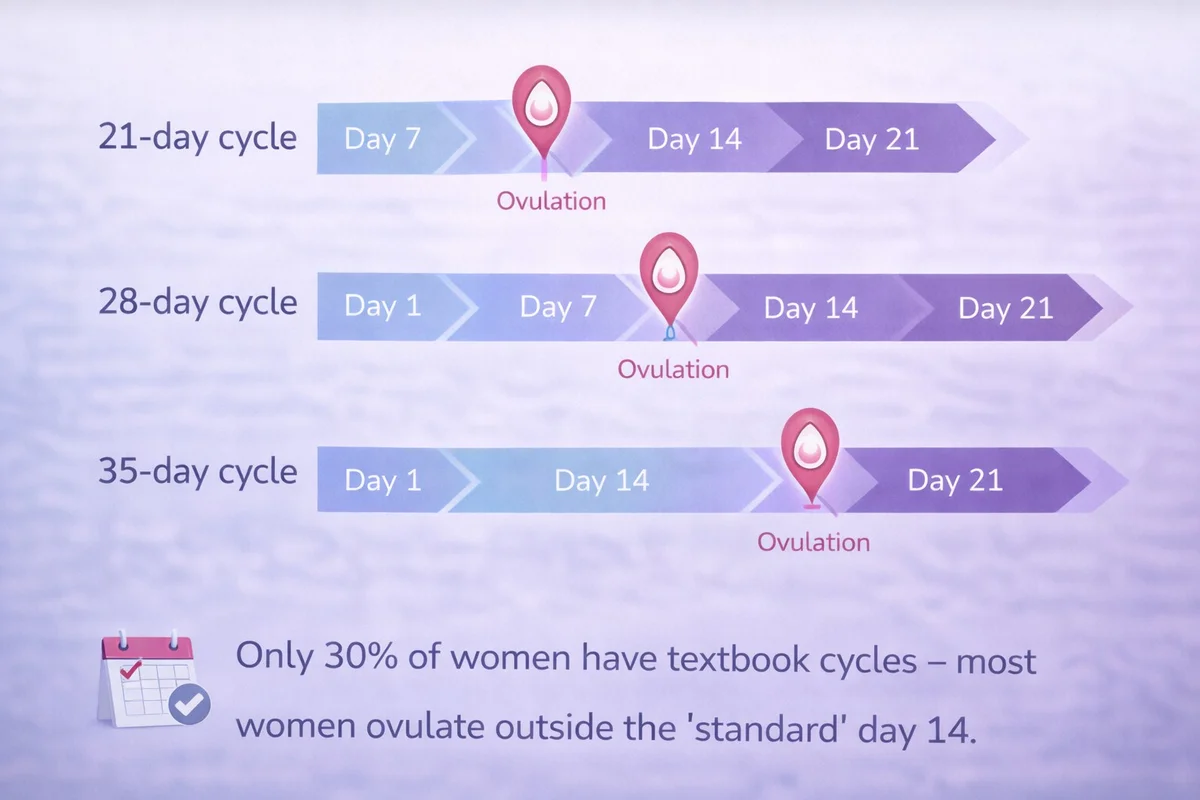
Let's say you have a 21-day cycle (which is perfectly normal, by the way). Your period lasts 6 days. You have sex on day 5 or 6 of your cycle - still technically during your period or just as it's ending.
With a 21-day cycle, you're likely to ovulate around day 7-9. If you had sex on day 5, and ovulation occurs on day 9, that's only 4 days apart. Well within the sperm survival window.
The Wilcox study found that approximately one-third of women with short cycles (27 days or less) had reached their fertile window by the end of the first week of their cycle - including during their period.
The Irregular Cycle Problem
Now throw in cycle irregularity. A 2020 study in Human Reproduction Open analysed data from over 600,000 cycles tracked via a fertility app and found enormous variability in both cycle length and ovulation timing.
The researchers noted that many women seeking to conceive "incorrectly believe" the 28-day cycle definition applies to them, when in reality cycles are "much more variable." The study found that 52% of women experience cycle-to-cycle variability of greater than 5 days.
Other research shows that approximately 42.5% of women have even greater variability - more than 7 days between their shortest and longest cycles. Your cycle this month might be 28 days, next month 35 days, the following month 26 days.
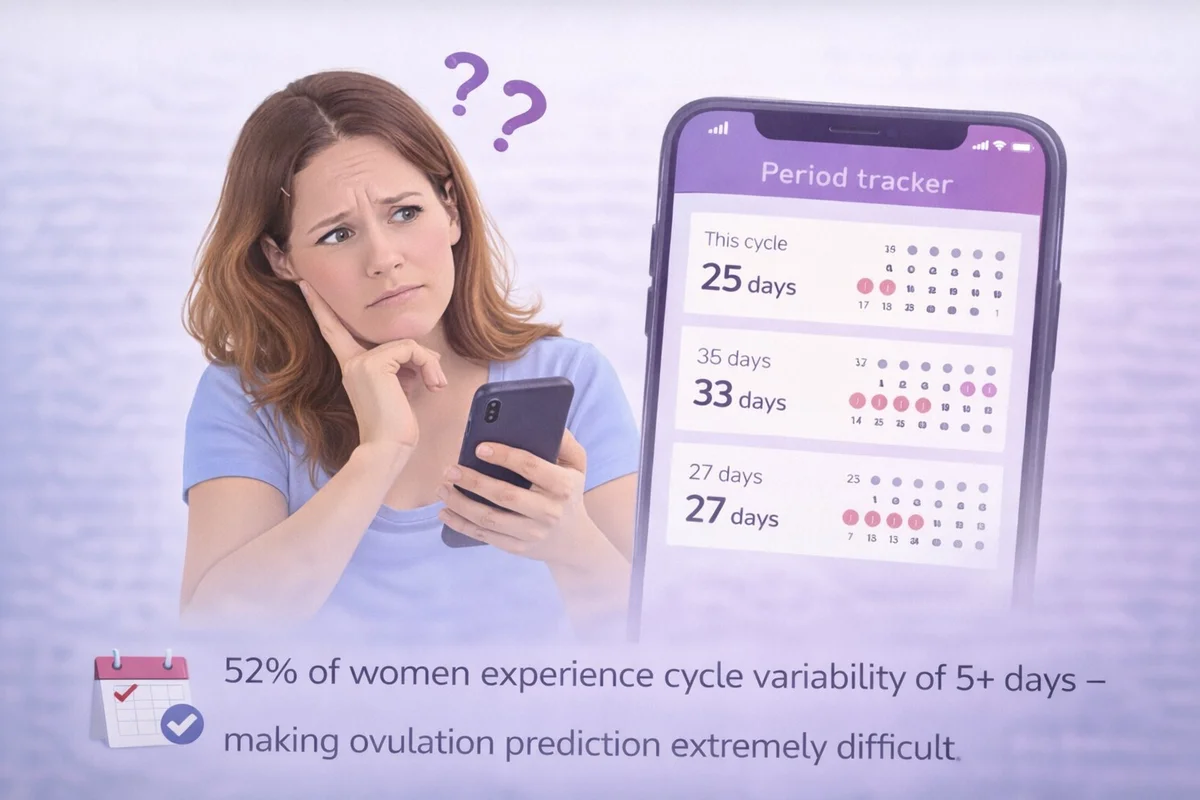
If your cycles vary by this much, predicting when you'll ovulate based on "I usually ovulate on day 14" becomes essentially meaningless.
The "Is It Actually Your Period?" Issue
There's another complication: not all vaginal bleeding is menstruation.
According to Mayo Clinic, some women experience mid-cycle bleeding (spotting around ovulation) which can be mistaken for a period. If you have sex thinking you're on your period, when you're actually experiencing ovulation bleeding, you're having intercourse at your most fertile time.
Dr. Denise Millstine from Mayo Clinic explains: "Many women will have bleeding, particularly spotting, around the middle of their cycles when they are ovulating, and some will mistake that for a period. That actually is a highly fertile time."
So... What Are Your Actual Chances?
Right, let's be clear about the probabilities here.
For most women with regular, average-length cycles: your chances of getting pregnant from period sex are very low. Not zero, but low.
For women with short cycles (21-24 days): your chances are significantly higher, especially if you have sex towards the end of your period. The Wilcox research showed that 33% of women with cycles of 27 days or less reached their fertile window by day 7.
For women with irregular cycles: all bets are off. If you can't reliably predict when your next period will start, you can't reliably predict when you'll ovulate, which means you can't reliably predict when your fertile window is.
The NHS is characteristically straightforward about this: if you're having unprotected sex, you can get pregnant at any time during your menstrual cycle - including during or just after your period.
The Real-World Implications
So what does all this mean for actual human beings trying to either achieve or avoid pregnancy?
If You're Trying to Conceive:
Having sex during your period probably isn't the most efficient use of your time, but if you have short or irregular cycles, it's not impossible for period sex to result in pregnancy. The research shows that focusing intercourse in the days before ovulation gives you the best odds.
If You're Trying NOT to Get Pregnant:
Do not rely on period sex as contraception. Period. (Pun absolutely intended.)
Dr. Millstine's advice is unequivocal: "If you are not wanting to become pregnant and you are having sex - meaning penis-in-vagina sex - then you should use contraception regardless of where you are in your cycle."
The British Medical Journal research concluded that "women should be advised that the timing of their fertile window can be highly unpredictable, even if their cycles are usually regular."
Why This Myth Persists
So if the science is this clear, why does the "you can't get pregnant on your period" myth persist?
Partly because it's based on a grain of truth: you're less likely to get pregnant during your period than during ovulation. The problem is that "less likely" gets translated in people's minds to "impossible," which it absolutely isn't.
There's also a lot of outdated information floating around from the 1950s and 60s, before modern hormone testing allowed researchers to pinpoint ovulation precisely. Earlier studies relied on basal body temperature, which is much less accurate.
And finally, there's the uncomfortable fact that comprehensive, evidence-based sex education is still seriously lacking in many places. People end up relying on what their mates tell them over wine, rather than what peer-reviewed research actually shows.
The Bottom Line
Can you get pregnant if you have sex during your period?
Technically during active menstruation when you're definitely not ovulating? No.
From sperm deposited during your period that survive until you ovulate days later? Yes, it's possible - especially if you have short or irregular cycles.
The Wilcox studies demonstrated that conception can occur from intercourse up to five days before ovulation. If you have sex on day 5 or 6 of your cycle (still during or just after your period) and ovulate on day 9 or 10, those sperm could absolutely still be viable.
Research shows that only 30% of women have their fertile window entirely in the "safe" days 10-17. For everyone else - the majority of women - fertile days can occur earlier, later, or be scattered unpredictably throughout the cycle.
So if you're using "I'm on my period" as birth control? Stop. Get actual contraception.
And if you're trying to conceive and wondering whether period sex could help? It's unlikely unless you have very short cycles, but the more important takeaway is that cycle variability is enormous. Track your actual ovulation (using ovulation predictor kits or apps that measure hormones) rather than assuming you know when you're fertile based on when your period starts.
The human menstrual cycle is far more variable, unpredictable, and individual than the neat 28-day cycle diagram suggests. And that's exactly why the "period sex is safe" myth is so dangerous.
Your cycle is not a textbook. It's a biological system that varies between women and even between cycles in the same woman. And that variability means period sex isn't the foolproof contraceptive method that myth would have you believe.
Disclaimer: This information is based on NHS guidance and studies, but isn't medical advice. If you have fertility concerns or have been trying to conceive for over a year (6 months if 36+), speak to your GP.