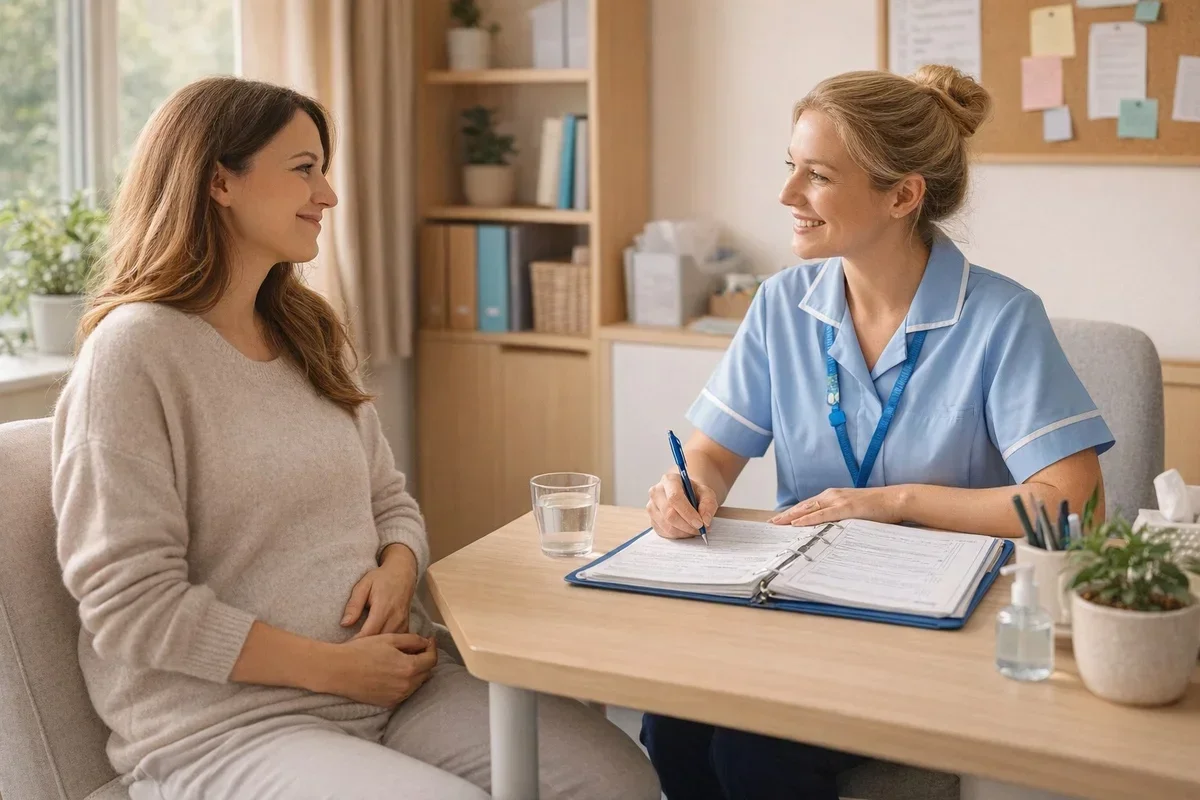

The wait between a positive pregnancy test and the first time you actually see your baby on a screen can feel like the longest weeks of your life. I spent those weeks oscillating between excitement and terror — convinced that something must be wrong because I couldn't see anything yet. My husband kept saying "everything's fine" and I kept saying "you don't know that."
He was right, as it turned out. But the wait was still brutal. This guide explains what the NHS offers, what private clinics can add, and helps you decide whether paying for an earlier scan is worth it for you.
The NHS Scan Timeline
The NHS offers two routine ultrasound scans during pregnancy. Both are free, optional (though strongly recommended), and performed by trained sonographers at your local hospital.
Dating scan: Weeks 11–14
This is your first NHS scan, commonly called the 12-week scan even though it can happen anywhere between 10 and 14 weeks (NHS: 12-week scan).
What it does:
Confirms your due date — The sonographer measures your baby from head to bottom (crown-rump length or CRL). This is more accurate than dating from your last period.
Checks baby's development — Confirms the pregnancy is in the uterus, that there's a heartbeat, the number of babies, and that early development looks normal.
Combined screening (optional) — If you opt in, the sonographer will also measure the fluid at the back of your baby's neck (nuchal translucency or NT). This measurement, combined with a blood test, calculates the probability of your baby having Down's syndrome, Edwards' syndrome, or Patau's syndrome. This is a screening test, not a diagnosis — it tells you the chance, not the certainty.
What to expect: The scan takes about 20–30 minutes. You'll usually need a full bladder (drink a pint of water an hour beforehand). The sonographer applies gel to your abdomen and moves a probe across your belly. It doesn't hurt, though light pressure can be uncomfortable.
Important timing note: The combined screening can only be done between 11 weeks + 2 days and 14 weeks + 1 day. If your dating scan happens after 14 weeks, you'll be offered a different blood test (the quadruple test) between 14 and 20 weeks, which screens for Down's syndrome only (NHS: 12-week scan).
Results: The sonographer usually shares what they see during the scan. If you've opted for combined screening, the Down's/Edwards'/Patau's results come later by letter — ask your midwife how long this takes in your area.
Photos: Most hospitals offer printed scan photos, usually for a small fee (typically £3–5). Not guaranteed — it depends on the baby's position and the hospital's policy.
Anomaly scan: Weeks 18–21
Your second NHS scan, known as the 20-week scan or mid-pregnancy scan. This is a detailed scan that checks your baby's physical development, looking for 11 specific rare conditions including heart defects, spina bifida, and cleft lip (NHS: Your antenatal appointments).
Can they tell the sex? Many hospitals will tell you the sex at the 20-week scan if you want to know and if the baby is in a good position. But this isn't guaranteed and isn't the primary purpose of the scan.
What the NHS doesn't routinely offer
No scan before 11 weeks — Unless there's a medical concern (bleeding, pain, history of ectopic pregnancy), the NHS doesn't offer routine scans in the first 10 weeks.
No extra scans between 12 and 20 weeks — Unless complications are identified.
No 3D/4D/5D scans — These are not clinically necessary and are only available privately.
Private Early Pregnancy Scans: Filling the Gap
The gap between a positive test (around 4–5 weeks) and the NHS dating scan (11–14 weeks) is 6–10 weeks with no visual confirmation that everything is OK. For many women, particularly those with a history of miscarriage, fertility treatment, or anxiety, this wait feels unbearable.
This is where private scans come in. They're not medically necessary for most women, but they can provide genuine reassurance at an anxious time.
Early reassurance / viability scan (6–10 weeks)
What it does: Confirms the pregnancy is in the uterus (ruling out ectopic), checks for a heartbeat, and dates the pregnancy.
What you'll see:
At 6 weeks: A gestational sac and possibly a tiny fetal pole. A heartbeat may just be detectable — but if it isn't visible at 6 weeks, that's normal. Many clinics recommend waiting until at least 7 weeks for a more reliable heartbeat detection.
At 7–8 weeks: A clearer fetal pole with a visible heartbeat (typically 140–170 bpm). You can start to make out the head and body. One study found that the miscarriage risk drops to around 5% once a heartbeat is seen at 7 weeks, falling to approximately 2% at 8 weeks.
At 9–10 weeks: The baby is nearly fully formed in miniature. You can often see limbs, movement, and clear head/body differentiation.
How it's done: Before 10 weeks, most clinics use a transvaginal scan (a slim ultrasound probe inserted gently into the vagina). This gives a much clearer image than an abdominal scan at this early stage. It's not painful — similar to a smear test. You can decline and request an abdominal scan instead, but the images may be less clear.
Cost: Typically £60–£120 depending on the clinic and location.
Important caution: If you go too early (before 6–7 weeks), there's a real risk of seeing a sac but no heartbeat — which may be perfectly normal but can cause enormous anxiety. Most experienced clinics recommend 7–8 weeks as the sweet spot for a meaningful reassurance scan.
Private dating scan (8–14 weeks)
What it does: The same as an NHS dating scan — measures the baby to estimate your due date and checks development. Some private clinics also offer NT measurement and combined screening as an add-on.
Cost: Typically £80–£150. Combined screening (NT + blood test) may cost an additional £50–100.
When to consider it: If your NHS dating scan appointment is later than 14 weeks (which means you'd miss the combined screening window), a private scan can ensure you don't lose the option for first-trimester screening.
NIPT (Non-Invasive Prenatal Testing)
What it is: A blood test (taken from the mother's arm) that analyses fragments of the baby's DNA circulating in the mother's blood. It screens for Down's syndrome, Edwards' syndrome, and Patau's syndrome with higher accuracy than the combined screening test — detection rates of around 99% for Down's syndrome with a very low false positive rate.
NHS availability: NIPT is available on the NHS as a second-line test — meaning it's offered if your combined screening comes back as higher chance (1 in 150 or higher). It's not routinely offered as a first-line test on the NHS.
Private availability: You can pay for NIPT privately from around 10 weeks, regardless of your combined screening result. Costs range from £350–£500 depending on the provider (Harmony test, Panorama, IONA are common brands). Some private clinics offer it as part of a scan + NIPT package.
Important: NIPT is still a screening test, not a diagnostic test. A positive result would need to be confirmed with a diagnostic test (CVS or amniocentesis) before any decisions are made.
NHS vs Private: An Honest Comparison
When private scans make sense
You've had a previous miscarriage or ectopic pregnancy and the anxiety of waiting until 12 weeks is overwhelming.
You've conceived through fertility treatment and want early confirmation of viability.
You're experiencing symptoms (bleeding, pain) and can't get an urgent NHS appointment quickly enough.
Your NHS dating scan is booked late (after 14 weeks) and you want combined screening.
You want NIPT as a first-line screening test.
When private scans may not be worth it
You have no risk factors, no symptoms, and no particular anxiety — in which case the NHS scans provide everything you need.
You're considering a very early scan (before 7 weeks) purely for excitement — the risk of an inconclusive result causing more anxiety than it resolves is real.
You're on a tight budget — the NHS scans are free and clinically comprehensive.
Things to check before booking a private scan
CQC registration — In England, scan clinics must be registered with the Care Quality Commission. Check their CQC rating before booking.
Sonographer qualifications — Your scan should be performed by a qualified, registered sonographer — not an untrained operator. Check for HCPC registration or equivalent professional body membership.
What's included — Some clinics charge extra for printed photos, the report, or combined screening blood tests. Get the full price upfront.
Referral pathway — A good clinic will have a clear process for referring you back to your NHS team if they find anything concerning.
What If Something Unexpected Is Found?
Whether on an NHS or private scan, there's always a small chance that something unexpected is seen. This might include:
No heartbeat detected — If it's before 7 weeks, this may simply be too early. You'll usually be offered a rescan in 1–2 weeks. If a heartbeat was expected and isn't seen, this may indicate a missed miscarriage — your care team will explain the options.
A subchorionic haematoma — A collection of blood near the placenta. Common and usually resolves on its own, but may need monitoring. See our guide: Bleeding in Early Pregnancy.
Higher-chance screening result — If your combined screening or NIPT indicates a higher chance of Down's, Edwards', or Patau's syndrome, you'll be offered diagnostic testing (CVS or amniocentesis) and supported through the decision-making process. A screening result is not a diagnosis.
Ectopic pregnancy — If the pregnancy is not visible in the uterus, further investigation (repeat scans, blood tests) will be arranged urgently.
In all these situations, you'll be supported by healthcare professionals who deal with these findings every day. You won't be left to figure it out alone.
Frequently Asked Questions
Can I have a scan at 6 weeks on the NHS?
Only if there's a clinical reason — bleeding, pain, or a history of ectopic pregnancy. Your GP or midwife can refer you to the Early Pregnancy Unit for an urgent scan. For reassurance without symptoms, you'd need to go private.
Will the 12-week scan tell me the sex of the baby?
No. The baby is too small at 12 weeks for reliable sex determination. You may be told the sex at the 20-week scan if you ask and the baby cooperates.
What if I'm too nervous for a transvaginal scan?
That's completely understandable. You can always request an abdominal scan instead. At very early stages (6–8 weeks) the images may be less clear, but it's your body and your choice.
Is it worth getting a private scan AND having the NHS scans?
The NHS scans are clinically important and shouldn't be skipped. A private early scan is an optional add-on for reassurance — it doesn't replace your NHS care.
How accurate are private scans compared to NHS scans?
If performed by a qualified sonographer using appropriate equipment, private scans are equally accurate. The key variable is the sonographer's skill and qualifications, not whether the scan is NHS or private.
My NHS dating scan showed a different due date to my private scan — which is right?
The NHS dating scan (11–14 weeks) is considered the gold standard for establishing your due date. Earlier scans are useful for viability but less accurate for dating because very small differences in measurement at 7–8 weeks can shift the date by several days.
The Bottom Line
The NHS provides two comprehensive, free ultrasound scans that cover everything clinically important. For most women, these are all you need.
But if the wait between a positive test and the 12-week scan feels unbearable — and for many women it does — a private early reassurance scan at 7–8 weeks can offer genuine peace of mind. Just make sure you use a CQC-registered clinic with qualified sonographers, go at 7+ weeks for the best chance of seeing a heartbeat, and understand that a private scan is a supplement to NHS care, not a replacement.
The first time you see that tiny flickering heartbeat on the screen, however you get there, is a moment you'll never forget.
Medical disclaimer: This article is for informational purposes only and does not constitute medical advice. If you have concerns about your pregnancy, contact your midwife, GP, or local Early Pregnancy Unit.
Related articles: