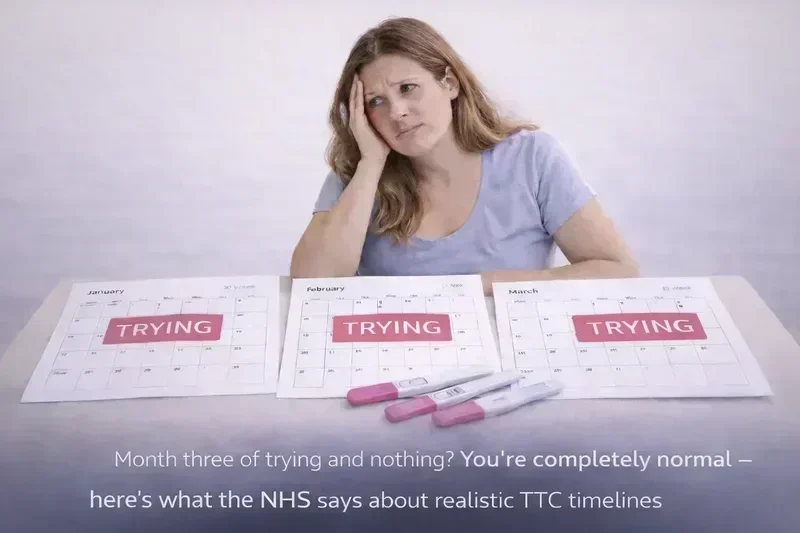
Month one of trying to conceive: negative test. Month two: negative. Month three: panic mode activated.
Is something wrong? Why isn't this happening? Everyone on the parenting forums seems to get pregnant immediately. My mate's cousin's friend got pregnant on her wedding night. So why am I on cycle three with nothing to show for it but a drawer full of expensive pregnancy tests?
If this sounds familiar, you're not alone. And more importantly, you're completely normal.
The truth about trying to conceive? It takes most couples far longer than you'd expect from the way we talk about pregnancy. Between the Instagram announcements and the "we weren't even trying!" stories, it's easy to feel like you're the only one who can't conceive instantly.
So let's talk about what the NHS and actual research say about how long it really takes to get pregnant—because the reality might surprise you.
The "You'll Get Pregnant Immediately" Myth
Remember sex education at school? The message was clear: have unprotected sex once and you'll definitely get pregnant. Don't even think about it, or you'll end up with a baby.
Fast forward to actually trying for a baby, and... crickets.
Here's what they never told us: getting pregnant isn't actually that easy, even when everything's working perfectly.
According to Tommy's, about 1 in 3 women who are having regular sex or timing intercourse around ovulation will conceive within the first month. That sounds promising, right?
But flip that statistic around: 2 in 3 couples won't get pregnant in their first month of trying.
Even with perfect timing, healthy eggs, healthy sperm, and everything functioning exactly as it should, your chances in any given cycle are only about 20-25% if you're in your twenties or early thirties.
That's one in four. Not exactly the pregnancy guarantee we were led to believe.
What the NHS Says About "Normal" TTC Timelines
The NHS is refreshingly straightforward about this: most couples will get pregnant within a year if they have regular sex and don't use contraception.
But notice what they didn't say: most couples will get pregnant instantly.
Research shows that approximately 84-85% of couples actively trying to conceive will become pregnant within one year of having regular unprotected sex. That means having sex every 2 to 3 days throughout your cycle—not just around ovulation.
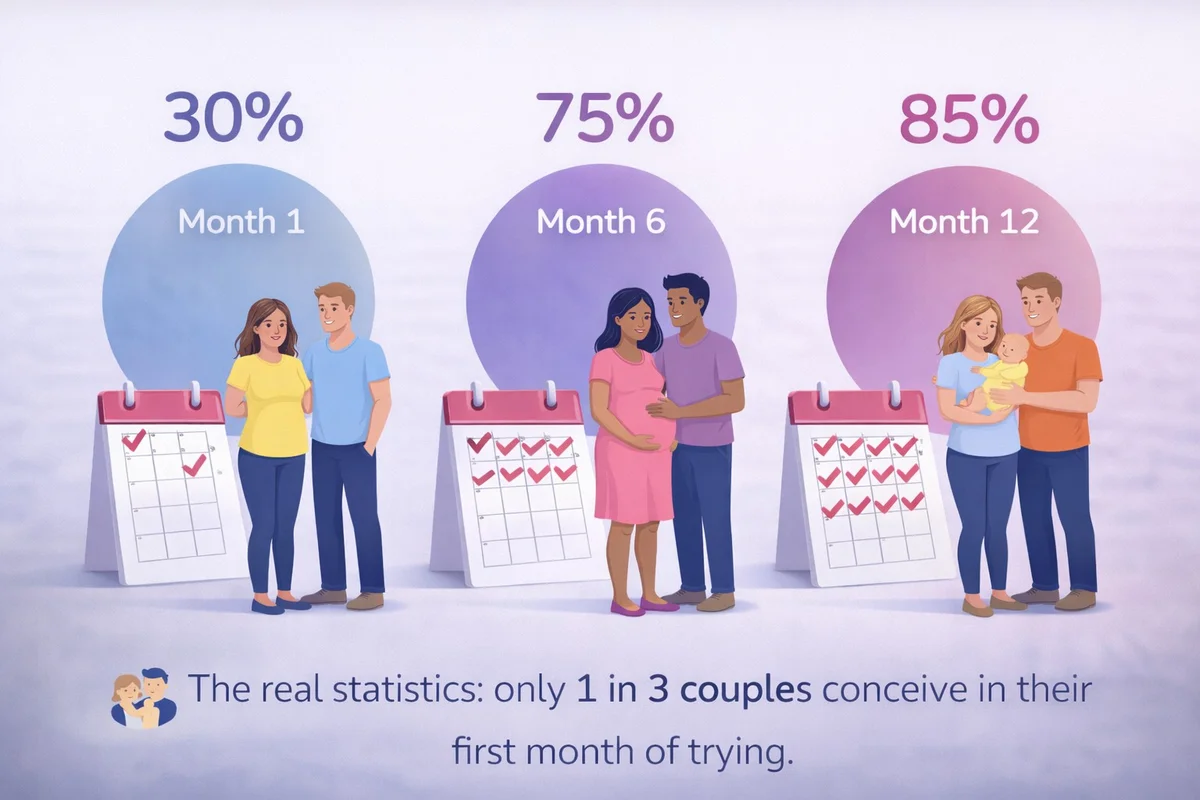
Let's break down what happens over that year:
- 30% get pregnant in the first month (that lucky one-in-three we mentioned)
- 75-79% within six months (depending on age)
- 84-85% within twelve months
And for those who don't conceive in the first year? About half will go on to conceive in the second year without any intervention.
So if you're on month three, four, or even eight of trying and it hasn't happened yet—you're still well within the range of completely normal.
The "3-Month Panic" Trap
I see this constantly in TTC forums: someone's been trying for three whole months without success, and they're convinced something must be wrong.
Three months feels like forever when you're desperately wanting to see those two pink lines. I get it. Each month that goes by without a positive test can feel like a personal failure.
But here's the thing: if only 30% of couples conceive in month one, and it takes most people up to a year, then three months is barely the beginning of your trying-to-conceive journey.
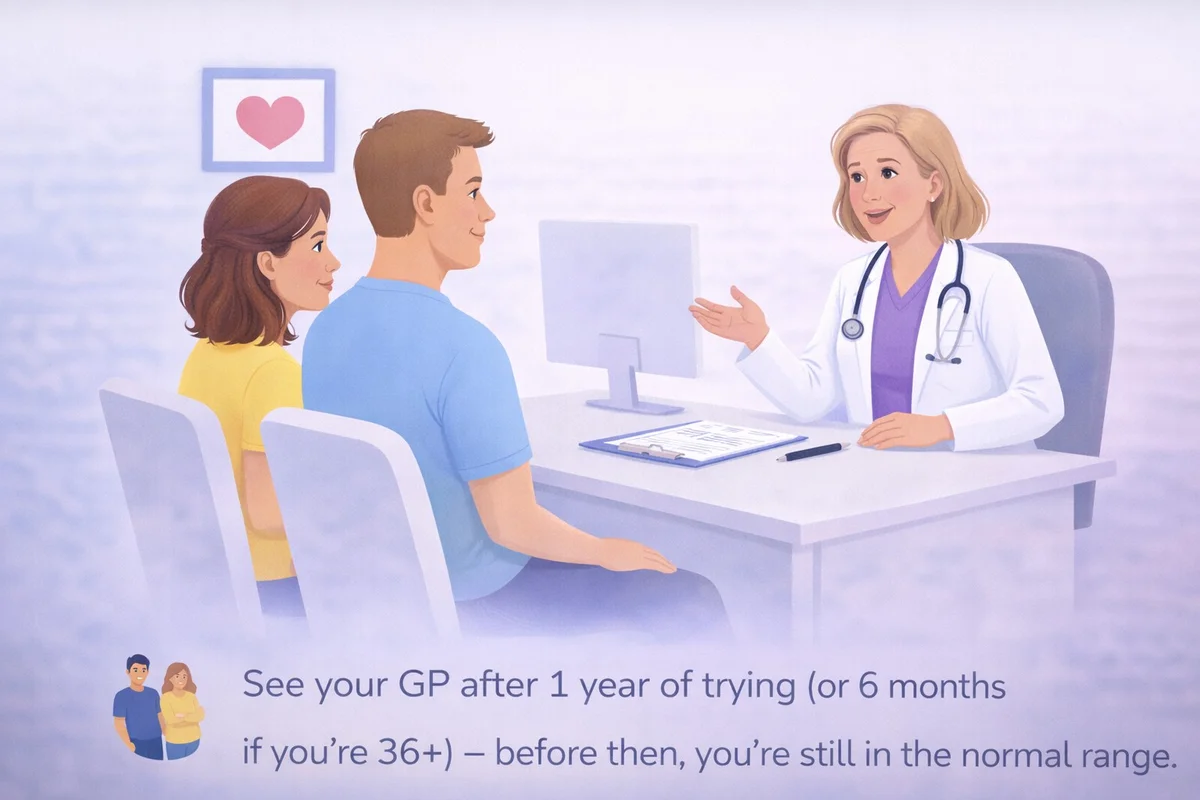
The NHS doesn't even recommend seeking fertility help until you've been trying for a full year (or six months if you're 36 or older). Not because they don't care, but because statistically, most couples haven't had enough time yet.
Think of it this way: if you have a 20-25% chance each month, you're basically rolling a dice where you need to land on a specific number. Sometimes it happens first try. Sometimes it takes a dozen tries. Both are completely normal outcomes.
Age Actually Does Matter (But Not How You Think)
Right, let's talk about the elephant in the room: age and fertility.
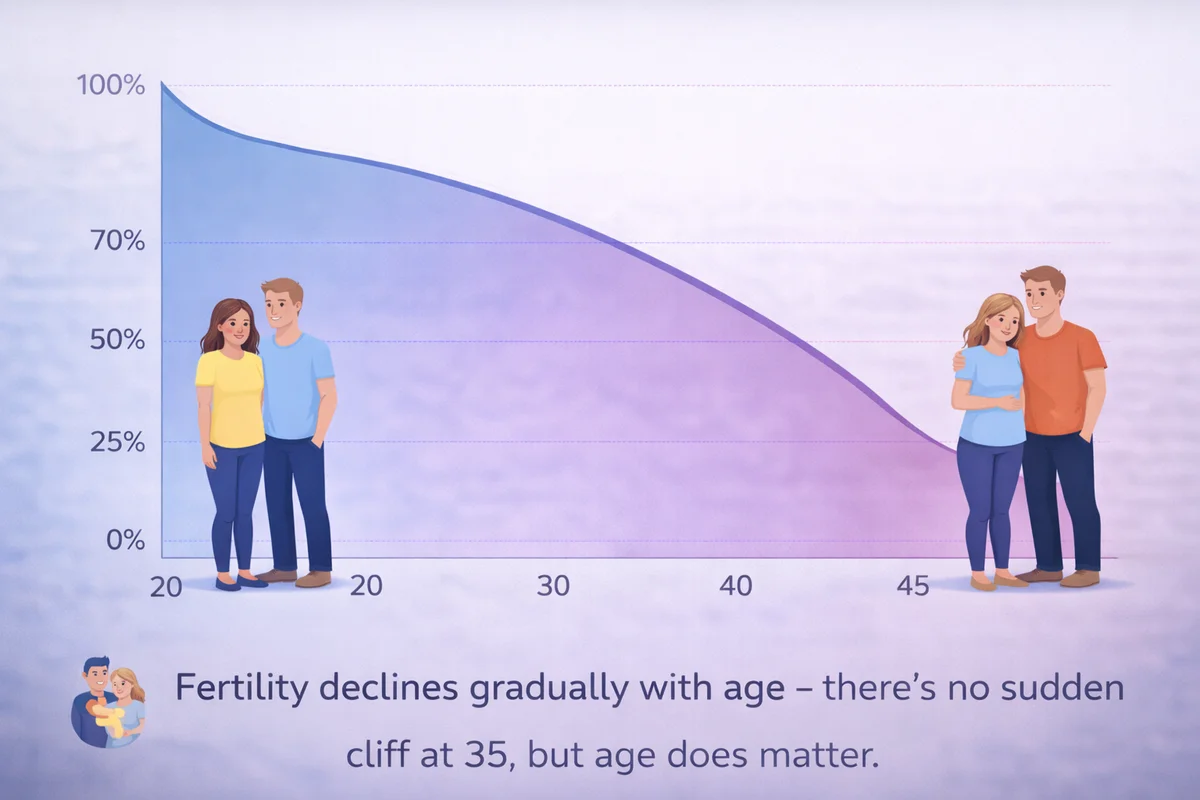
We've all heard the stories about celebrities having babies at 45, or that friend of a friend who got pregnant naturally at 42. These stories can make it seem like age doesn't really matter—or that fertility drops off a cliff the moment you turn 35.
Neither is quite accurate.
Here's what the research actually shows:
In Your 20s: Your chances are highest here. Research indicates that women aged 25-27 have about a 79% chance of conceiving within twelve months, and women aged 28-30 are most likely to get pregnant within six cycles (62%).
Each cycle, your odds are around 25%. Not a guarantee, but decent odds.
In Your Early 30s: Your fertility remains pretty similar to your twenties. Women aged 31-33 have a 77% chance of pregnancy within twelve months, and 61% within six cycles—not dramatically different from the 25-27 age group.
After 35: This is where things start to change more noticeably. Women aged 34-36 have a 75% chance within twelve months and 56% within six cycles. The decline becomes more significant in your late thirties.
At 40: By 40, your chances drop to about 5-10% per cycle, with a 44% chance of pregnancy within one year. This doesn't mean it's impossible—just that it's statistically less likely and may take longer.
After 45: Natural pregnancy becomes very unlikely, though not impossible.
The key point? Fertility doesn't fall off a cliff at 35. It declines gradually from your late twenties onwards, with a steeper drop after 37.
But equally, age does matter. If you're in your mid-to-late thirties and want to have children, it's worth being proactive rather than assuming you have unlimited time.
When Should You Actually Seek Help?
This is where NHS guidance becomes really important, because it's based on statistics and medical evidence—not panic or anxiety.
According to the NHS, you should see your GP if:
- You're under 36 and have been trying for a year with regular unprotected sex (every 2-3 days)
- You're 36 or over and have been trying for six months
- You have any known fertility issues or conditions that could affect conception (like PCOS, endometriosis, very irregular periods)
- Your partner has a known fertility issue (like previous testicular surgery or treatment for cancer)
- Either of you have had treatment that could affect fertility
Notice what's not on this list: "you've been trying for three months and are feeling anxious."
I'm not dismissing your feelings—TTC anxiety is real and valid. But from a medical standpoint, three months, six months, even nine months of trying is still completely within the normal range for most couples.
That said, if you have any specific concerns or risk factors, speak to your GP sooner. There's no harm in having a conversation, getting some baseline tests done, or just getting reassurance that everything's working as it should.
What "Regular Sex" Actually Means
The NHS keeps mentioning "regular sex", but what does that actually mean?
According to NHS guidance, regular sex means having intercourse every 2 to 3 days throughout your entire cycle—not just around ovulation.
Why? Because:
- Sperm can survive for up to 5-7 days in your reproductive tract
- You can't always predict ovulation exactly, especially if your cycles vary
- Stress about timing can actually work against you
Some couples prefer to track ovulation using apps, temperature charting, or ovulation predictor kits, and that's fine. If it gives you a sense of control and reduces anxiety, go for it.
But you don't need to turn sex into a military operation with strict schedules and positions. The NHS is clear: having sex regularly throughout your cycle is just as effective as precisely timing it around ovulation—and probably less stressful.
The Truth Nobody Tells You About TTC
Here's what I wish someone had told me before we started trying:
Month one won't necessarily work. Month three won't necessarily work. Even month six or eight might not work—and that's all completely normal.
Most couples take several months to a year to conceive. Not because something's wrong, but because that's just how human reproduction works. We're not particularly fertile as a species compared to other mammals.
The constant negative tests are hard. The waiting is hard. Watching everyone else seem to get pregnant effortlessly while you're stuck in limbo is really bloody hard.
But unless you've been trying for a year (or six months if you're 36+), or you have specific risk factors, there's probably nothing wrong. You're just in the frustrating-but-normal phase of trying to conceive.
What Actually Affects Your Chances
While you're waiting for those two pink lines to appear, are there things you can do to improve your odds?
According to the NHS, these factors can help:
Things That Help:
- Maintaining a healthy weight (both being underweight and overweight can affect fertility)
- Taking 400mcg folic acid daily (or 5mg if you have certain risk factors)
- Having sex every 2-3 days
- Stopping smoking (both partners)
- Cutting down on alcohol
Things That Don't Help:
- Stressing about timing
- Obsessing over every twinge and symptom
- Comparing yourself to others on TTC forums
- Testing before your period is actually due
- Spending a fortune on supplements with no evidence base
Your body isn't a machine that you can optimise into instant pregnancy. Sometimes it just takes time—frustrating, anxiety-inducing, hope-crushing time.
The Bottom Line
If you're trying to conceive and it hasn't happened yet, here's what you need to know:
One month of trying is nothing. Three months is still early days. Six months is normal. Even a year is within the expected range for most couples.
The NHS says most couples will conceive within twelve months of regular sex, and research backs that up: about 84-85% of couples will be pregnant within a year.
That means for every six couples trying to conceive, five will be successful within twelve months—but each of those couples will have their own timeline. Some will be lucky month one. Others will be month three, six, nine, or twelve.
Your timeline is your timeline. It doesn't mean anything about your worth, your body, or your future fertility.
When to actually worry: If you're under 36 and it's been a year, or you're 36+ and it's been six months. That's when the NHS recommends seeking help—not before (unless you have specific risk factors or concerns).
And if you are in that position? There's help available. Initial fertility testing is straightforward, and many common issues are treatable. But for most couples reading this, you're still in the normal range.
Take a deep breath. Keep having regular sex. Try to find the balance between being informed and being obsessed (easier said than done, I know).
And remember: TTC taking longer than month one doesn't mean it won't happen. It just means you're experiencing what the majority of couples experience.
You're not broken. You're not failing. You're just normal.
Disclaimer: This information is based on NHS guidance and studies, but isn't medical advice. If you have fertility concerns or have been trying to conceive for over a year (6 months if 36+), speak to your GP.