When you're trying to conceive (TTC), understanding when you ovulate is one of the most powerful tools you have. Ovulation—the release of an egg from your ovary—typically happens once per menstrual cycle, and you can only get pregnant during a narrow window around this time. Knowing when that window opens dramatically improves your chances of conception.
This guide explains every proven method for tracking ovulation when trying to conceive, from simple calendar calculations to advanced fertility tracking tools available in the UK.
Why Ovulation Tracking Matters for TTC
Your fertile window—the days when pregnancy is possible—lasts about six days: the five days before ovulation and the day of ovulation itself. Sperm can survive in the female reproductive tract for up to five days, but an egg only remains viable for 12-24 hours after release.
Research shows that couples who time intercourse to their fertile window have significantly higher conception rates. A study published in the New England Journal of Medicine found that pregnancy rates were highest when couples had sex on the day of ovulation or the two days before.
But here's the challenge: most women don't ovulate on day 14. While that's the textbook midpoint of a 28-day cycle, only about 10% of women with regular cycles actually ovulate exactly then. Your ovulation day depends on your unique cycle length, and it can vary from month to month even if your cycles are regular.
That's why tracking matters. Instead of guessing, you learn your body's specific patterns.
Method 1: Calendar Method (Fertility Awareness)
Best for: Women with regular cycles who want a free, simple starting point
How it works:
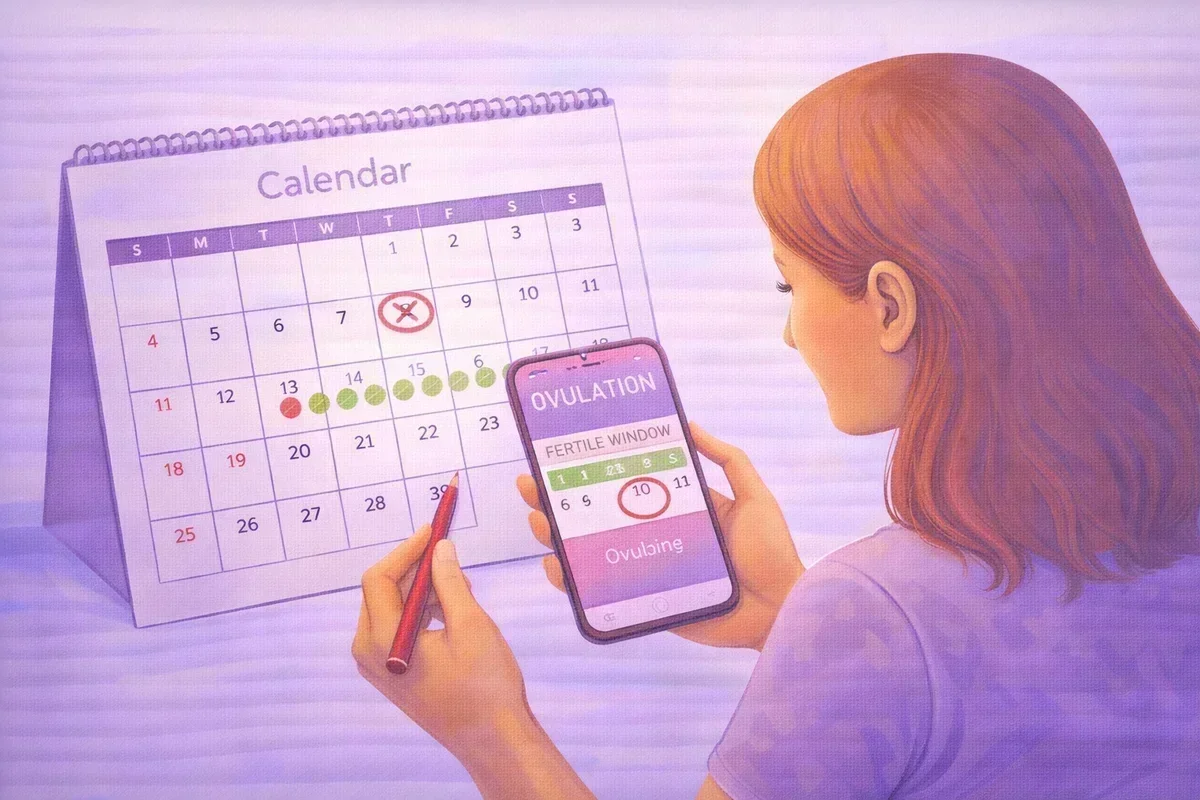
The calendar method involves tracking your cycle length over several months to predict when you're likely to ovulate.
What to do:
- Track the start date of your period for 3-6 months (the more data, the better)
- Calculate your average cycle length (from day 1 of one period to day 1 of the next)
- Subtract 14 days from your average cycle length—this estimates your ovulation day
- Your fertile window is the 5 days before this date through the day of ovulation
Example:
If you have a consistent 30-day cycle:
- Ovulation estimate: Day 16 (30 - 14 = 16)
- Fertile window: Days 11-16
Accuracy: Moderate. This method assumes a consistent 14-day luteal phase (the time between ovulation and your next period), which is true for most women but not all. It also can't account for cycle variations.
UK resources: You can track this with pen and paper, a basic phone calendar, or use the NHS's period tracking guidance.
Pros: Free, simple, good for getting to know your cycle
Cons: Requires regular cycles, doesn't work well if your cycles vary by more than a few days, can't detect actual ovulation
Method 2: Basal Body Temperature (BBT) Tracking
Best for: Women willing to take their temperature daily and who want to confirm ovulation happened
How it works:
Your basal body temperature—your temperature at complete rest—rises slightly (0.2-0.5°C) after ovulation due to increased progesterone. By tracking this daily, you can confirm ovulation occurred, though it doesn't predict it in advance. Research shows that BBT tracking can accurately confirm ovulation has occurred, though the temperature rise typically happens 1-2 days after the egg is released.
What to do:
- Get a basal thermometer (more sensitive than regular thermometers; available at Boots, Amazon UK, or Superdrug for £5-15)
- Take your temperature every morning before getting out of bed, talking, or drinking water
- Record it daily using an app or paper chart
- Look for the temperature shift: After ovulation, you'll see temperatures rise and stay elevated until your next period
- Identify your fertile window retrospectively: Your temperature shift confirms ovulation happened 1-2 days earlier
Accuracy: High for confirming ovulation, but it's retrospective—by the time your temperature rises, ovulation has already happened.
UK-specific tips:
- Boots and Superdrug stock BBT thermometers in-store and online
- Take your temperature at the same time each morning (set an alarm if needed)
- Track at least 3 months to see patterns
Best used with: Combine BBT with another method (like LH tests or cervical mucus monitoring) so you can predict ovulation in advance and confirm it afterward.
Pros: Confirms ovulation, helps you understand your luteal phase length, inexpensive
Cons: Requires consistent morning routine, doesn't predict ovulation in advance, can be affected by illness/poor sleep/alcohol
Method 3: Ovulation Predictor Kits (LH Tests)
Best for: Women who want accurate, advance warning of ovulation
How it works:
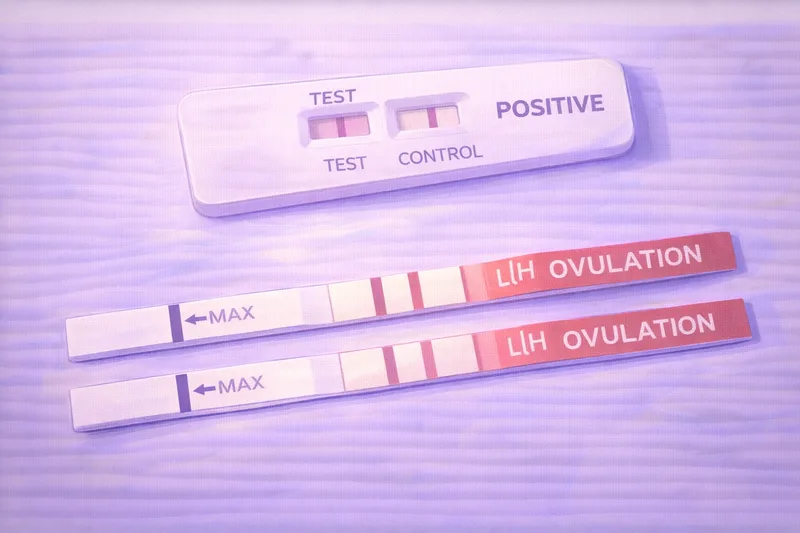
Ovulation predictor kits (OPKs) detect luteinising hormone (LH) in your urine. LH surges 24-36 hours before ovulation, giving you advance notice of your most fertile days. Studies indicate that ovulation typically occurs 24-36 hours after the initial LH surge, giving you advance notice of your most fertile time.
What to do:
- Calculate when to start testing: If you have a 28-day cycle, start testing around day 11. For other cycle lengths, subtract 17 from your average cycle length (e. g., 32-day cycle = start testing day 15)
- Test once or twice daily (some women test twice to catch the surge)
- Look for the LH surge: When the test line is as dark as or darker than the control line, you're likely to ovulate within 24-36 hours
- Have sex within the next 48 hours for the best chance of conception
Popular UK brands:
- Clearblue Digital Ovulation Tests (available at Boots, Superdrug, Tesco) – digital display, easy to read
- First Response Ovulation Tests (widely available) – traditional line tests
- Budget options: One Step or Easy@Home (Amazon UK) – bulk packs, very affordable
Cost: £10-30 for a month's supply at high street pharmacies; £5-10 for bulk Amazon packs
Accuracy: Very high (around 99% for detecting the LH surge when used correctly)
Tips for UK users:
- Buy in bulk online to save money if you're testing for several months
- Test with afternoon urine (not first morning urine) for best results
- Hold off on drinking lots of fluids for 2 hours before testing
Pros: Predicts ovulation in advance, highly accurate, gives clear results
Cons: Requires daily testing, can be expensive if buying premium brands, doesn't work well for women with PCOS (who may have persistently elevated LH)
Method 4: Cervical Mucus Monitoring
Best for: Women comfortable with their bodies who want a free method that predicts ovulation
How it works:
As ovulation approaches, rising estrogen causes your cervical mucus to change consistency. Just before ovulation, it becomes clear, slippery, and stretchy—often compared to raw egg white. This "egg white cervical mucus" (EWCM) creates an ideal environment for sperm and signals your most fertile days.
What to do:
- Check your cervical mucus daily (wipe with toilet paper or check internally with clean fingers)
- Note the consistency:
- After your period: Dry or minimal mucus (low fertility)
- As ovulation approaches: Creamy or sticky mucus (fertility increasing)
- Just before ovulation: Clear, stretchy, slippery mucus—EWCM (peak fertility)
- After ovulation: Mucus dries up again or becomes thicker
- Have sex when you see EWCM: This is your most fertile time
Accuracy: Moderate to high for predicting ovulation, but requires practice to recognise changes. Research suggests that cervical mucus observations can be a reliable predictor of the fertile window when tracked consistently.
Tips:
- Track for a few months to learn your patterns
- Some women produce less noticeable mucus (still fertile, just harder to track this way)
- Vaginal infections or lubricants can affect mucus consistency
Pros: Free, predicts ovulation in advance, helps you understand your body
Cons: Requires comfort with checking mucus, can be confusing at first, not all women produce obvious EWCM
Method 5: Fertility Tracking Apps
Best for: Women who want technology to do the calculations and reminders
How it works:
Fertility apps combine multiple tracking methods—calendar calculations, symptom logging, temperature tracking, and test result recording—to predict your fertile window. Many use algorithms that learn your patterns over time.
Popular UK-friendly apps:
- Natural Cycles (digital contraceptive/fertility tracker, requires BBT thermometer)
- Flo (free period and ovulation tracker)
- Clue (science-based cycle tracking)
- Fertility Friend (detailed charting, popular with TTC community)
- Ovia Fertility (comprehensive TTC tracker)
What to do:
- Download an app and input your cycle start dates
- Log any symptoms (cervical mucus, BBT, LH test results)
- The app predicts your fertile window based on your data
- Get daily reminders and fertility predictions
Accuracy: Varies by app and how much data you input. Apps improve their predictions as you log more cycles.
UK note: The NHS doesn't officially recommend specific fertility apps, but they can be useful tools when trying to conceive. Just remember they're predictions, not guarantees.
Pros: Convenient, combines multiple methods, visualises your data, sets reminders
Cons: Predictions are only as good as the data you input, premium features often cost money, some apps sell your data
Method 6: Advanced Fertility Monitors
Best for: Women who want the most accurate tracking without daily effort
How it works:
High-tech fertility monitors track multiple fertility indicators—hormone levels, temperature, or even saliva patterns—to predict ovulation. These are the most expensive option but offer the most comprehensive data.
Options available in the UK:
- Clearblue Fertility Monitor (£80-120, tests LH and estrogen, available at Boots)
- Ava Bracelet (wearable that tracks multiple parameters while you sleep; ships to UK)
- Mira Fertility Tracker (measures actual LH hormone levels, not just presence; ships to UK)
- Ovusense (monitors internal body temperature overnight)
Accuracy: Very high—these devices are designed for women actively trying to conceive
Pros: Highly accurate, convenient, comprehensive data
Cons: Expensive (£80-300+), requires ongoing costs for test strips/subscriptions in some cases
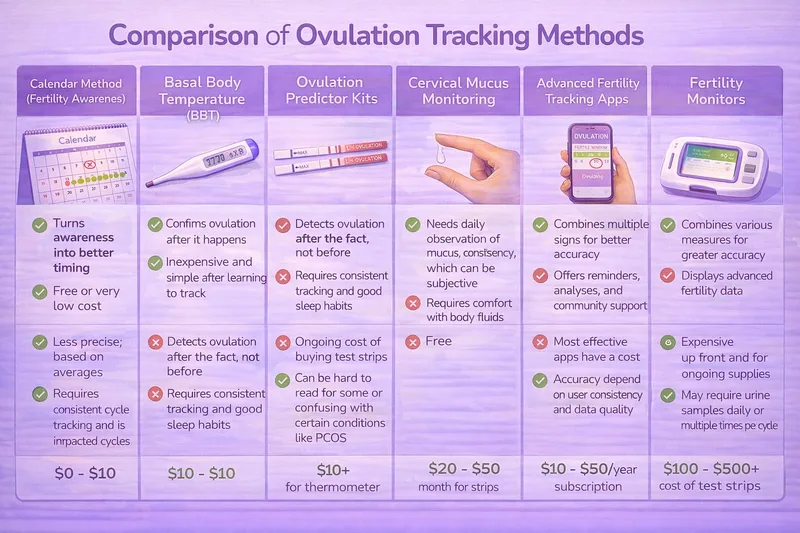
Which Method Should You Use?
If you're just starting TTC:
Start with the calendar method and cervical mucus monitoring (both free). Add ovulation predictor kits after 1-2 months if you want more precision.
If you have regular cycles:
Calendar + LH tests will likely be enough.
If you have irregular cycles:
LH tests + cervical mucus monitoring work better than calendar predictions. Consider tracking with an app to spot patterns over time.
If you want to confirm ovulation is actually happening:
Add BBT tracking to any of the above methods.
If you've been trying for 6+ months without success:
Consider a fertility monitor or speak with your GP about next steps.
If you have PCOS:
LH tests may not work reliably for you (PCOS can cause elevated LH). Focus on cervical mucus, BBT, or see your GP for guidance.
Common Mistakes When Tracking Ovulation
1. Starting to track too late in your cycle
Many women miss their LH surge because they start testing too late. Calculate your expected ovulation day and start testing at least 3-4 days before.
2. Only having sex on ovulation day
Sperm can survive for up to 5 days, so having sex in the days before ovulation is just as important—if not more so—than the day of ovulation itself. Aim for every 1-2 days during your fertile window.
3. Assuming you ovulate on day 14
This is a myth. Ovulation timing varies between women and even between cycles for the same woman.
4. Taking BBT at inconsistent times
For BBT to be accurate, you need to take your temperature at the same time every morning before any activity.
5. Relying on just one method
Combining two methods (e. g., calendar + LH tests, or cervical mucus + BBT) gives you much more reliable information.
6. Stressing about "perfect" timing
Trying to conceive can feel clinical, but remember: having sex every 2-3 days throughout your cycle gives you excellent chances without the pressure of precise tracking.
When to See a Doctor
You should speak with your GP about fertility concerns if:
- You're under 35 and have been trying to conceive for 12 months without success
- You're over 35 and have been trying for 6 months without success
- You have very irregular cycles (varying by more than a week)
- You have no periods or very infrequent periods
- You consistently track ovulation but don't see signs you're ovulating
- You have known fertility risk factors (endometriosis, PCOS, previous pelvic infections)
- Your partner has known fertility concerns
The NHS provides fertility testing and treatment. Your GP can refer you to a fertility specialist if needed.
UK resources:
- NHS Fertility Services
- Fertility Network UK (charity offering support)
Final Thoughts
Tracking ovulation when trying to conceive doesn't have to be complicated or expensive. Start with the methods that feel manageable—whether that's a simple calendar, an app, or a pack of ovulation tests from Boots—and build from there if needed.
The goal isn't perfection. It's understanding your body well enough to recognise your fertile window and time intercourse accordingly. For most couples, this dramatically improves the chances of conception within the first few months of trying.
And if tracking starts to feel stressful, remember: many couples conceive without any tracking at all, just by having regular sex throughout the month. Do what works for you.
Related Articles
- Ovulation Timing Myths: When Can You Actually Get Pregnant?
- How Long Does It Really Take to Get Pregnant? (The Truth About TTC)
- Best Ovulation Tests UK 2026: Reviews & Comparisons
Disclaimer: This article provides general information about ovulation tracking when trying to conceive and is not a substitute for medical advice. If you have concerns about your fertility or menstrual cycle, please speak with your GP or a fertility specialist.