
The Comment That Made Me Want to Scream
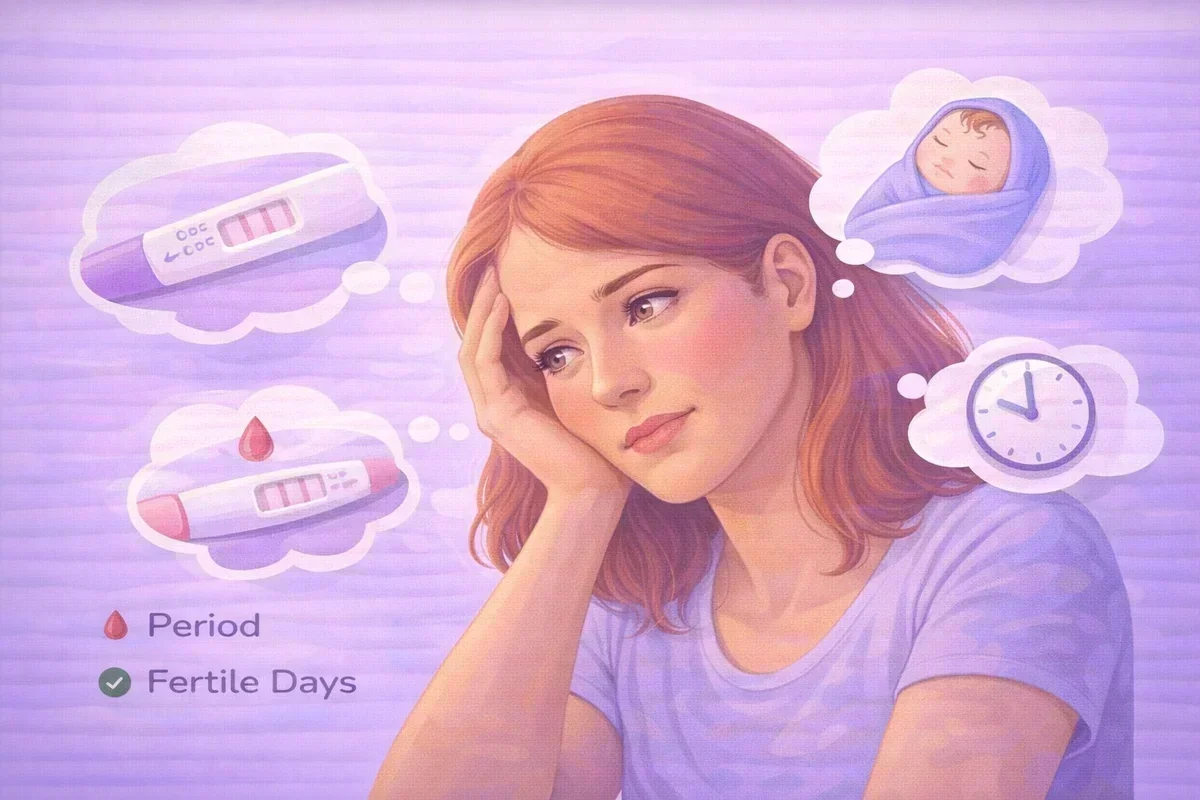
I was at a family gathering when my aunt pulled me aside. Friends of ours had confided that they'd been trying to conceive for eight months. "You know what they need to do?" my aunt said, with complete confidence. "Just relax. My friend's daughter tried for ages, then went on a yoga retreat with her husband and boom—pregnant the next month. It's all about stress."
I smiled politely and changed the subject. But inside, I was fuming.
Here's why: that advice isn't just unhelpful—it's actively harmful to both partners. It transforms a medical condition into a personal failing. It suggests that if you're not pregnant yet, it's because you're not trying hard enough to calm down. It places the blame squarely on the couple experiencing infertility.
And worst of all? For every anecdotal "my friend's cousin relaxed and got pregnant" story, there are thousands of couples with genuine biological fertility issues—affecting either or both partners—who are now questioning whether their stress is sabotaging their chances.
Let's look at what the research actually says about stress, relaxation, and fertility—and why "just relax" might be the worst advice you can give someone trying to conceive.
The Myth: "You're Too Stressed—That's Why You're Not Pregnant"
The Claim: If you would just stop worrying, calm down, and relax, you'd get pregnant. Your stress is preventing conception.
What the Research Actually Shows:
The relationship between stress and fertility is far more complicated than well-meaning relatives suggest.
Study 1: Stress Biomarkers and Infertility
A study published in Human Reproduction followed 501 women trying to conceive and measured salivary alpha-amylase (a biomarker of stress) at baseline. The findings:
- Women with the highest levels of alpha-amylase were twice as likely to experience infertility
- This effect was measurable through biological stress markers, not just self-reported feelings
Study 2: Self-Reported Stress Shows Different Results
However, a similar study of 339 women in the UK found that self-reported symptoms of depression, anxiety, and stress were NOT significantly associated with time to pregnancy.
Study 3: Perceived Stress and Conception Rates
A Boston University study of over 4,000 women found:
- Women with high perceived stress scores (25+) were 13% less likely to conceive than women with low stress scores
- This association was stronger in women under 35 and those who'd been trying for fewer than 2 cycles
- Part of the effect could be explained by decreased intercourse frequency and irregular cycles
The Bottom Line:
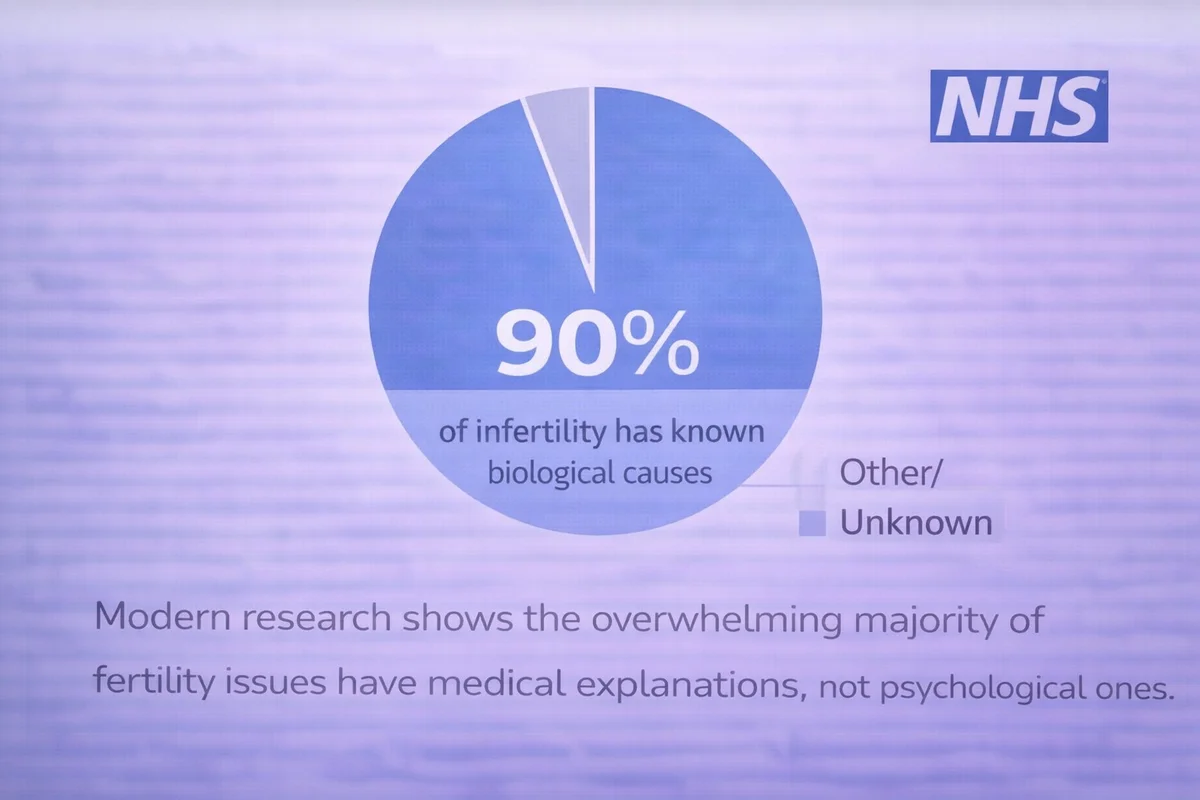
There IS some evidence that very high stress levels measured through biomarkers may affect fertility in both women and men. But here's the crucial bit: 90% of infertility cases have a known biological cause. Male factor issues are involved in approximately 50% of infertility cases. Telling someone to "just relax" implies their infertility is psychological or their own fault, when the vast majority of the time, it's not.
Study 4: Stress and Male Fertility
Research shows stress affects men's fertility too. A Columbia University study of 193 men found:
- Men who felt stressed had lower sperm concentrations
- Stressed men's sperm were more likely to be misshapen or have impaired motility
- Both subjective stress (how they felt) and objective stress (life events) affected semen quality
A Danish study found participants with highest stress levels had:
- 38% lower sperm concentration
- 34% lower total sperm count
- 15% lower semen volume
The stress of producing a semen sample for IVF itself has been shown to cause a 39% decrease in sperm concentration and 48% decrease in motility.
How Stress Affects Male Fertility:
Research suggests stress may trigger release of glucocorticoids (stress hormones) which can lower testosterone and impair spermatogenesis. The hypothalamic-pituitary-adrenal axis (stress response) directly inhibits the hypothalamic-pituitary-gonadal axis (reproduction).
But just like with women, this doesn't mean "relaxing" cures male infertility—most cases have biological causes requiring medical investigation.
Why "Just Relax" Is Actually Harmful
It Invalidates Real Medical Conditions
As the American Society of Reproductive Medicine explains: "Even though infertility is very stressful, there isn't any proof that stress causes infertility."
When you tell someone to "just relax," you're essentially saying:
- Their genuine medical concerns aren't valid
- If they're not pregnant, it's because they haven't tried hard enough to calm down
- Their infertility is a personal failing, not a health condition
It Creates Self-Blame and Guilt
Research shows that both partners experiencing infertility struggle with intense feelings of inadequacy. A 2018 meta-analysis noted: "The self-blame created from the idea that a woman's emotional distress is somehow responsible for treatment failure only adds to the anguish experienced by many women during this experience."
The same applies to men. When told to "just relax," both partners begin to question:
- "Am I not relaxed enough?"
- "Is my anxiety preventing us from getting pregnant?"
- "If I were calmer, would this work?"
- "Is this my fault for being too stressed?"
This creates a vicious cycle: stress about possibly being too stressed to conceive.
It Increases Isolation
When couples hear "just relax" repeatedly from friends and family, research shows they begin to withdraw. They stop sharing their struggles because they feel misunderstood. They skip baby showers, christenings, and family gatherings. They isolate themselves when they need support the most.
It Suggests They're Not Trying Hard Enough
"Just relax" transforms a medical diagnosis into a goal someone hasn't achieved. As fertility psychologist Elisabeth Morray explains: "Telling someone to 'just relax' implies that they're doing something wrong."
The Real Relationship: Infertility Causes Stress (Not the Other Way Around)
Here's what the research conclusively shows: infertility causes significant psychological distress.
The Emotional Toll Is Equivalent to Serious Illness
Studies show that women undergoing infertility treatments report levels of anxiety and depression equal to people diagnosed with:
- Cancer
- Heart disease
- HIV
A separate study found that 49% of women and 15% of men described infertility as the most upsetting event of their lives. While women report higher distress levels on average, men also experience significant psychological impact—though they may be less likely to express it or seek support.
Men Experience Infertility Stress Differently
Research shows male partners often feel:
- Pressure to "be strong" for their partner
- Guilt if male factor issues are identified
- Helplessness during female-focused treatments
- Stress about semen analysis and performance
- Isolation (fewer support resources for men)
The stress is real for both partners, but manifests differently and is often dismissed by "just relax" advice.
It's a Recognized Medical Condition
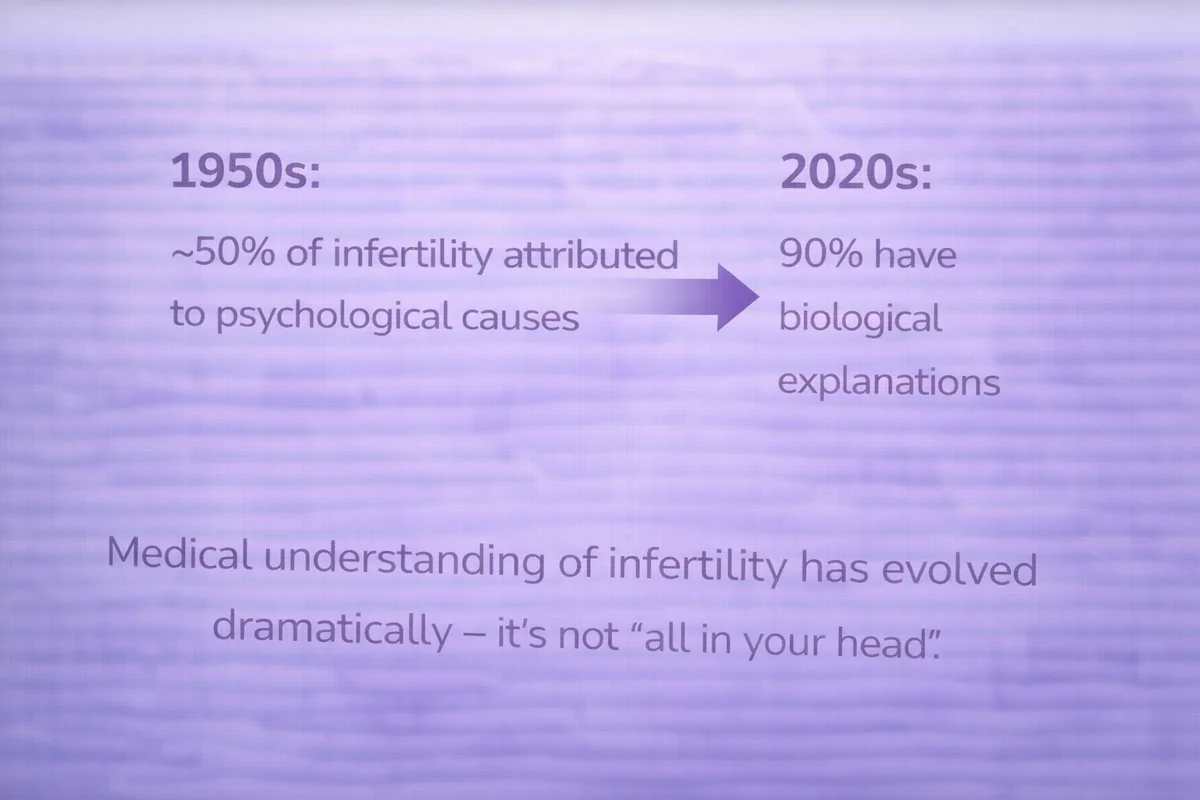
Before the mid-20th century, roughly half of infertility cases were deemed "unexplainable" or attributed to psychological causes. Today, we know better: 90% of infertility cases have a known biological explanation.
The idea that challenges getting pregnant are "psychological" or caused by a "negative attitude" is outdated, harmful, and places blame on women instead of offering proper medical support.
What Actually Helps? (It's Not "Just Relaxing")
While telling someone to "relax" is unhelpful, there IS evidence that structured psychological interventions can help—both with wellbeing and potentially with conception rates.
Mind-Body Programs Show Real Results
Dr. Alice Domar's research at Harvard found that women who participated in a 10-session mind-body program experienced:
- Decreased anxiety and depression
- 34% pregnancy rate among participants
- Better coping strategies for the fertility journey
Importantly, women in the mind-body program or professionally-led support groups had higher treatment success rates than controls.
But This Is Different from "Just Relaxing"
These programs included:
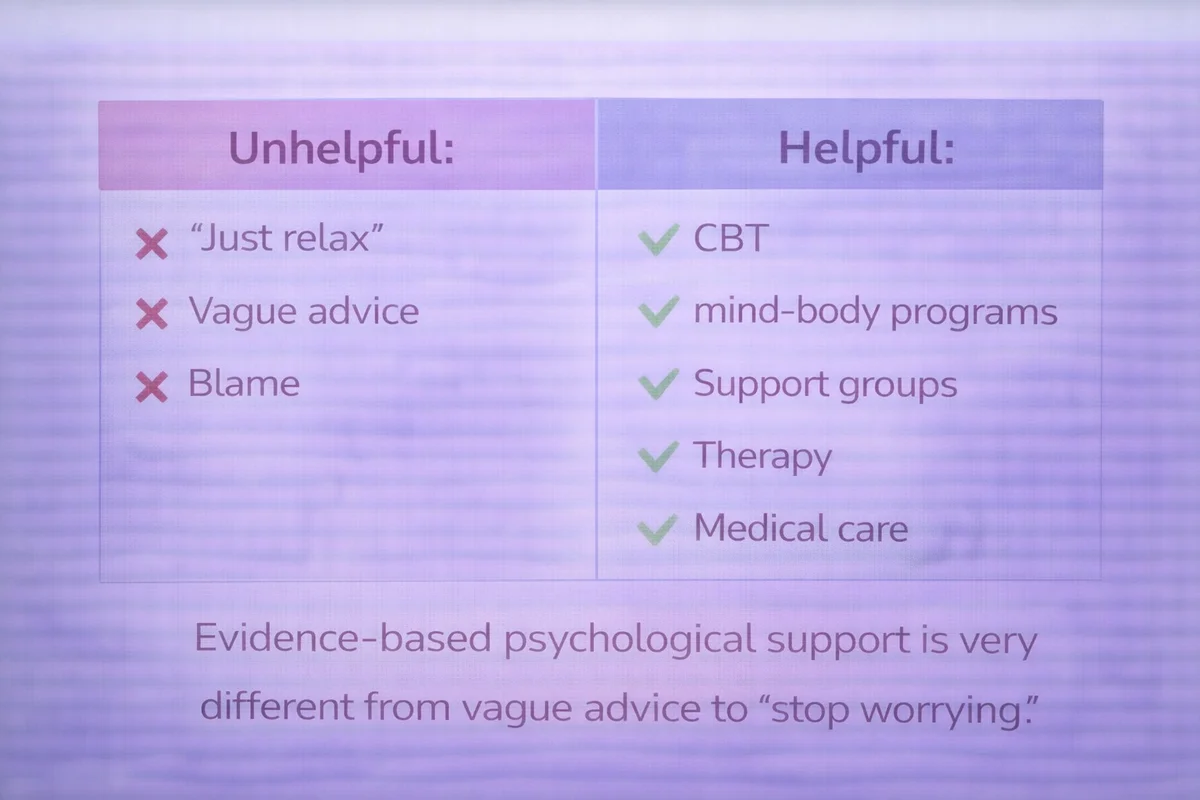
- Cognitive Behavioral Therapy (CBT)
- Relaxation training
- Stress management skills
- Social support
- Journaling and self-awareness exercises
This is evidence-based psychological support—not vague advice to "calm down."
What the Interventions Actually Do
As one research psychologist notes: "Reducing stress during infertility through peer support isn't about getting you pregnant faster: It's about making the infertility journey a little less painful, a little less isolating, and a lot more empowered."
The goal isn't to magically cure infertility by thinking positive thoughts. It's to provide genuine coping skills for an incredibly difficult experience.
What To Say Instead (If You Want To Actually Help)
If someone you care about is struggling with infertility, here's what's actually helpful:
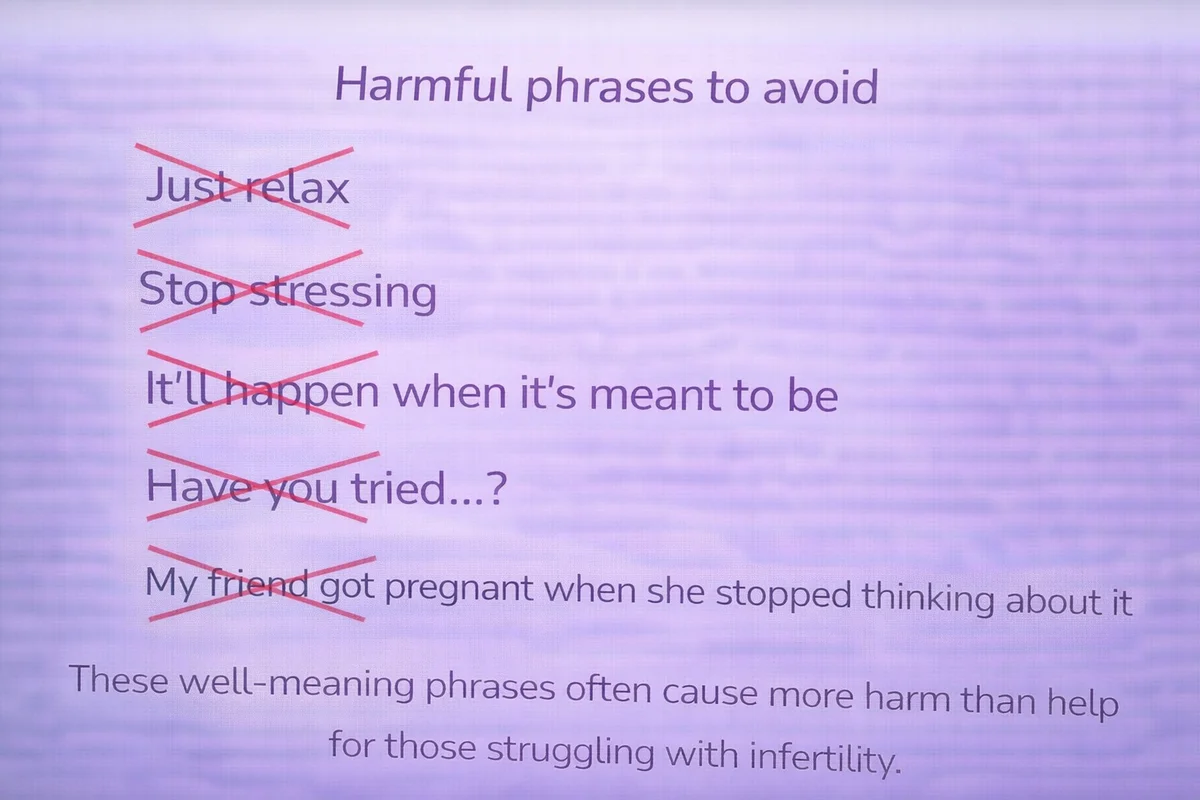
What NOT To Say:
- ❌ "Just relax and it'll happen"
- ❌ "Stop trying so hard"
- ❌ "Maybe you're not meant to have children"
- ❌ "At least you already have one child"
- ❌ "You have plenty of time"
- ❌ "My friend got pregnant after she stopped thinking about it"
- ❌ "Have you tried [insert random fertility advice]?"
What TO Say:
- ✓ "I'm sorry you're going through this"
- ✓ "This must be really hard for you"
- ✓ "I'm here if you want to talk—or if you'd rather not talk about it"
- ✓ "Would it help if I [specific offer: bring dinner, go for a walk, watch a film together]?"
- ✓ "I can't imagine how difficult this is"
What TO Do:
- Listen without offering solutions. Sometimes people just need to vent.
- Don't minimize their pain. Avoid "at least" statements.
- Respect their boundaries. If they don't want to talk about it, drop it.
- Show practical support. Offer specific, concrete help rather than vague "let me know if you need anything."
- Remember significant dates. If they've mentioned an appointment or treatment, follow up afterwards.
The Real Story: What I've Seen Friends Go Through
I mentioned we were lucky—conceiving came naturally for us. But I've watched close friends go through the fertility struggle, and I've seen the damage that "just relax" advice causes to both partners.
One couple was six months into trying when the woman's mother-in-law suggested she "stop being so uptight about everything." The husband felt helpless—he couldn't defend his wife without creating family drama, and he was dealing with his own stress about their situation. They both stopped confiding in family after that.
Another friend's husband was told by a colleague to "take your wife on vacation—that's when it always happens!" They'd already discovered he had low sperm motility and were seeing a specialist. The implication that they just needed to holiday somewhere sunny felt insulting to both of them.
What actually helped them? Proper medical care for both partners. Testing. Diagnosis. Treatment. And crucially: support from people who understood that infertility is a medical condition affecting couples, not a relaxation problem for one person.
When To Seek Help
The NHS recommends seeing your GP if you've been trying to conceive for:
- 1 year if the woman is under 36
- 6 months if the woman is 36 or over
Don't wait longer because someone told you to "just relax." Infertility is a medical condition that deserves proper investigation for both partners—male factor issues are involved in approximately 50% of cases.
Approximately 1 in 7 couples experience fertility issues. That's 48 million couples worldwide. This isn't rare. This isn't "all in your head" for either partner. This is a genuine health concern requiring medical support for both of you—not platitudes.
The Bottom Line
Can stress affect fertility? Possibly, in some cases, when stress levels are very high as measured by biomarkers—this applies to both women and men.
Does "just relaxing" cure infertility? Absolutely not.
Is infertility primarily caused by stress or anxiety? No—90% of cases have biological causes, with male factor issues involved in about 50% of infertility cases.
Should you tell someone struggling with infertility to "just relax"? Never—it harms both partners.
The next time you're tempted to offer relaxation advice to a couple trying to conceive, pause. Consider that they've both likely:
- Heard this advice a hundred times already
- Spent months or years feeling like failures
- Been told repeatedly that it's somehow their fault
- Dealt with invasive testing and treatment
- Experienced significant emotional toll
Instead, offer compassion to both partners. Offer to listen. Offer concrete support. And if you really want to help with the stress of infertility, point them toward evidence-based resources: fertility counselors (for both partners), support groups, mind-body programs.
Because the problem isn't that they need to relax more. The problem is that infertility is genuinely, medically difficult for couples—and they both deserve proper support, not blame.
Disclaimer: This information is based on peer-reviewed studies and medical guidance, but isn't medical or mental health advice. If you're experiencing infertility or significant distress related to trying to conceive, please speak to your GP or a qualified fertility counsellor.