"Just have sex on day 14 - that's when everyone ovulates!"
This cheerful advice came from a friend who'd recently got pregnant on her first month of trying. She'd used a period tracking app, had sex on day 14, and boom - positive pregnancy test. Obviously, this method was foolproof and would work for everyone.
Except when I tried the same approach for three months and got nothing but negative tests, I started to wonder: was I actually ovulating on day 14? Or was that just... a myth?
Turns out, it's very much a myth. And not just a harmless one - this "everyone ovulates on day 14" misconception could be causing you to completely miss your fertile window.
Here's what the actual research says about ovulation timing, and why you might want to bin that "day 14" advice immediately.
The "Day 14" Myth: Where It Came From
The idea that ovulation occurs on day 14 comes from the "average" 28-day menstrual cycle. If you ovulate roughly 14 days before your next period (which is broadly true), and your cycle is 28 days long, then simple maths says: ovulation on day 14.
The problem? Most women don't have 28-day cycles.
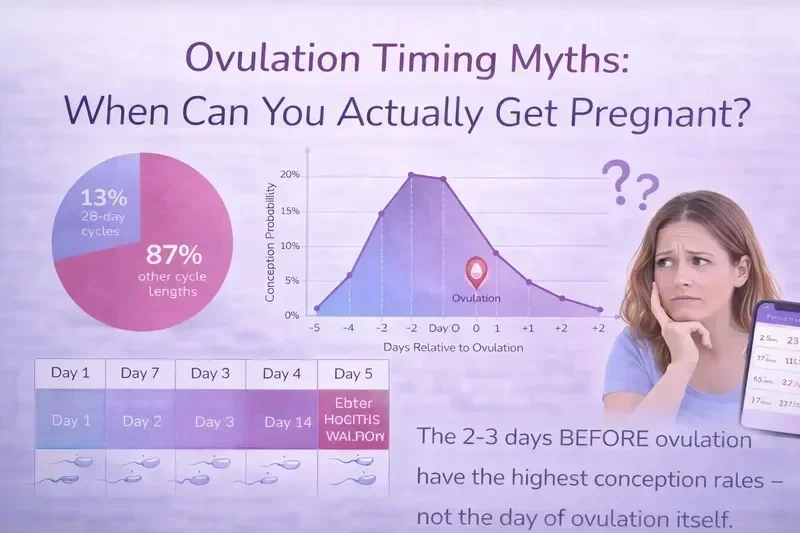
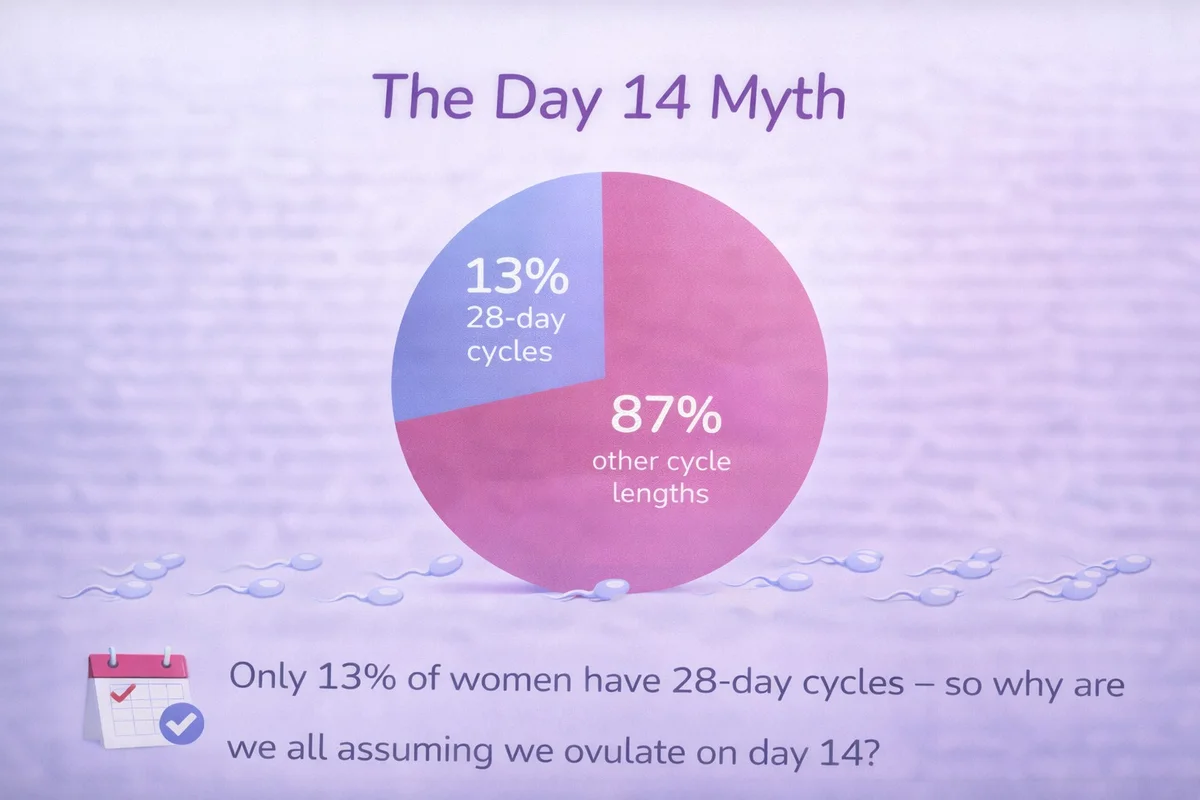
Research analysing over 600,000 menstrual cycles found that only 13% of women actually have 28-day cycles. That's right - 87% of women have cycles that are shorter or longer than the "textbook" 28 days.
If only 13% of women have 28-day cycles, why are we all using day 14 as the standard for when ovulation occurs?
Because it's an average. Averages are useful for understanding populations, but they're rubbish for predicting what happens in your individual body.
What Research Actually Shows About Ovulation Timing
Right, let's look at what happens when researchers actually track ovulation precisely rather than just assuming everyone's the same.
The landmark study by Wilcox, Dunson, and Baird (2000) published in the British Medical Journal tracked 696 menstrual cycles in 221 women using daily urinary hormone measurements to pinpoint ovulation.
Their findings completely demolish the "day 14" myth:
Only 30% of women have their fertile window entirely within days 10-17 (the "standard" window based on the day 14 assumption).
More than 70% of women are in their fertile window before day 10 or after day 17 - completely outside the "textbook" fertile days.
Women had at least a 10% probability of being in their fertile window on every single day between days 6 and 21. That's a 16-day range where conception is possible.
Some women ovulated as early as day 8. Others as late as day 60.
The earliest ovulation recorded - day 8 - resulted in a healthy baby. So "early" ovulation isn't abnormal or less fertile, it's just... earlier than the myth suggests.
Why Your Cycle Length Matters More Than You Think
If you don't have a 28-day cycle, your ovulation day will be different from the mythical day 14.
Here's the key principle: ovulation typically occurs about 14 days before your next period, regardless of overall cycle length.
That means:
- 21-day cycle: Ovulation around day 7 (a full week earlier than "day 14")
- 24-day cycle: Ovulation around day 10
- 28-day cycle: Ovulation around day 14 (the only time the myth is accurate)
- 32-day cycle: Ovulation around day 18
- 35-day cycle: Ovulation around day 21
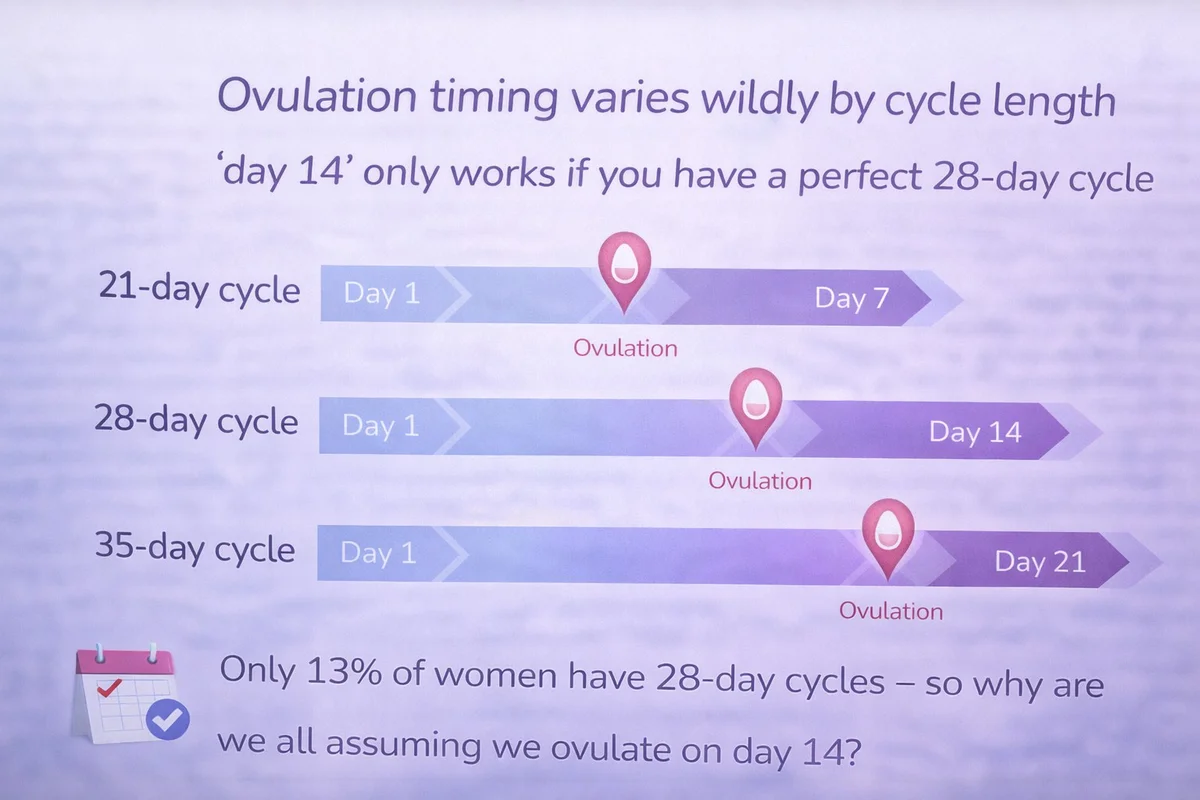
If you have a 21-day cycle and you're dutifully having sex on "day 14," you're having sex a full week after you've already ovulated. Your fertile window has come and gone.
Research from Oura Ring data tracking over 2,500 members showed the follicular phase (time from period start to ovulation) ranged from about 8 days up to 25 days. That's massive variability.
The "Regular Cycle" Illusion
"But my cycles are regular!" I hear you say. "They're always 28-29 days, so I definitely ovulate on day 14-15, right?"
Not necessarily.
The Wilcox study found that even women who reported their cycles as "regular" had enormous variability in when they actually ovulated.
Here's what the researchers said: "The timing of the fertile window is highly variable, even among women who regard their menstrual cycles as regular."
Why? Because "regular" doesn't mean "identical every single month." Your cycle this month might be 28 days, next month 30 days, the following month 26 days - all of which could be considered "regular." But each of those cycles could have different ovulation timing.
Plus, there's the luteal phase variability problem. Everyone assumes the luteal phase (time from ovulation to your period) is always 14 days. But research shows it can vary from 10 to 16 days between women, and even within the same woman from cycle to cycle.
If your luteal phase is actually 11 days but you're assuming 14, your predicted ovulation day will be off by 3 days. That's potentially your entire fertile window.
The Fertility App Problem
Period tracking apps are brilliant for tracking your cycle. They're less brilliant for predicting ovulation.
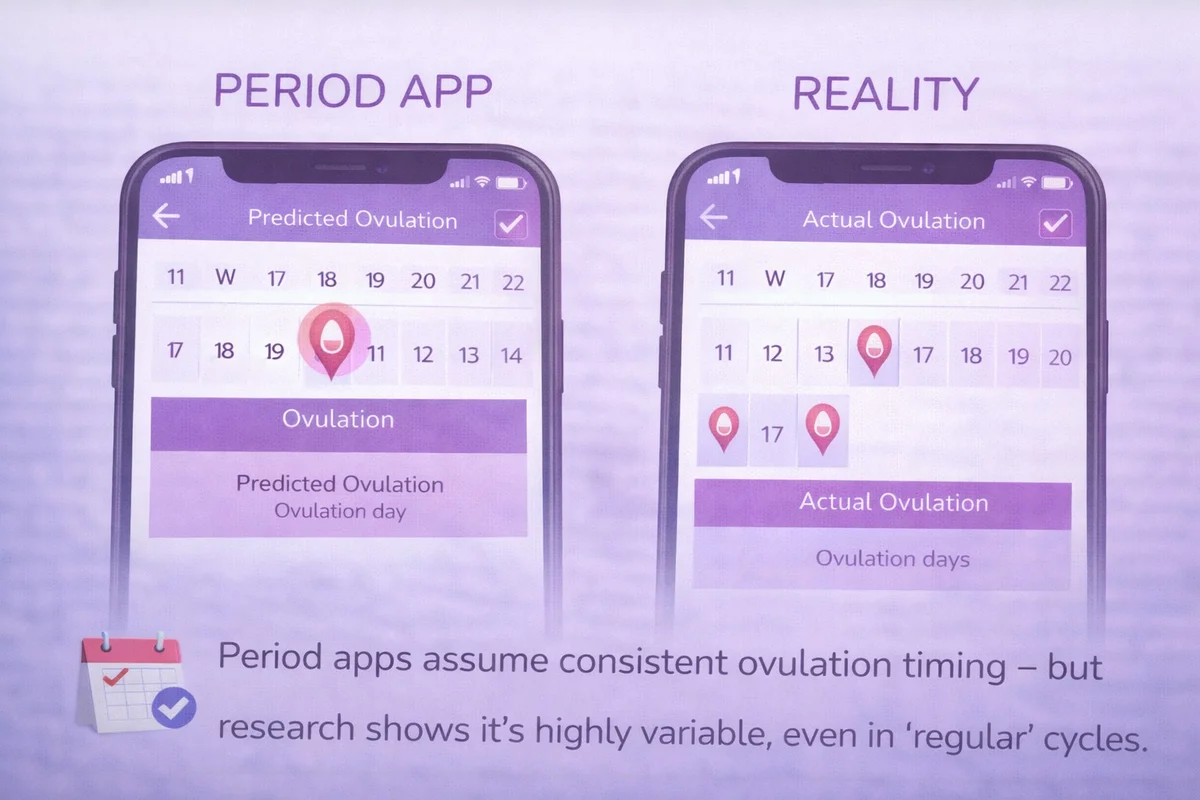
Why? Because most apps use the "calendar method" - they assume you ovulate 14 days before your next period, based on your average cycle length.
So if you tell the app your average cycle is 30 days, it will always predict ovulation on day 16. Every single month. Even if your actual ovulation varies by several days from cycle to cycle.
Research on fertility tracking misconceptions highlights that apps can't account for:
- Month-to-month variability in ovulation timing
- Luteal phase differences (10-16 day range)
- Early or late ovulation in individual cycles
- Anovulatory cycles (where you don't ovulate at all)
If you have irregular cycles where you sometimes skip months or your cycle length varies by a week or more, calendar-based predictions become essentially useless.
The only way to know when you actually ovulate is to track it using methods like:
- Ovulation predictor kits (OPKs/LH tests)
- Basal body temperature tracking
- Cervical mucus monitoring
- Fertility monitors that track hormones
The "Have Sex on Ovulation Day" Myth
Right, so you've figured out when you actually ovulate. Problem solved - just have sex on ovulation day and you'll get pregnant, yeah?
Not quite.
Here's another myth: the day of ovulation is your most fertile day.
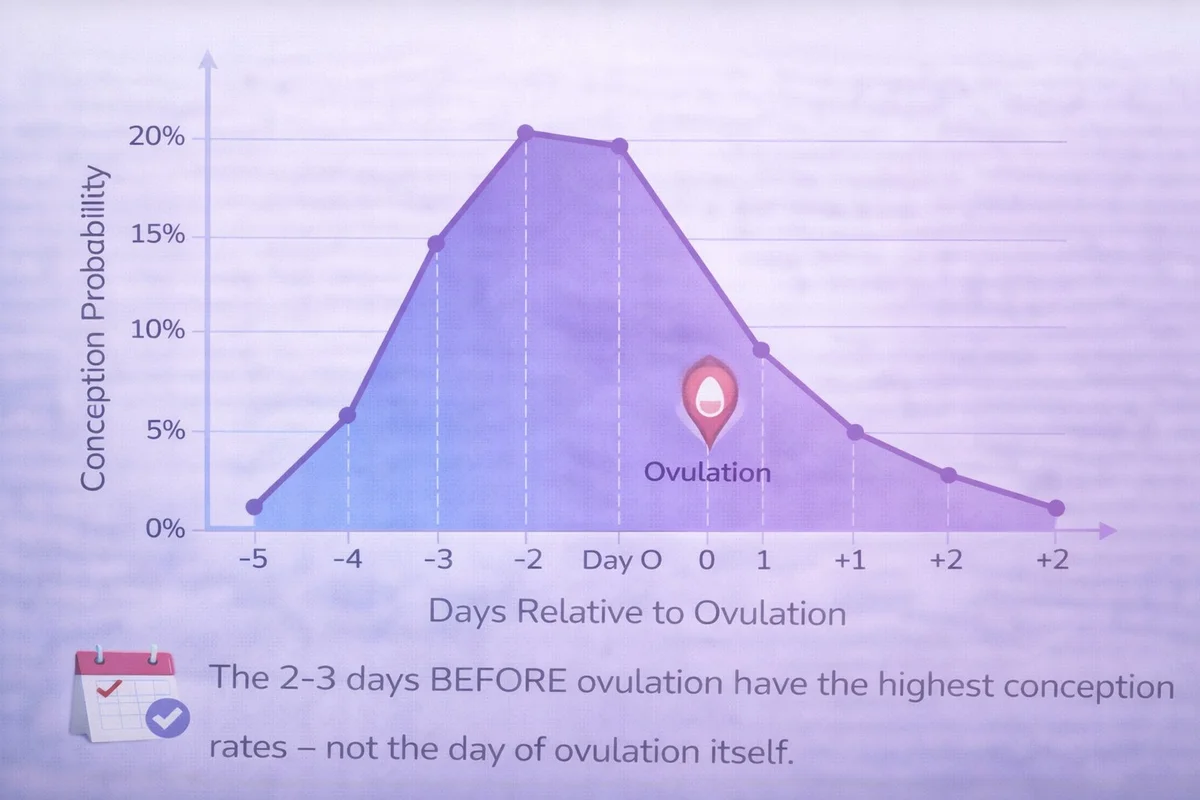
Research actually shows that the 2-3 days before ovulation have higher conception rates than the day of ovulation itself.
The Wilcox 1995 study published in the New England Journal of Medicine found:
- Day of ovulation: 33% conception probability
- 1 day before ovulation: Similar or slightly higher
- 2 days before ovulation: Peak fertility
- 3 days before ovulation: Still high
- 5 days before ovulation: 10% probability
Why are the days before ovulation more fertile than ovulation day itself?
Because sperm need time to travel up to the fallopian tube and capacitate (become capable of fertilising an egg). If sperm are already waiting when your egg is released, conception is more likely than if they arrive after the egg is released.
Remember, your egg only survives 12-24 hours after ovulation. If you wait until you've confirmed ovulation to have sex, you might be too late - especially if ovulation occurred in the morning and you're having sex that evening.
The Ovulation Predictor Kit (OPK) Trap
OPKs detect the LH surge that triggers ovulation, usually occurring 24-36 hours before ovulation. They're useful tools. But they come with a caveat:
By the time your OPK is positive, you might have already missed some of your most fertile days.
If your most fertile days are 2-3 days before ovulation, and your OPK only turns positive 24-36 hours before ovulation, then you're getting the signal right at the tail end of your fertility window.
This doesn't mean OPKs are useless - just that you shouldn't wait for a positive test to start having sex. Think of the LH surge as "the beginning of the end" of your fertile window, not the start of it.
Also worth noting: a positive OPK means your body is trying to ovulate. It doesn't guarantee ovulation actually occurs. To confirm ovulation, you'd need to see a sustained rise in progesterone (measured via basal body temperature or progesterone tests) after the LH surge.
What This Means for Actually Getting Pregnant
So if the "day 14" myth is nonsense, and ovulation timing is wildly variable, how are you supposed to time intercourse?
Here's what the research suggests:
Option 1: Track Your Actual Ovulation
Use OPKs, basal body temperature, cervical mucus monitoring, or a combination. Track for at least 2-3 months to understand your personal pattern.
Then have sex in the 3-5 days leading up to your expected ovulation, including the day you get a positive OPK.
Option 2: The "Every 2-3 Days" Method
Can't be bothered with tracking? The NHS recommends having sex every 2-3 days throughout your cycle.
This ensures you'll hit your fertile window regardless of when you actually ovulate. Sperm survive up to 5-7 days, so regular intercourse means there are always sperm hanging about waiting for whenever ovulation occurs.
Research shows this method is just as effective as precisely timing intercourse, and significantly less stressful.
Option 3: Focus on the First Half of Your Cycle
If every 2-3 days feels like too much, focus your efforts on the first half of your cycle (days 7-17 for most women).
The Wilcox study showed that women had at least a 10% chance of being fertile on any day between days 6 and 21. If you have sex regularly throughout this window, you're very likely to hit your fertile days.
Special Cases: Short Cycles and Irregular Cycles
Short Cycles (21-25 days)
If you have short cycles, you're likely ovulating much earlier than day 14 - possibly as early as day 7-10.
This means:
- Your fertile window could start as early as day 2-5 of your cycle
- You might overlap with the end of your period
- The "wait until day 10 to start trying" advice could cause you to miss your entire fertile window
For short cycles, start having sex (or start tracking ovulation) as soon as your period ends.
Irregular Cycles
If your cycles vary by more than a week from cycle to cycle, calendar-based predictions are basically useless.
Your best options are:
- Track ovulation using OPKs or monitoring methods every cycle
- Use the "every 2-3 days" approach throughout the month
- Work with your GP to investigate underlying causes (PCOS, thyroid issues, etc.)
The Wilcox study found that women with irregular cycles had their fertile days "spread more broadly across their cycles" - meaning you can't reliably predict when you'll be fertile based on averages.
The Bottom Line
The "everyone ovulates on day 14" myth is not only wrong, it's potentially causing couples to miss their fertile window entirely.
What the research actually shows:
- Only 13% of women have 28-day cycles
- Only 30% have fertile windows in the "standard" days 10-17
- Over 70% ovulate before day 10 or after day 17
- Ovulation can occur anywhere from day 8 to day 60+
- The 2-3 days before ovulation are more fertile than ovulation day itself
- Even "regular" cycles have significant ovulation timing variability
If you're trying to conceive:
- Stop assuming you ovulate on day 14 unless you actually have perfect 28-day cycles (and even then, confirm it)
- Track your actual ovulation for 2-3 cycles to understand YOUR pattern
- Have sex in the days leading up to ovulation, not just on ovulation day
- Consider the "every 2-3 days" approach if tracking feels stressful
- If you have short or irregular cycles, don't rely on calendar predictions at all
The "day 14" myth comes from textbook diagrams of an "average" cycle. But you're not an average - you're an individual with your own unique cycle.
Stop trying to fit yourself into a textbook diagram and start paying attention to what your actual body is doing. Because the only ovulation day that matters is yours - not the mythical "day 14" that only applies to 13% of women.
Disclaimer: This information is based on NHS guidance and studies, but isn't medical advice. If you have fertility concerns or have been trying to conceive for over a year (6 months if 36+), speak to your GP.