Legs Up After Sex & Other TTC Old Wives' Tales: What Actually Works?
The Well-Meaning but Dodgy Advice
After announcing we were trying for a baby, the advice poured in:
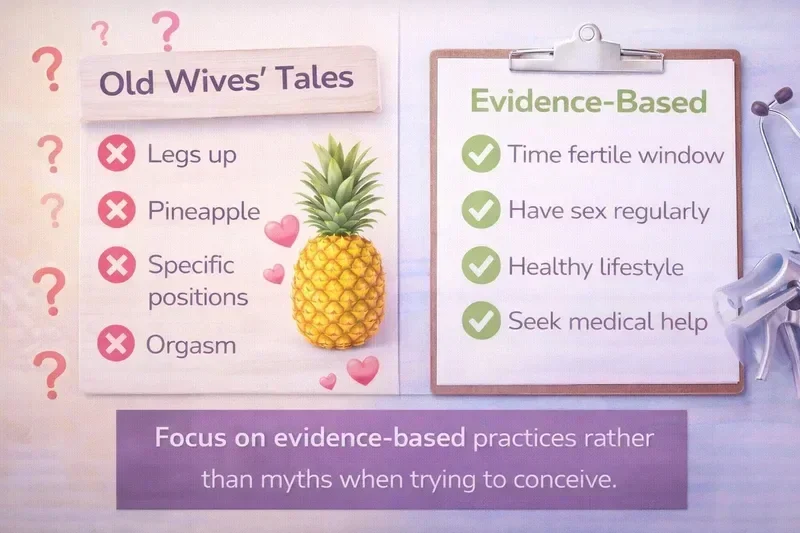
"Put your legs up against the wall for 15 minutes after sex—it helps the sperm swim up!"
"Make sure you orgasm AFTER he does, otherwise your fluid will kill the sperm."
"Eat pineapple core every day after ovulation—bromelain helps implantation."
"Missionary position only! Gravity matters!"
Everyone had a trick, a tip, an old wives' tale they swore worked for their cousin's best friend's sister. And when you're desperate to conceive, you'll try almost anything.
So did I stick my legs up? Absolutely. Did it work? Who knows—I got pregnant eventually, but not because of weird post-sex gymnastics.
Here's what research actually says about the most common TTC old wives' tales, from the harmless to the genuinely unhelpful.
Old Wives' Tale #1: "Put Your Legs Up After Sex"
The Claim: Elevating your legs (or hips) after sex helps sperm "swim uphill" with gravity's assistance, improving your chances of conception.
What the Research Shows:
This is probably the most widespread fertility myth, and it's complete nonsense.
A European study of 500 intrauterine insemination (IUI) patients tested this directly:
- Half the women stayed lying down for 15 minutes after the procedure
- Half got up immediately
- Result: NO difference in pregnancy rates
Why Legs Up Doesn't Work
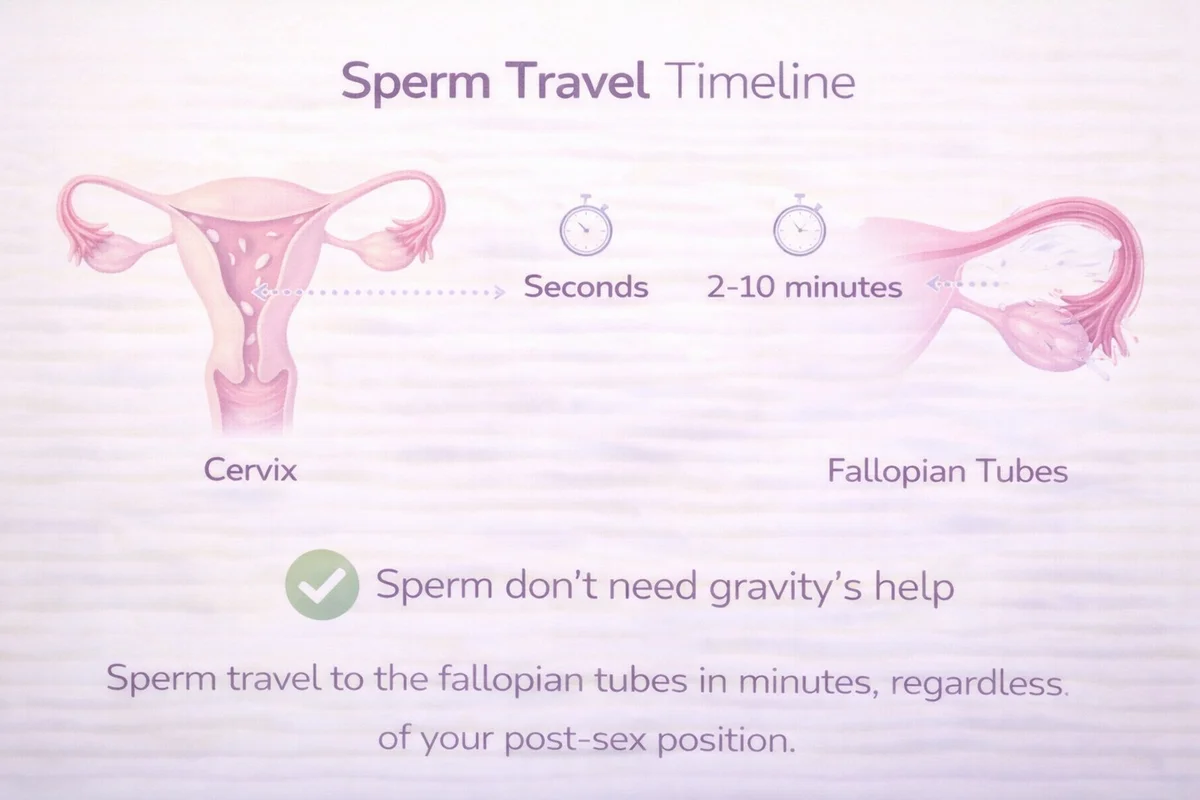
Sperm reach the cervix within seconds of ejaculation, regardless of position. Within 2-10 minutes, sperm can already be found in the fallopian tubes.
Sperm are designed to swim—and swim they do, against gravity if necessary. The female reproductive tract actively transports sperm through uterine contractions that occur naturally, driven by hormones. This process is called "rapid sperm transport," and it happens whether you're lying down, standing up, or doing a handstand.
But Why Does Everyone Still Do It?
Fertility clinics often have IUI patients lie down for 10-15 minutes after the procedure—not because it helps, but because it's tradition and gives patients a moment to rest. This has reinforced the myth that lying down matters.
Dr. Alexandra Gannon, a fertility specialist, confirms: "There's no scientific evidence that elevating your hips or lying down after sex helps sperm reach the cervix."
The Bottom Line:
Want to put your legs up? Go ahead—it won't hurt. But don't feel obligated. Getting up to pee (which helps prevent UTIs) won't wash away your chances of conceiving.
Old Wives' Tale #2: "Certain Sex Positions Work Better"
The Claim: Positions that allow deeper penetration (like missionary or doggy style) get sperm closer to the cervix, improving conception chances.
What the Research Shows:
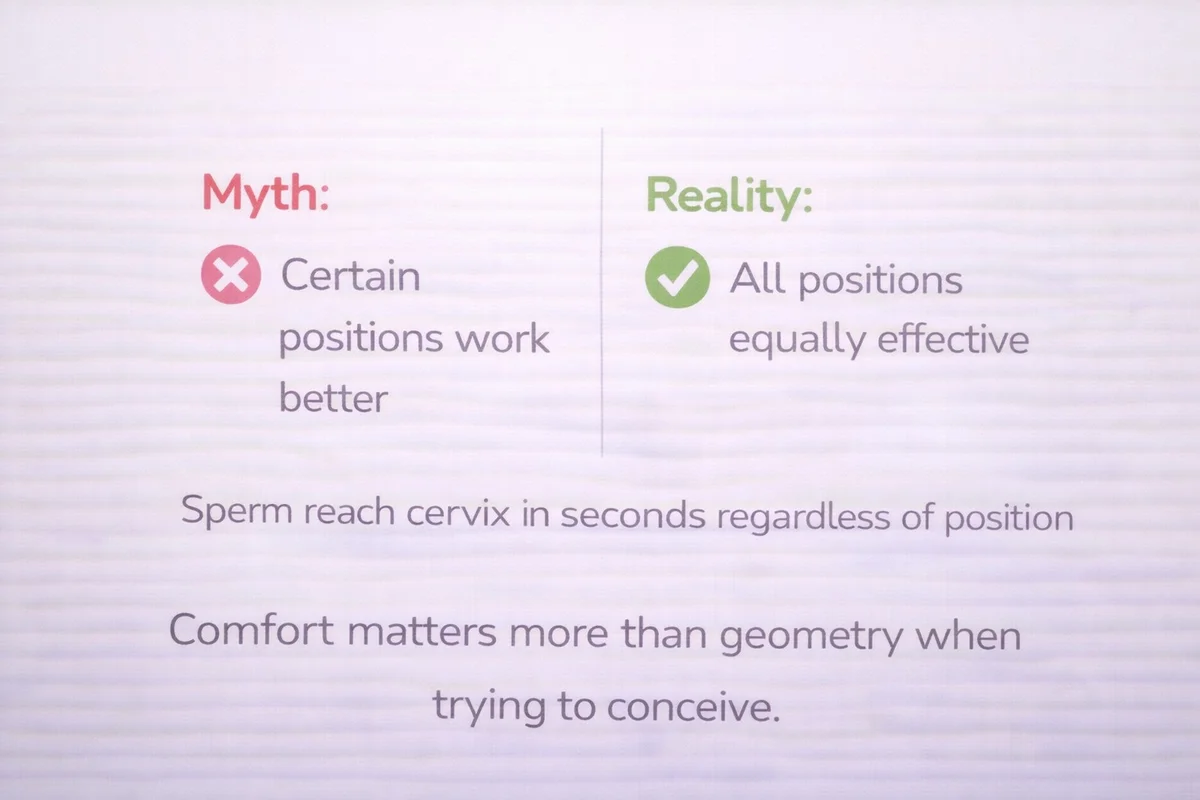
No position has been proven to improve conception odds. You can get pregnant from any position where sperm enters the vagina—including supposedly "gravity-defying" positions like woman-on-top or standing up.
The Logic Seems Sound, But...
Yes, different positions allow different depths of penetration. But this doesn't matter because:
- Sperm arrives at the cervix within seconds, regardless of how far it has to travel initially
- The vaginal canal is only 7-9cm on average—depth differences are minimal
- Sperm actively swim toward the egg; they're not passively drifting
Research shows: "Sperm arrives at the cervix within seconds of ejaculation, no matter which position you're in."
The Bottom Line:
Use whatever position feels comfortable and enjoyable for both partners. The stress of trying uncomfortable positions is more likely to harm your chances (by making sex feel like a chore) than help them.
Old Wives' Tale #3: "You Need to Orgasm"
The Claim: Female orgasm creates uterine contractions that "suck" sperm toward the egg, improving conception chances. Bonus claim: orgasming BEFORE his ejaculation will kill sperm with vaginal fluids.
What the Research Shows:
No relationship has been found between female orgasm and fertility. Many, many women conceive without experiencing orgasm during the conception act.
The "Upsuck Theory"
In the 1900s, scientists proposed that uterine contractions during orgasm propel sperm toward the fallopian tubes. This became known as the "upsuck hypothesis."
Modern research has thoroughly debunked this:
- A study of over 16,000 women found NO correlation between female orgasms and fertility
- Researchers now call upsuck theory a "zombie hypothesis"—"a dead idea that refuses to lie down"
The Timing Myth
The claim that orgasming before his ejaculation "kills sperm" with vaginal fluid is pure fiction. There's no evidence for this whatsoever.
What Orgasm CAN Do
While orgasm doesn't directly improve conception, it can help by:
- Reducing stress hormones
- Releasing oxytocin (bonding hormone)
- Making the whole process more enjoyable (so you're more likely to have sex during your fertile window)
The Bottom Line:
Enjoy sex, orgasm or don't—it makes no difference to conception. What matters is having sex during your fertile window, not whether you climax.
Old Wives' Tale #4: "Eat Pineapple Core for Implantation"
The Claim: Eating pineapple core (specifically the core) daily after ovulation or embryo transfer helps implantation because bromelain (an enzyme in pineapple) reduces inflammation and improves blood flow to the uterus.
What the Research Shows:
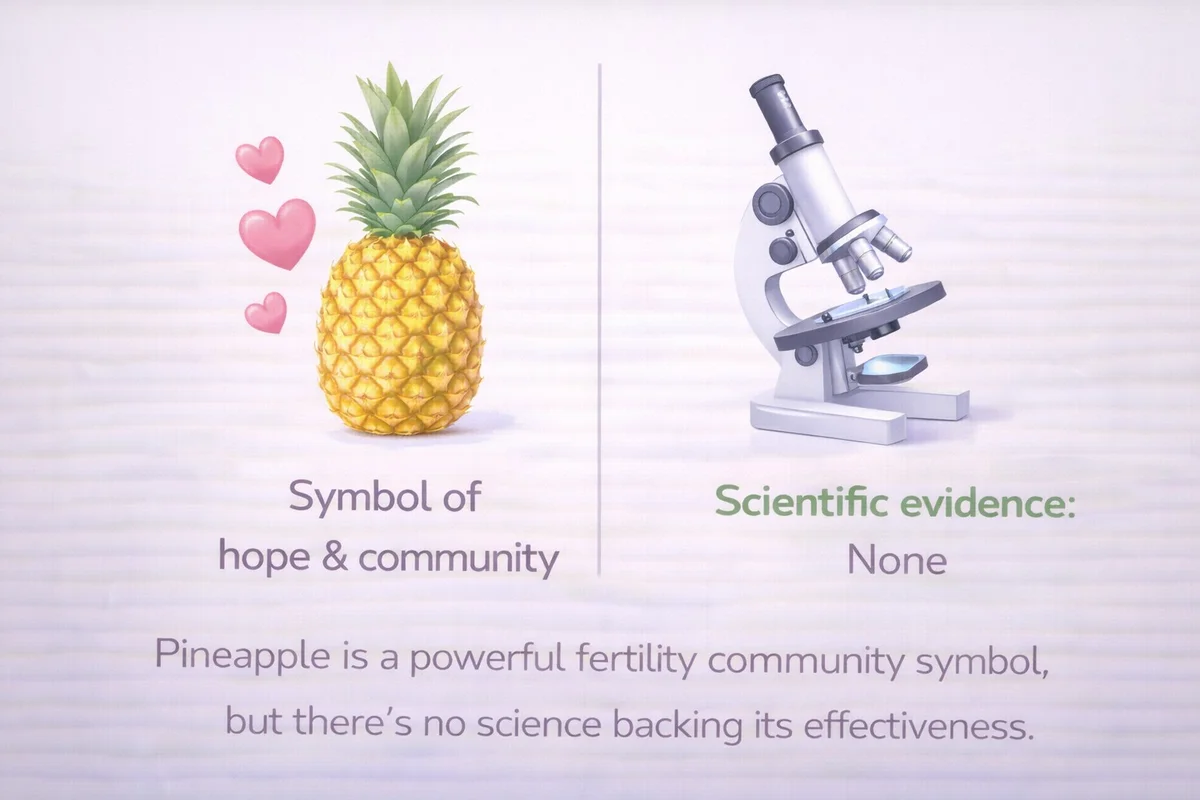
There is NO scientific evidence that pineapple consumption improves fertility or helps implantation.
The Bromelain Theory
Pineapple core contains bromelain, an enzyme with anti-inflammatory properties. The logic:
- Inflammation might interfere with implantation
- Bromelain reduces inflammation
- Therefore, pineapple helps implantation
The problem? This connection has never been proven in studies. Dr. Tomer Singer, a reproductive endocrinologist, states: "There's no evidence in the literature that says consuming pineapple prior to an embryo transfer will improve implantation."
Why Pineapple Became a Symbol
Despite lack of evidence, pineapple has become the unofficial symbol of the fertility community. You'll see it on:
- Fertility socks
- Jewelry
- T-shirts
- Social media profiles
The New York Times even featured "How the Pineapple Became the Icon of IVF."
It represents hope, community, and shared struggle—which is valuable, even if the fruit itself doesn't boost fertility.
The Bottom Line:
Pineapple is healthy (vitamin C!), and if eating it makes you feel hopeful or connected to the fertility community, enjoy it. Just don't expect it to improve your chances of conceiving. And definitely don't force yourself to eat pineapple core if you find it unpleasant—it won't make a difference.
Old Wives' Tale #5: "Eat McDonald's Fries After Embryo Transfer"
The Claim: Eating salty foods (specifically McDonald's fries) after IVF embryo transfer helps prevent ovarian hyperstimulation syndrome (OHSS) and improves implantation.
What the Research Shows:
This one has a grain of truth buried under mythology.
The Origin Story
Some fertility doctors DO recommend salty foods after egg retrieval for women at risk of OHSS—a complication where ovaries become swollen and painful. Salt helps the body retain fluids, which can reduce OHSS symptoms.
But this advice:
- Applies to egg RETRIEVAL, not embryo transfer
- Only helps women at risk of OHSS
- Doesn't require McDonald's specifically—any salty food works
The myth morphed from "some women need salt after retrieval" to "everyone should eat McDonald's after transfer."
Does It Hurt?
No, eating fries won't harm your chances. But as one fertility specialist notes: "It's just an old wives' tale, but this can be a highly stressful procedure, so go ahead and eat comfort food if it makes you feel better."
The Bottom Line:
If you want McDonald's fries after your embryo transfer, enjoy them. Just know they're not medically beneficial—they're comfort food, which has its own value during a stressful time.
Old Wives' Tale #6: "Avoid Orgasms/Sex During the Two-Week Wait"
The Claim: Having orgasms or sex during the two-week wait (between ovulation/embryo transfer and pregnancy test) will dislodge the embryo or prevent implantation.
What the Research Shows:
There is NO evidence that orgasm can dislodge an embryo or prevent implantation.
Why This Myth Persists
Orgasm causes uterine contractions, which sounds scary when you're trying to get an embryo to implant. But:
- These contractions are mild and temporary
- The uterus is a robust, well-protected organ
- If orgasm could dislodge embryos, labour contractions (which are FAR stronger) would cause infertility
Medical experts confirm: "The likelihood of an orgasm causing a miscarriage or dislodging an embryo is extremely low."
The Bottom Line:
Unless your doctor has given you specific bed rest instructions, sex and orgasms are safe during the two-week wait. In fact, reducing stress and maintaining intimacy might help more than abstaining.
What ACTUALLY Helps When TTC?
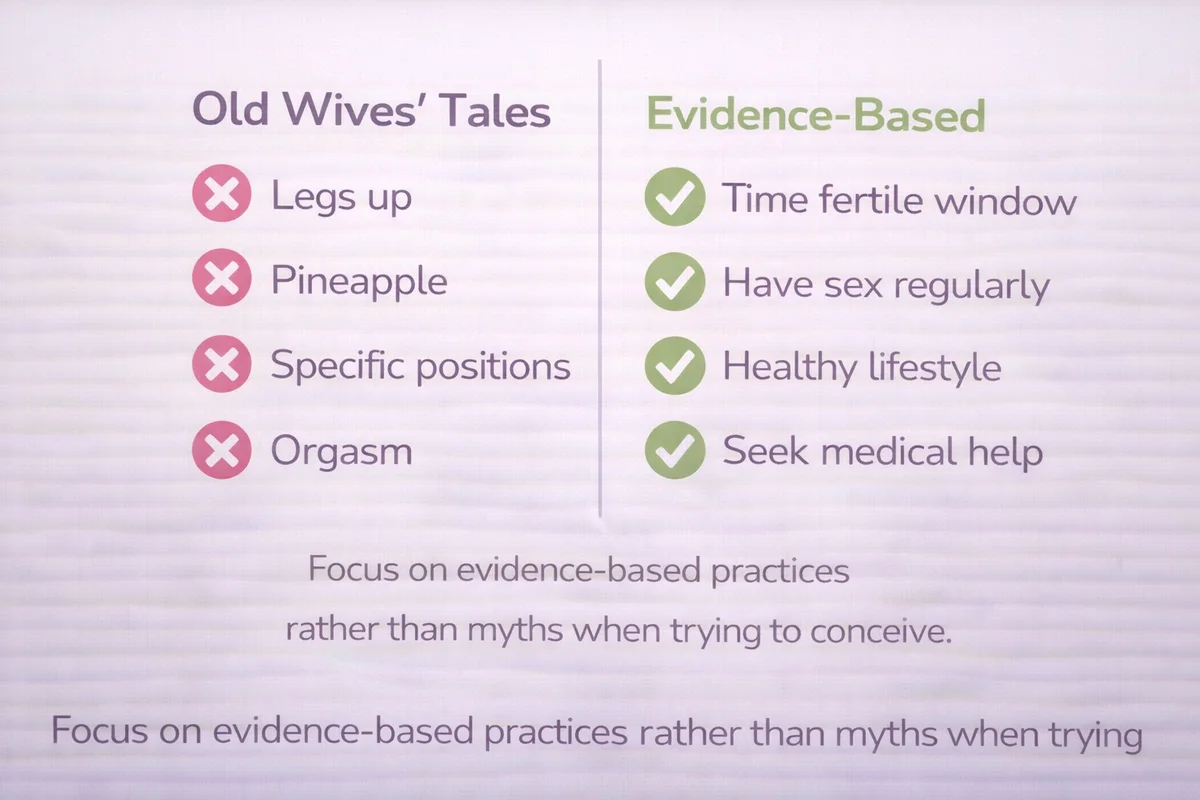
Instead of legs-up routines and pineapple cores, focus on factors with actual evidence:
1. Time Intercourse to Your Fertile Window
Your fertile window is the 5 days before ovulation plus ovulation day. Pregnancy rates are highest (around 38%) when sex occurs during peak cervical mucus days.
How to identify your fertile window:
- Track cervical mucus (clear and slippery = fertile)
- Use ovulation predictor kits
- Track basal body temperature
- Use a period tracking app
2. Have Regular Sex
Contrary to the "save it up" myth, frequent ejaculation improves sperm quality. The American Society for Reproductive Medicine recommends sex every 1-2 days during the fertile window.
3. Maintain Overall Health
For both partners:
- Maintain healthy weight (BMI 20-25 ideal)
- Don't smoke
- Limit alcohol
- Reduce stress where possible
- Take prenatal vitamins (folic acid for women)
- Get adequate sleep
For men specifically:
- Keep testicles cool (avoid hot tubs, laptops on lap)
- Wear looser underwear if sperm quality is borderline
4. Seek Help at the Right Time
See your GP if:
- Trying for 12 months without success (if you're under 35)
- Trying for 6 months without success (if you're 35+)
- You have irregular periods or known fertility issues
The Psychology of Old Wives' Tales
So why do these myths persist when there's no evidence?
1. The Need for Control
Trying to conceive can feel powerless. These rituals give couples something to DO—a sense of control over an unpredictable process.
2. Confirmation Bias
When someone gets pregnant after eating pineapple or putting their legs up, they credit the ritual—ignoring the thousands who did the same thing and didn't conceive.
3. Community and Hope
Shared rituals (like pineapple symbolism) create connection among people going through fertility struggles. That emotional support has real value, even if the ritual itself doesn't.
As one fertility specialist wisely noted: "I'm not one to discourage patients from trying something if there is no harm to it and it's not extremely expensive. Whatever can make the journey feel a little bit less stressful and more manageable, I'm all for that."
My Take: Harmless Rituals vs Harmful Myths
After researching all this, here's my position:
Harmless rituals I support:
- Putting your legs up if it makes you feel better
- Eating pineapple if you like it
- Wearing lucky socks to appointments
- Any ritual that reduces your stress without harming your health or wallet
Harmful myths to avoid:
- Thinking your inability to conceive is because you're "not doing it right"
- Spending money on expensive "fertility" foods or supplements without evidence
- Avoiding sex/orgasms during the two-week wait
- Delaying medical help because you're still trying different positions or foods
The Real Story
Here's what actually happened with us: We tried for several months. I did all the things—legs up, ate pineapple, tracked ovulation obsessively, worried about positions.
Then one month, we went on holiday. Didn't think about any of it. Had sex when we felt like it, in whatever position felt good, got up immediately after because we were in a hotel and wanted to shower.
Pregnant.
Did the relaxed approach help? Who knows. More likely, we just hit the right timing by chance. That's how conception works most of the time—you're fertile for 5-6 days a month, you have sex during that window, and either it works or it doesn't.
The pineapple, the legs up, the "perfect" position—none of it mattered.
The Bottom Line
- Legs up after sex: Doesn't help, won't hurt
- Sex positions: Any position works—use what's comfortable
- Female orgasm: Not necessary for conception
- Pineapple core: No evidence it helps implantation
- McDonald's fries: Comfort food, not fertility treatment
- Avoiding sex during two-week wait: Unnecessary
What actually matters:
- Having sex during your fertile window (5 days before and day of ovulation)
- Regular sex (every 1-2 days during fertile window)
- Overall health for both partners
- Seeking medical help if you've been trying for 12 months (or 6 months if 35+)
Do the rituals if they bring you comfort or hope. But don't waste energy worrying whether you're "doing it right." The evidence is clear: legs up or legs down, pineapple or no pineapple, orgasm or no orgasm—none of it significantly affects your chances of conceiving.
What matters most is timing, overall health, and getting help if you need it.
Disclaimer: This information is based on peer-reviewed studies and medical guidance, but isn't medical advice. If you have concerns about fertility, speak to your GP or a fertility specialist.