

Nobody gives you a manual for birth. But writing a birth plan is the closest thing to preparing for something you cannot fully predict. It is not about controlling labour — because you cannot. It is about making sure the people looking after you know what matters to you, so they can support you as well as possible.
I wish I had taken it more seriously. Mine was a few lines scribbled at 37 weeks because the midwife had asked if I had one. It did not cover what should happen if things changed. It did not mention how I felt about certain interventions. And when the birth did not go to plan, nobody had a clear sense of what I actually wanted — including me.
If I did it again, I would start earlier, think about more scenarios, and treat the plan as a conversation rather than a form to fill in.
Quick answer: A birth plan is a record of your preferences for labour, birth, and the time afterwards. According to the NHS, it helps your maternity team understand what you want, and you can change your mind at any time. NICE guideline NG235 recommends that preferences and choices for labour and birth should be discussed and recorded as early as possible in pregnancy. Under UK law, your consent is required for every procedure — your birth plan is an expression of that right.
What Is a Birth Plan?
A birth plan is a written record of what you would like to happen during your labour, birth, and the time immediately afterwards. According to the NHS, it helps your maternity team understand your priorities and gives you the chance to think through your options in advance.
According to Tommy's, you do not need a special form — a few bullet points on a piece of paper works. Or you can download the NHS birth plan template and fill it in. What matters is not the format but the thinking behind it.
NICE guideline NG235 on intrapartum care emphasises that women should be free to make their decisions and change their mind at any time, including during labour. Recording your preferences in advance simply means you have more time to think about your options before you are in the middle of contractions.
When Should You Write It?
Your midwife will usually discuss your birth preferences with you at around 34 to 36 weeks. But it is worth starting to think about it earlier — perhaps from around 28 to 32 weeks — so you have time to ask questions, do some reading, and talk things through with your partner.
The NCT notes that the midwife reading your birth plan during labour is unlikely to be someone who knows you. Therefore, everything important should be written down, even if you have already discussed it verbally with your community midwife during pregnancy.
What to Include
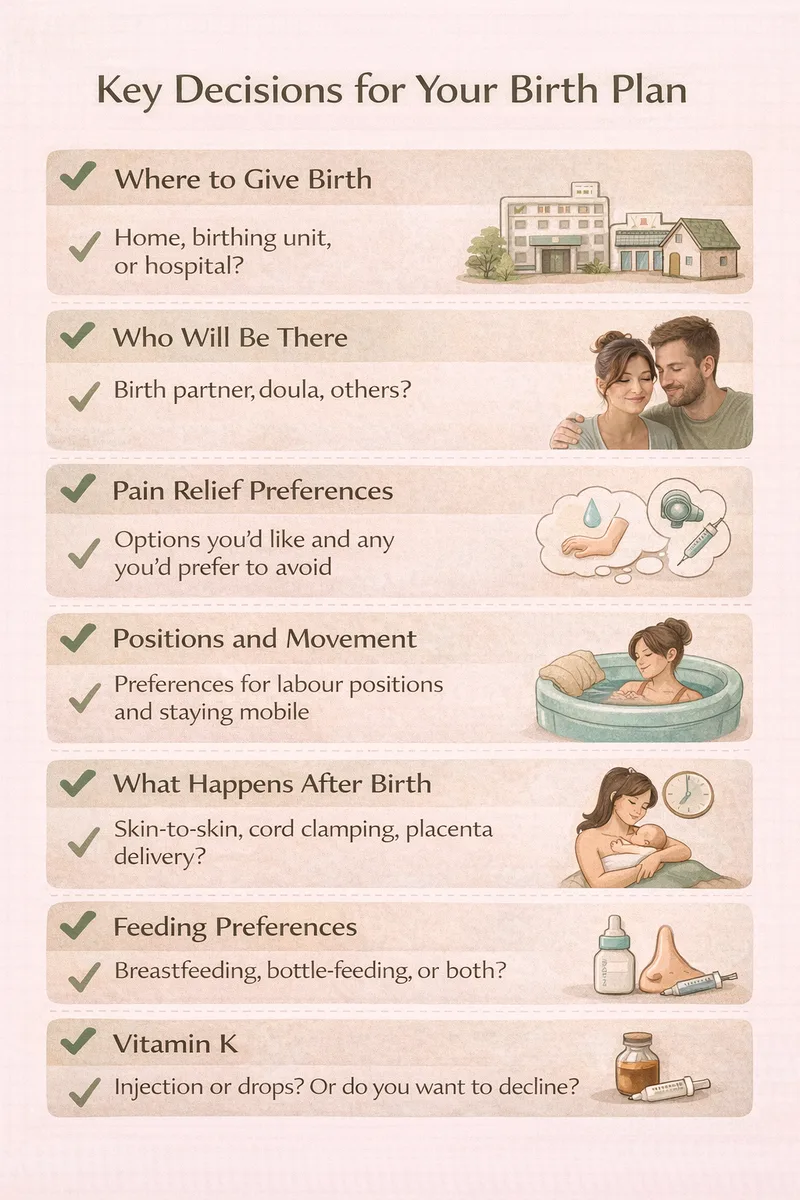
There is no right or wrong birth plan. It depends on what matters to you, your medical history, and what is available at your maternity unit. But here are the key areas to think about.
Where You Want to Give Birth
According to the NHS, your options may include home, a freestanding midwifery unit, an alongside midwifery unit, or a hospital obstetric unit. NICE recommends that all four settings should be available to women, though what is offered locally may vary. Your midwife can explain the options near you and help you choose the setting that feels right.
Who You Want With You
Think about who you want as your birth partner — this could be your partner, a family member, a friend, or a doula. The NHS also asks you to consider whether you would want someone with you if you needed a forceps or vacuum delivery, or if a caesarean became necessary.
Pain Relief
This is one of the most important parts of the plan — and it is an area where NICE guidance has recently been updated. Think about which types of pain relief you would like to try, which you would prefer to avoid, and at what point you would want them offered.
According to NICE guideline NG235, the following options should be available or discussed:
Non-pharmacological options — breathing techniques, water (bath or pool), TENS machine, movement and position changes. These are available in all birth settings.
Sterile water injections — a newer recommendation in NG235. These involve small injections of sterile water into the lower back and may help with back pain during labour. They are not yet available everywhere, but you can ask whether your unit offers them.
Gas and air (Entonox) — widely available in all settings. You control when you use it.
Opioids (pethidine, diamorphine) — available in all birth settings but provide limited pain relief according to NICE, and may cause side effects for both you and your baby including drowsiness and difficulty breastfeeding.
Remifentanil patient-controlled analgesia (PCA) — this is a significant new recommendation in NG235. It is a short-acting opioid delivered through a drip that you control yourself. According to NICE, compared with pethidine, women using remifentanil PCA are less likely to need an epidural or an assisted delivery, and are more likely to have a spontaneous vaginal birth. It requires one-to-one midwife care and continuous monitoring, and is only available in obstetric units. Not all hospitals offer it yet — include it in your plan if it is something you would like to explore, and ask your midwife whether it is available at your unit.
Epidural — available only in obstetric units. According to NICE, epidural provides more effective pain relief than opioids. It is not associated with an increased chance of caesarean birth, but is associated with a longer second stage and an increased chance of assisted delivery. NG235 also now recommends programmed intermittent epidural bolus as a maintenance technique, which may provide more even pain relief than a continuous infusion.
According to the NHS, it is worth thinking about your preferences but also being open to changing your mind — many women find that what they want in labour is different from what they expected. NICE is clear: if a woman requests regional analgesia, her decision should be supported.
Positions and Movement
Think about whether you want to be encouraged to stay mobile and upright, whether you would like to use a birthing pool, and whether you have preferences about positions for pushing. You do not need to commit to specific positions in advance — but including a note that says "I would like to be encouraged to move and try different positions" tells the midwife that this matters to you.
The Environment
Small things can make a big difference: dimmed lighting, your own music, minimal interruptions, keeping the number of people in the room low. If the hospital is a teaching hospital, the NHS asks whether you are happy for student midwives, nurses, or doctors to be present during your labour. You can say no.
Perineal Care During Birth
This is an area that many birth plans overlook, but NICE guideline NG235 now includes specific recommendations that you can ask for. NICE recommends that once the baby's head is stretching the perineum in the second stage of labour, you should be offered a warm wet compress applied to the perineum and continued until birth. Evidence reviewed by NICE found that warm compresses may help reduce the risk of serious perineal tears.
NICE also recommends that perineal massage with a water-soluble lubricant during the second stage should be considered, if this is acceptable to you and you prefer it to a warm compress.
You can include your preferences for perineal care in your birth plan. For example: "I would like to be offered warm compresses during the second stage" or "I would prefer perineal massage with lubricant during pushing." Your midwife can discuss these options with you in advance so you understand what is involved.
After the Birth
Think about what you want to happen immediately after your baby is born. According to Tommy's, things to consider include whether you want immediate skin-to-skin contact with your baby, whether you want delayed cord clamping — where the umbilical cord is not cut for at least one to five minutes after birth, allowing blood to continue flowing to your baby, and how you want the third stage of labour (delivery of the placenta) to be managed — either actively with an injection or physiologically without medication.
Feeding
Include your preferences for feeding — whether you plan to breastfeed, bottle-feed, or combination-feed. If you plan to breastfeed, you may want to note that you would like support from a midwife or lactation consultant in the early hours after birth.
Vitamin K
Your baby will be offered vitamin K after birth to help with blood clotting. According to the NHS, this is usually given as an injection, but can also be given by mouth if you prefer — though the oral route requires additional doses. You can include your preference in your birth plan.
Your Rights: Consent, Autonomy, and Being Heard
A birth plan is not just a wish list — it is grounded in your legal right to make decisions about your own body. Understanding this can help you feel more confident about expressing your preferences and, if necessary, declining care you do not want.
According to Birthrights, a UK charity dedicated to human rights in maternity care, every person has the right to bodily autonomy during pregnancy and birth. This means that no medical examination or procedure can be carried out without your consent. This right is protected under Article 8 of the European Convention on Human Rights and by UK common law. It applies even during labour, and even in an emergency.
Birthrights explains that consent means you must understand what the treatment is, what the risks and benefits are, what the alternatives are, and what will happen if you accept or decline. You do not have to consent. You do not have to explain why. And you can withdraw consent at any time.
This was reinforced by the landmark Montgomery v Lanarkshire Health Board ruling in 2015, which confirmed that healthcare professionals have a legal duty to disclose any risks that a reasonable patient would consider significant — not just the risks the professional thinks are important.
NICE guideline NG235 reflects this in its clinical recommendations. It states that all birth settings should have a culture of respect for each woman as an individual, that women should be empowered to make supported decisions, and that consent must be obtained before carrying out any care option or intervention.
What this means for your birth plan: Your preferences are not just nice-to-haves. They are an expression of your legal right to make informed decisions about your own care. If something in your plan is declined or overridden, you are entitled to an explanation, a discussion of alternatives, and the opportunity to make a new decision. If you feel your choices are not being respected during labour, the NCT suggests asking: "Am I in immediate danger? Is my baby in immediate danger?" — this starts a conversation about the actual level of risk and how urgently a decision is needed.
Recent UK maternity investigations — including the Ockenden Review into failings at the Shrewsbury and Telford Hospital NHS Trust — have highlighted the consequences of a maternity culture that does not listen to women or respect their decisions. The advocacy work of organisations like Birthrights, AIMS, and the Maternal Mental Health Alliance continues to push for maternity care that centres women's voices, informed consent, and dignity.
You do not need to be an expert in human rights law to benefit from this. You just need to know three things: your consent is required for every procedure, you can say no at any time, and your maternity team should support your decisions even when they differ from standard recommendations.
The "What If" Sections
This is the part most birth plans miss — and the part that matters most when things do not go to plan.
Tommy's advises that you should be prepared for things not going as you had hoped. Rather than treating the birth plan as a fixed script, think about what your preferences would be if circumstances change.
What if I need to be induced? Would you still want to try certain pain relief methods? Would you want your birth partner with you throughout?
What if I need an assisted delivery (forceps or ventouse)? Who do you want in the room? Do you want to be talked through what is happening?
What if I need an emergency caesarean? Do you still want your birth partner present? Would you like skin-to-skin as soon as it is safe? Do you want to be told what is happening as it happens?
What if the baby needs to go to special care? Would you want your partner to go with the baby? Would you want to express colostrum as soon as possible?
These scenarios are not pessimistic — they are practical. Having thought about them in advance means that if something unexpected happens, your maternity team still knows what matters to you.
What Your Birth Partner Should Know
Your birth partner should read the birth plan and understand it. During labour, you may not be able to articulate your preferences clearly, and your partner may need to advocate on your behalf.
Make sure they know what pain relief you want to try first, what you feel strongly about, what the "what if" preferences are, and that they can speak to the midwife on your behalf if you are unable to. The NCT notes that the birth partner may also be the person who fetches items from the hospital bag, so they should know where everything is.
What About When Things Change?
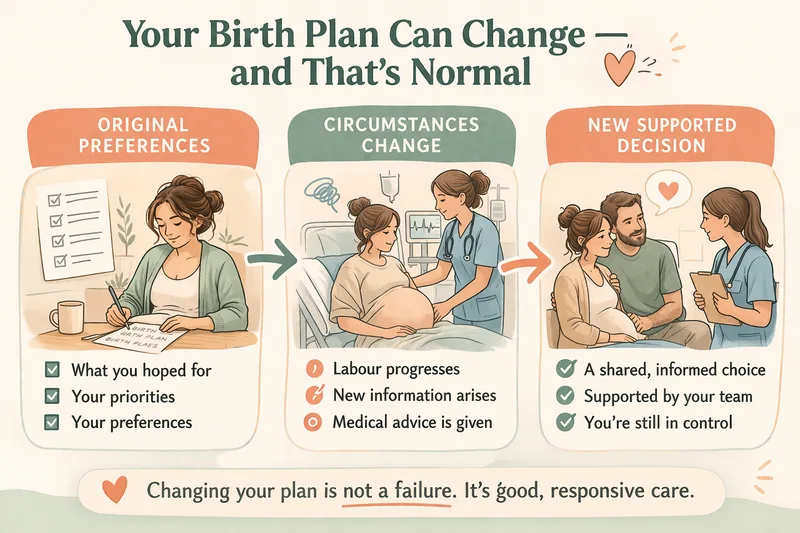
Plans change. Labour is unpredictable. The pool might be occupied. The epidural might be needed earlier than you expected. The birth might not happen in the setting you planned.
NICE is clear: women are free to make their decisions and change their mind at any time, including during labour. A birth plan is not a contract — it is a starting point. If circumstances change, your maternity team will discuss the options with you, explain what they recommend and why, and support you in making a new decision.
Some women feel guilty or disappointed when their birth does not go to plan. According to Tommy's, this is understandable — but changing your plans to keep you and your baby safe is not a failure. It is good care.
Practical Tips
Keep it short and clear. The midwife reading your plan during labour needs to absorb it quickly. A few bullet points under clear headings works better than a three-page essay.
Use positive language. "I would like to try water for pain relief before considering other options" is clearer and more helpful than "I do not want drugs."
Include the "what if" preferences. These are often more useful than the ideal-scenario preferences.
Print a few copies. Put one in your hospital bag, give one to your birth partner, and keep one in your maternity notes.
Discuss it with your midwife. Your midwife can help you understand which options are available at your unit and whether any of your preferences need adjusting based on your medical history.
Revisit and update it. Circumstances can change during pregnancy. Review your plan at around 36 weeks and make any adjustments.
Frequently Asked Questions
Do I have to have a birth plan? No. It is completely optional. But the process of thinking through your preferences — even if you do not write them down — can help you feel more prepared and more in control.
Can I change my birth plan during labour? Yes. NICE states that women are free to change their mind at any time. Your plan is a guide, not a commitment.
What if my birth partner cannot be there? Make sure a second person knows your preferences, or give a copy of your plan to the midwife as soon as you arrive. Your plan speaks for you when you cannot.
Should I include preferences for a caesarean? Yes, even if you are not planning one. Around 1 in 4 UK births are by caesarean, and having preferences recorded for that scenario means you still have a voice if it happens.
Where can I find an NHS birth plan template? You can download the official NHS birth plan template as a Word document and fill it in.
Can I ask for warm compresses or perineal massage during birth? Yes. NICE guideline NG235 recommends that warm compresses should be offered during the second stage of labour, and perineal massage with lubricant should be considered if you prefer it. Include your preference in your birth plan.
What if I feel my choices are not being respected during labour? You have the legal right to make decisions about your own body, including during labour. Birthrights advises that you can ask for an explanation, request a different member of staff, or ask your birth partner to advocate on your behalf. If you feel your rights have been violated, you can contact Birthrights for advice after the birth.
The Bottom Line
A birth plan is not about controlling birth. It is about making sure the people supporting you know what you want, what you care about, and how to help you make decisions when the time comes.
The best birth plans are short, clear, honest, and flexible. They cover the ideal scenario and the "what if" scenarios. They are discussed with your midwife and understood by your birth partner. And they leave room for things to change — because they often do.
Write it early. Talk about it together. And remember: the plan is not the point. The point is that you feel heard, supported, and in control of your own experience — whatever happens.
This article is for general information only and does not replace advice from your midwife or maternity team. Your midwife can help you write a birth plan that reflects your preferences and your individual circumstances.
This article was written in April 2026. We regularly review our content against the latest NHS and NICE guidelines to help ensure accuracy. This article references NHS: How to Make a Birth Plan, NHS Start for Life: What to Include in Your Birth Plan, Tommy's: Making Your Birth Plan, NCT: Writing a Birth or Postnatal Plan, NICE guideline NG235: Intrapartum Care (published September 2023, updated November 2025), Birthrights: Human Rights in Maternity Care, Birthrights: Consenting to Treatment, NCT: Maternity Rights and Informed Decision Making, and AIMS: Human Rights Law. If you have questions about your birth plan or your rights during maternity care, please speak to your midwife or contact Birthrights for further support.