

You are 40 weeks and 3 days. Everyone you have ever met has texted to ask if there is "any news yet." Your mum has suggested a long walk. Your friend swears by a vindaloo. Someone on a forum has told you to eat seven pineapples. And your partner is looking at you with a hopeful expression that you really do not have the energy for.
The desire to get things moving at the end of pregnancy is completely understandable. But how much of what you have heard is actually supported by evidence — and how much is wishful thinking?
I was five days overdue and getting increasingly frustrated. I tried raspberry leaf tea, a long walk, and a hot curry on the same evening. I did not go into labour. I did get terrible heartburn and sore feet. Our baby arrived four days later, entirely on their own schedule.
Quick answer: There are no proven natural methods that reliably start labour. According to Tommy's, there are theories about how to encourage labour naturally, but not enough scientific evidence to prove that any of them work. The methods with the most research behind them are nipple stimulation and eating dates — though neither is guaranteed.
The Honest Truth
No food, drink, exercise, or activity has been reliably proven to start labour. The reason you hear so many stories of women going into labour after eating curry or having sex is simple: at 40+ weeks, labour can start at any time. If you eat a curry on Tuesday and go into labour on Wednesday, you credit the curry — but you were probably going to go into labour anyway.
According to Tommy's, there are theories about how to get labour going naturally, but there is not enough scientific evidence to prove that any of them work. That does not mean they are all harmful — most are harmless. But it does mean you should manage your expectations.
Method by Method: What Does the Evidence Say?
Eating Dates
This is one of the few methods with genuine clinical research behind it. A study published in the Journal of Obstetrics and Gynaecology (Al-Kuran et al., 2011) found that women who consumed six dates per day for four weeks before their due date had significantly higher cervical dilation on admission, a higher rate of spontaneous labour (96% vs 79%), and less need for synthetic oxytocin during labour. The mean latent phase of labour was also shorter in the date-eating group.
A more recent systematic review and meta-analysis in BMC Pregnancy and Childbirth (2024), which included 48 studies, confirmed that date consumption in late pregnancy significantly shortened labour, reduced the need for induction, and increased cervical dilation on admission.
However, it is important to be honest about the limitations. Many of the studies are small, and the overall quality of the evidence is still developing. Eating dates is safe, nutritious, and inexpensive — and the research is more promising than for any other food-based method. But it is not a guarantee.
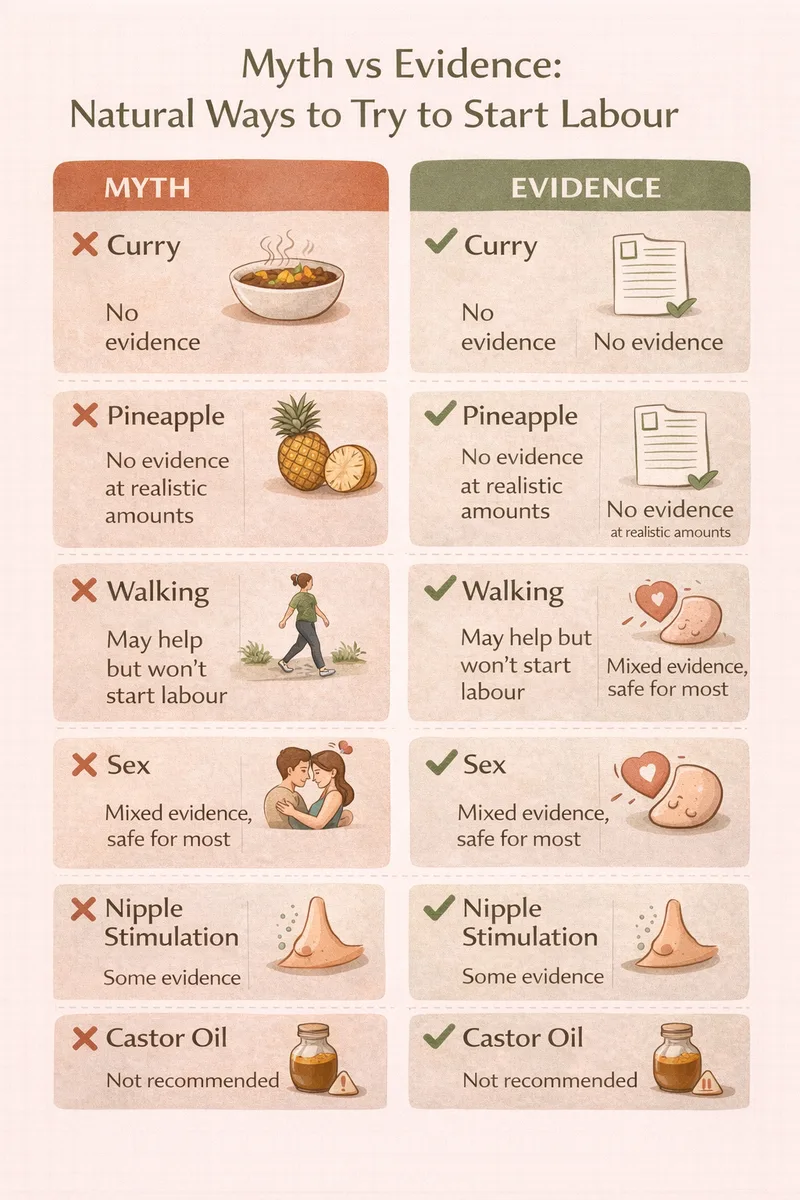
Nipple Stimulation
This is the other method with some research behind it. Gentle nipple stimulation encourages the body to release oxytocin — the hormone that triggers contractions. According to the NCT, research shows that breast stimulation — typically one breast at a time for one to three hours daily — may increase the number of women who go into labour within 72 hours. However, it should only be tried at term (from 37 weeks), and ideally after discussion with your midwife.
Spicy Food / Curry
The theory is that a spicy curry can stimulate the gut, which may in turn stimulate the uterus. According to Tommy's, there is no proof that this works. If you enjoy spicy food, there is no harm in having a curry — but if you have been struggling with heartburn or indigestion, which are common in late pregnancy, it may make things worse rather than better.
Pineapple
Pineapple contains an enzyme called bromelain, which has been linked in theory to softening the cervix. However, according to Tommy's, there is no real evidence that eating pineapple helps at all. You would need to eat an enormous amount to get any meaningful dose of bromelain, and doing so is more likely to give you an upset stomach than a baby.
Walking
Staying active in late pregnancy is generally a good thing — it can help with mood, fitness, and may help the baby move into a good position in the pelvis. But according to the NCT, there is no strong evidence that walking can start labour. It is worth doing for your own wellbeing, but do not exhaust yourself expecting contractions to begin.
Sex
Semen contains prostaglandins — the same type of hormones used in medical inductions to soften the cervix. Orgasm can also cause mild uterine contractions. In theory, this sounds promising. In practice, according to Tommy's, there is no clear evidence that sex brings on labour. If you are having a straightforward pregnancy and want to give it a try, sex is safe and will not harm the baby. However, you should avoid sex if your waters have broken, as this can increase the risk of infection.
Raspberry Leaf Tea
Raspberry leaf tea is a traditional remedy widely used in late pregnancy. According to the NCT, it is believed to tone the uterine muscles, potentially making contractions more effective — but the small amount of research that exists suggests it may help shorten labour rather than start it. It is not a labour induction method.
Tommy's notes that experts are still unsure whether raspberry leaf works or how safe it is in pregnancy, and advises speaking to a health professional before using it. You should not take raspberry leaf tea or tablets if you have had a caesarean section within the last two years, have any medical conditions such as epilepsy, heart problems, or blood clotting disorders, or if your midwife has advised against it for any other reason.
Castor Oil
According to Tommy's, castor oil is not recommended by health professionals. While there is some evidence it may have an effect, it is a powerful laxative that can cause nausea, vomiting, and high blood pressure. The last thing you want as you approach labour is dehydration from severe diarrhoea. Avoid it.
Evening Primrose Oil and Herbal Remedies
According to Tommy's, it is best not to take evening primrose oil during pregnancy, as there is not enough evidence that it is safe or effective. The same applies to other herbal remedies such as clary sage — always speak to your midwife before using any herbal products in late pregnancy.
What Is Actually Offered by the NHS?
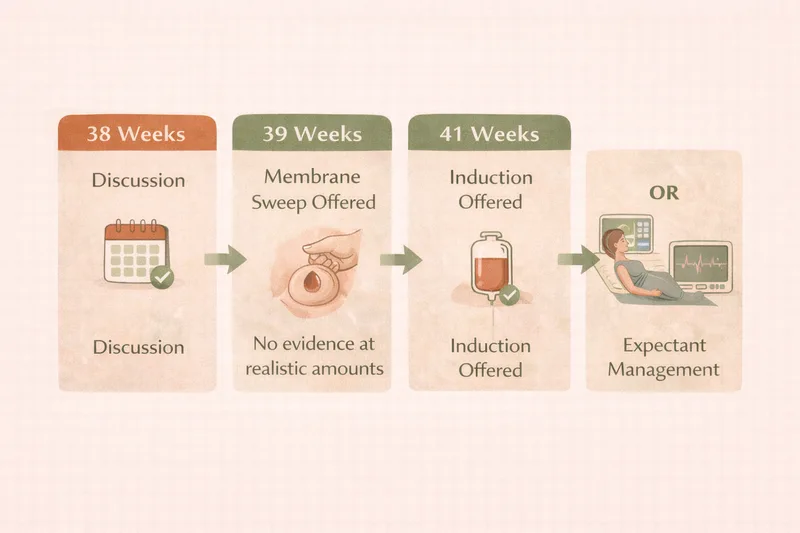
If your pregnancy goes past your due date, there is a clear pathway of care.
From 38 weeks: Your midwife will start discussing what happens if labour does not start naturally. According to NICE guideline NG207, women should be given information and time to discuss their options with partners and families before making any decisions.
From 39 weeks: You will usually be offered a membrane sweep at your antenatal appointment. This is a procedure where the midwife sweeps a finger around the cervix to try to encourage the release of prostaglandins and start labour naturally. Additional sweeps can be offered if the first one does not work. We have a full guide to membrane sweeps in a separate article.
From 41 weeks: You will usually be offered an induction. NICE recommends that induction should be offered from 41 weeks, as the risk of stillbirth increases after this point.
If you choose not to be induced: You always have the right to decline. If you choose not to be induced, you will be offered expectant management — a structured pathway where your pregnancy is allowed to continue naturally, supported by increased monitoring of your baby's wellbeing. This typically involves more frequent hospital appointments with cardiotocography (CTG) monitoring. Your maternity team will discuss the benefits and risks with you so you can make the decision that is right for your situation.
What You Should Avoid
Some methods are not just unproven — they may be harmful.
Castor oil — not recommended due to the risk of nausea, vomiting, and dehydration.
Herbal supplements without medical advice — some herbal products can interact with medications or have unknown effects during pregnancy. Always speak to your midwife before taking anything.
Trying to induce labour before 37 weeks — your baby's lungs and brain are still developing. Do not attempt any induction method before term without medical guidance.
Any method that causes you significant discomfort or distress — if something does not feel right, stop. Your body and your instincts matter.
Frequently Asked Questions
Does walking induce labour? There is no strong evidence that walking will start labour. However, staying active and upright may help the baby settle into the pelvis and can support your overall wellbeing in late pregnancy.
Can eating dates help start labour? Several clinical studies suggest that eating six dates per day in the last four weeks of pregnancy may help the cervix ripen, reduce the need for induction, and shorten the first stage of labour. The evidence is promising but still developing, and dates are not guaranteed to work.
Is it safe to eat pineapple to bring on labour? Yes, eating a normal amount of pineapple is perfectly safe, but there is no evidence it actually induces labour. You would need to eat an unrealistic amount to get enough of the enzyme bromelain, and doing so would likely cause stomach problems.
Can I use nipple stimulation to start labour? Research suggests that gentle nipple stimulation may help encourage contractions by releasing oxytocin. However, it requires a significant time commitment and should only be tried from 37 weeks after speaking to your midwife.
Is sex safe at the end of pregnancy? For most low-risk pregnancies, sex is safe right up until labour. There is no clear evidence it starts labour, but it will not harm the baby. You should avoid sex if your waters have broken.
The Bottom Line
The most honest answer to "how can I start labour naturally?" is: you probably cannot. Your baby will come when they are ready, and no amount of pineapple will change that.
What you can do is stay active, rest when you need to, eat well — and if you want to try eating dates from 36 weeks, the evidence is more promising than for most other methods. If you are concerned about going overdue, speak to your midwife. They can discuss your options, including membrane sweeps and induction, and help you make a plan that feels right for you.
And if someone suggests a vindaloo, at least it is a good dinner — even if it is not a reliable induction method.
This article is for general information only and does not replace advice from your midwife or maternity team. Do not try to bring on labour before your due date without speaking to your midwife first.
This article was written in April 2026. We regularly review our content against the latest NHS and NICE guidelines to help ensure accuracy. This article references Tommy's: What Can Bring on Labour?, NCT: Can I Make Myself Go Into Labour — Myths or Truths?, NHS: Inducing Labour, NICE guideline NG207: Inducing Labour (published November 2021), Al-Kuran O et al. (2011). The effect of late pregnancy consumption of date fruit on labour and delivery. Journal of Obstetrics and Gynaecology, 31(1), 29–31, and a comprehensive systematic review and meta-analysis on date consumption in the peripartum period, BMC Pregnancy and Childbirth (2024). If you have questions about induction, please speak to your midwife or maternity team.