

If you have seen a film or television show where a pregnant woman's waters break, you probably picture a dramatic gush of fluid in a public place, followed by an immediate rush to the hospital. In reality, it is almost never like that.
For most women, waters breaking is quieter, more confusing, and much less cinematic. It might be a slow trickle that makes you wonder if you have just wet yourself. It might be a dampness in your underwear that you cannot quite explain. Or it might be a definite gush — but even then, it is rarely followed by instant contractions.
I remember the night my waters broke. I was lying in bed at around 2am, shifted position, and felt a warm trickle. I said to my partner, "I think I've either wet the bed or my waters have gone." I put a pad on, lay back down, and twenty minutes later it was wet again. That was the clue — I could not stop it. We called the maternity unit and they told us to come in. Our baby was born the next day.
Quick answer: Your waters breaking may feel like a trickle, a gush, or just dampness — it varies widely. According to Tommy's, it can feel like a mild pop followed by a trickle or gush of fluid that you cannot stop, unlike when you urinate. If you think your waters have broken, contact your maternity unit. Use a pad (not a tampon) so the midwife can check the colour of the fluid.
What Does It Actually Feel Like?
There is no single answer because the experience varies from person to person — and even from pregnancy to pregnancy. According to Tommy's, some women describe it as:
A mild popping sensation followed by a trickle of warm fluid. A sudden, unmistakable gush that soaks through clothes. Just feeling damp or wet, with no obvious pop or gush at all.
Tommy's includes real experiences from women: one described it as feeling like she might have wet herself, nothing like the dramatic moment shown in films. Another said her waters broke differently with each of her children — the first was a gush, the second was a small pop and a trickle.
What most women agree on is that you cannot stop the flow. Unlike urine — which you can usually hold — amniotic fluid keeps coming. If you put on a pad and it is wet again twenty minutes later, that is a strong indicator that your waters have broken.
How to Tell the Difference
In late pregnancy, bladder leaks are common. So is increased vaginal discharge. The question "was that my waters or did I just wee?" is one midwives hear constantly. Here is how to tell the difference.
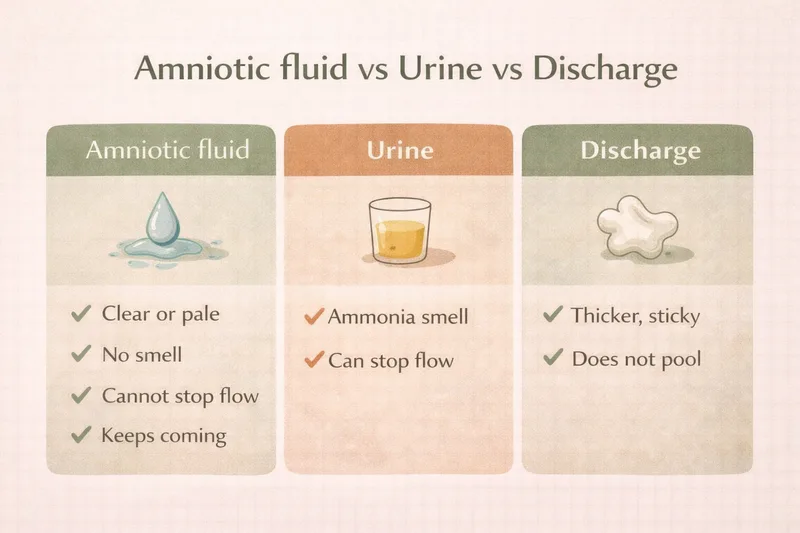
Amniotic fluid is usually clear or pale straw-coloured. It may be slightly pink. According to the NHS, it is odourless or has a very mild, slightly sweet smell. You cannot stop it by clenching your pelvic floor muscles. It continues to leak, especially when you move or change position.
Urine has a distinct ammonia smell. You can usually stop or slow the flow by tightening your pelvic floor. It does not keep coming once your bladder is empty.
Vaginal discharge is thicker and more sticky. It does not pool in your underwear the way amniotic fluid does, and it does not keep flowing.
The pad test. If you are not sure, put on a clean maternity pad, lie down for 30 minutes, then stand up. If the pad is wet with clear, odourless fluid — particularly if it gets wetter when you stand — it is likely your waters have broken. According to the NHS, you should use a pad (not a tampon) so your midwife can check the colour of the fluid when you arrive at the maternity unit.
When Do Waters Usually Break?
According to the NHS, it is most likely that your waters will break during labour. But for some women — around 1 in 10 — waters break before contractions start. This is called prelabour rupture of membranes (PROM) and it is normal at term.
According to Tommy's, around 6 in 10 women whose waters break before labour will go into labour on their own within 24 hours. If labour does not start, your maternity team will discuss the next steps with you, which may include induction because the risk of infection rises once the protective amniotic fluid is no longer around the baby.
It is also possible for a midwife or doctor to break your waters during labour to speed things up. This is called amniotomy or artificial rupture of membranes (ARM). According to Tommy's, this involves inserting a small plastic tool to make a hole in the amniotic sac. It may feel uncomfortable but should not be painful.
What to Do When Your Waters Break
Step 1: Note the time. Your maternity team will want to know when your waters broke, as the time since rupture affects decisions about your care.
Step 2: Check the colour and smell of the fluid. Clear or pale straw is normal. Pink is usually fine. Green, brown, or heavily blood-stained fluid needs urgent attention.
Step 3: Put on a maternity pad. Not a tampon. The pad helps you monitor how much fluid is coming and lets your midwife check the colour when you arrive.
Step 4: Call your maternity unit. According to the NHS, you should contact your midwife or maternity unit even if you are not yet having contractions. They will advise you whether to come in or stay at home and monitor.
Step 5: Monitor your temperature. According to the NHS, you should take your temperature every 4 hours while awake after your waters break. A temperature above 37.5°C may indicate infection and should be reported immediately.
Step 6: Avoid sex. According to the NHS, there is no evidence that having a bath or shower increases your risk of infection after your waters break — but having sex might. Avoid it.
When to Call Immediately
Most of the time, waters breaking is the start of a normal process. But there are some situations where you need to call your maternity unit urgently.
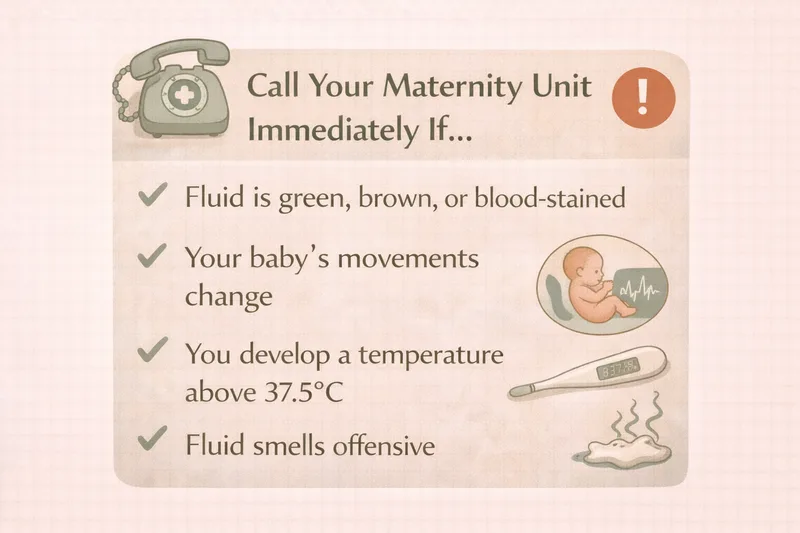
Call immediately if:
The fluid is green or brown — this may indicate your baby has passed meconium (their first bowel movement), which can be a sign of distress and may need urgent assessment.
The fluid is heavily blood-stained — a small amount of pink or blood-tinged fluid can be normal, but fresh red bleeding or heavy blood-staining needs immediate attention.
Your baby's movements change — if your baby is moving less than usual, or the pattern of movement feels different, contact your maternity unit straight away.
You develop a raised temperature — a temperature above 37.5°C after your waters break may indicate infection. Call your maternity unit.
The fluid has an unpleasant or offensive smell — this can also be a sign of infection.
You are less than 37 weeks pregnant — if your waters break before term, this is called preterm prelabour rupture of membranes (PPROM). According to Tommy's, you should contact your maternity unit immediately and go to hospital to be assessed. PPROM affects around 2 in every 100 pregnancies and requires specialist care.
What Happens at the Hospital?
If you go to the maternity unit after your waters break, you can expect the following:
Your midwife will take your temperature, pulse, and blood pressure. They will feel for the position of your baby and listen to the heartbeat. They may ask to see your maternity pad to check the colour and amount of fluid. If it is not clear whether your waters have broken, they may ask to do an internal examination using a speculum — a small plastic instrument inserted into the vagina, similar to a smear test. They may also do an ultrasound to check the amount of fluid around your baby.
If your waters have broken and you are at term but not yet in active labour, your maternity team will discuss your options. You may be advised to go home and wait for labour to start, with instructions to monitor your temperature and contact the unit if anything changes. According to the NHS, there is no evidence that bathing increases infection risk after your waters break — so a shower or bath is fine.
Frequently Asked Questions
Can your waters break without you noticing? Yes. If the leak is very slow — sometimes called a "hindwater leak" — it can be easy to mistake for bladder leakage or discharge. If you are consistently damp and unsure, contact your maternity unit for a check.
Can your waters break while you are asleep? Yes. Many women wake up feeling wet and realise their waters have broken during the night. Put on a pad, note the time, and call your maternity unit.
How much fluid is there? Your amniotic sac contains roughly 600 to 800ml of fluid at term — but you are unlikely to lose it all at once. Some comes out initially, and the rest leaks gradually as you move and as your baby shifts position.
Do contractions always start after your waters break? Not always. Around 6 in 10 women go into labour within 24 hours. If labour does not start, your maternity team will discuss options including induction.
Is it safe to have a bath after your waters break? Yes. According to the NHS, there is no evidence that bathing increases the risk of infection. But you should avoid sex.
The Bottom Line
Your waters breaking is one of those moments that pregnancy books describe in one paragraph but that in real life leaves you standing in the bathroom at 3am asking, "Was that it?"
It might be a gush, it might be a trickle, and it might just be dampness you cannot explain. All of those are real. The key test is whether the flow keeps coming — because amniotic fluid does not stop when you clench.
When it happens, stay calm, put on a pad, check the colour, note the time, and call your maternity unit. Most of the time, everything is fine. And even if nothing seems to be happening yet, your body has just signalled that your baby is on the way.
This article is for general information only and does not replace advice from your midwife or maternity team. If you think your waters may have broken, contact your maternity unit for advice.
This article was written in April 2026. We regularly review our content against the latest NHS and NICE guidelines to help ensure accuracy. This article references NHS: Signs That Labour Has Begun (×6 citations), Tommy's: What to Expect When Your Waters Break (×4 citations), and Tommy's: PPROM — When Your Waters Break Early (×1 citation). If you think your waters may have broken, contact your maternity unit for advice.