

At some point around 39 weeks, your midwife will probably mention a membrane sweep. If nobody has explained what one actually is, the name alone can be enough to make you nervous. Sweep? Of what? Where?
I remember my face when it was first mentioned — a mixture of confusion and mild horror. Nobody had explained it beforehand, and I felt put on the spot. I ended up saying yes without really understanding what was about to happen, and I found it uncomfortable. In hindsight, I wish I had known more before the appointment so I could have made a properly informed decision.
This guide will explain what a membrane sweep is, what it involves, what the evidence says about whether it works, and — importantly — that it is your choice.
Quick answer: A membrane sweep is a vaginal examination where a midwife or doctor sweeps their finger around the cervix to try to encourage labour to start naturally. It is usually offered from 39 weeks. According to NICE guideline NG207, it may reduce the need for formal induction, but it does not work for everyone and you do not have to agree to it.
What Is a Membrane Sweep?
A membrane sweep — also called a stretch and sweep or cervical sweep — is a procedure where a midwife or doctor inserts a gloved finger into the vagina and sweeps it around the cervix. The aim is to separate the membranes of the amniotic sac from the cervical wall.
According to the NHS, this separation releases hormones called prostaglandins, which may help to soften and ripen the cervix and encourage contractions to start. It is not a formal induction of labour, but it is considered a method of trying to get labour started.
Tommy's describes it as feeling similar to an internal examination. Your midwife will gently insert their finger through the cervix — if the cervix is open enough — and use a circular sweeping motion to part the membranes from the cervical wall.
When Is It Offered?
According to NICE guideline NG207, membrane sweeps should be offered at antenatal appointments from 39 weeks of pregnancy. Additional sweeps can be offered if labour does not start naturally after the first one.
The sweep is usually offered before a formal induction is discussed — the idea being that if a sweep can get labour started, it may avoid the need for medical induction in hospital.
Some hospitals may offer sweeps slightly earlier or later depending on individual circumstances. If you are unsure about the timing, ask your midwife to explain why a sweep is being suggested at that particular point.
What Actually Happens?
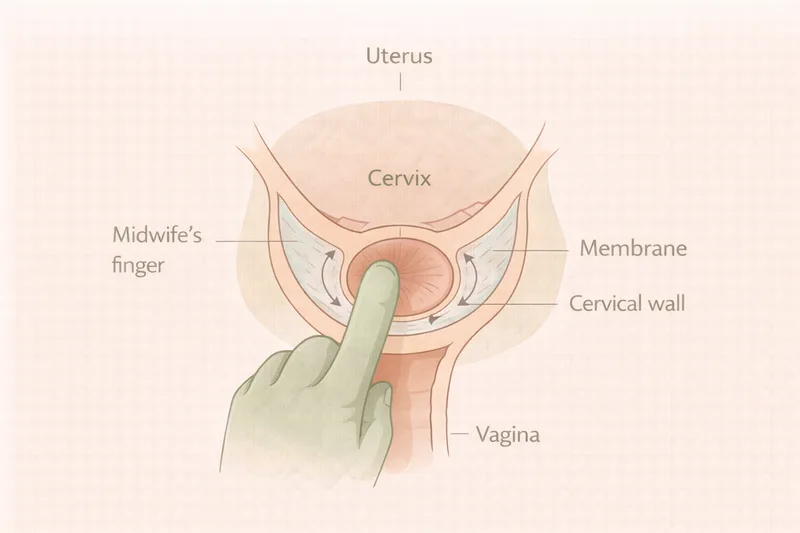
Here is what to expect during the procedure:
Your midwife will explain what they are going to do and ask for your consent before proceeding. You will lie on a bed or examination couch, similar to the position for a cervical smear or internal examination. The midwife or doctor will insert a gloved finger into the vagina and, if the cervix is open enough, use a circular sweeping motion around the cervix to try to separate the membranes from the cervical wall. The whole procedure usually takes a few minutes.
How it feels. Experiences vary widely. Some women describe it as mildly uncomfortable, similar to a smear test. Others find it painful, particularly if the cervix is not yet soft or open. The NHS acknowledges that some women find the procedure uncomfortable or painful.
NICE states that women should be informed that pain, discomfort, and vaginal bleeding are possible from the procedure. If you find it too uncomfortable, you can ask the midwife to stop at any time.
After the sweep. You may experience some light vaginal bleeding or spotting, which is normal. You may also notice a brownish or blood-tinged discharge, or irregular tightenings. These can be signs that the sweep has had some effect, but they do not guarantee that labour will start.
Does It Actually Work?
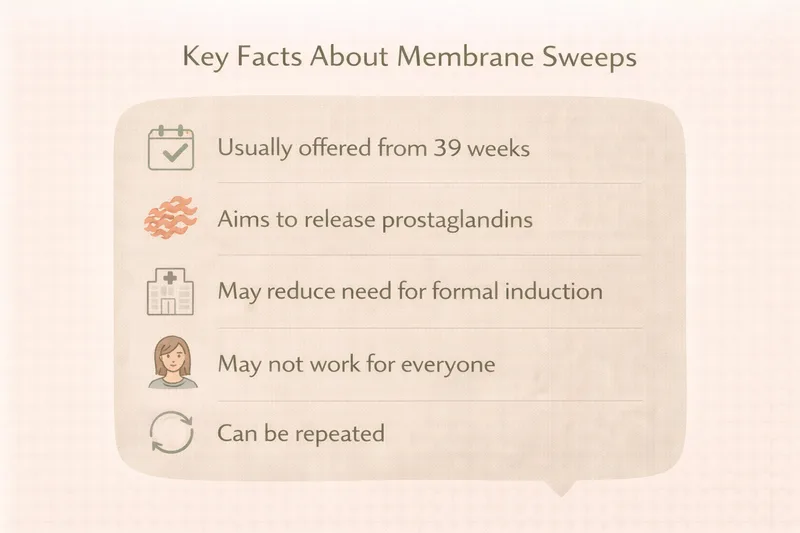
The honest answer is: it might. According to Tommy's, studies involving thousands of women have shown that a membrane sweep can be an effective way of encouraging labour to start and may reduce the need for more formal methods of induction such as pessaries or hormone drips.
However, the evidence is not straightforward. NICE acknowledges that more research is needed into when and how frequently membrane sweeping should be carried out to maximise its effectiveness. One commonly cited figure is that approximately 8 women need to have a sweep in order for 1 woman to go into labour who would not have done so otherwise — but it is impossible to know for certain whether any individual woman's labour was triggered by the sweep or would have started anyway.
The time it takes for a sweep to work varies. According to Tommy's, the aim is for labour to start within 48 hours of the sweep, but this does not happen for everyone. If the first sweep does not work, you may be offered another one.
A sweep is more likely to be effective if the cervix is already starting to soften and open. Your midwife may assess this using what is called a Bishop score — a numerical score based on the position, softness, and openness of the cervix. A higher score suggests the cervix is more ready for labour.
Do You Have to Say Yes?
No. A membrane sweep requires your consent, and you are under no obligation to agree.
NICE is clear that women should be provided with information, given time to ask questions, and allowed time for discussion before making a decision. Your midwife should explain what the procedure involves, why it is being offered, and what the alternatives are.
If you decline a sweep, that is completely fine. It does not mean you will automatically need a formal induction. Many women go into labour naturally without ever having a sweep. If you would prefer to wait, your midwife will discuss the next steps and the timing of any further decisions with you.
Some women find it helpful to ask their midwife to check their Bishop score first — this can give an indication of whether the cervix is ready and whether a sweep is likely to be effective, which may help inform your decision.
What If the Cervix Is Not Ready?
Sometimes the midwife will attempt a sweep but find that the cervix is still closed, firm, or not in a favourable position. In this case, they may not be able to carry out a full sweep. They may instead massage or stimulate the cervix, which is sometimes described as a "cervical massage" rather than a sweep.
This is not unusual and does not mean anything is wrong. The cervix may simply not be ready yet, and a sweep can be offered again at a later appointment.
Risks and Side Effects
Membrane sweeps are generally considered safe, but like any procedure, they carry some potential side effects:
Discomfort or pain during the procedure — this varies from person to person and depends on how soft and open the cervix is.
Light vaginal bleeding or spotting afterwards — this is common and usually nothing to worry about. If you experience heavy bleeding, contact your maternity unit.
Irregular contractions that may start and then stop — this can be frustrating but does not mean the sweep has failed. Labour may still follow in the coming days.
Accidental rupture of membranes — in rare cases, the sweep may cause the waters to break. If this happens, contact your midwife, as your care will need to be managed accordingly.
The Bottom Line
A membrane sweep is a simple, brief procedure that may help encourage labour to start naturally and reduce the need for a formal hospital induction. The evidence suggests it works for some women but not all, and more research is needed on the best timing and frequency.
The most important thing to know is that it is your choice. You can say yes, you can say no, you can ask for more information, and you can change your mind. Your midwife should support whatever decision you make.
If you are approaching your due date and a sweep has been mentioned, ask questions. Find out whether your cervix is showing signs of being ready. Understand what the procedure involves before you are in the room. And make the decision that feels right for you.
This article is for general information only and does not replace advice from your midwife or maternity team. A membrane sweep is a procedure that requires your consent — you can always ask questions, ask for more time, or decline.
This article was written in April 2026. We regularly review our content against the latest NHS and NICE guidelines to help ensure accuracy. This article references NHS: Inducing Labour, NICE guideline NG207: Inducing Labour (published November 2021), Tommy's: What Is a Membrane Sweep?, and NICE Quality Standard QS60: Membrane Sweeping. If you have questions about membrane sweeps or induction, please speak to your midwife or maternity team.