
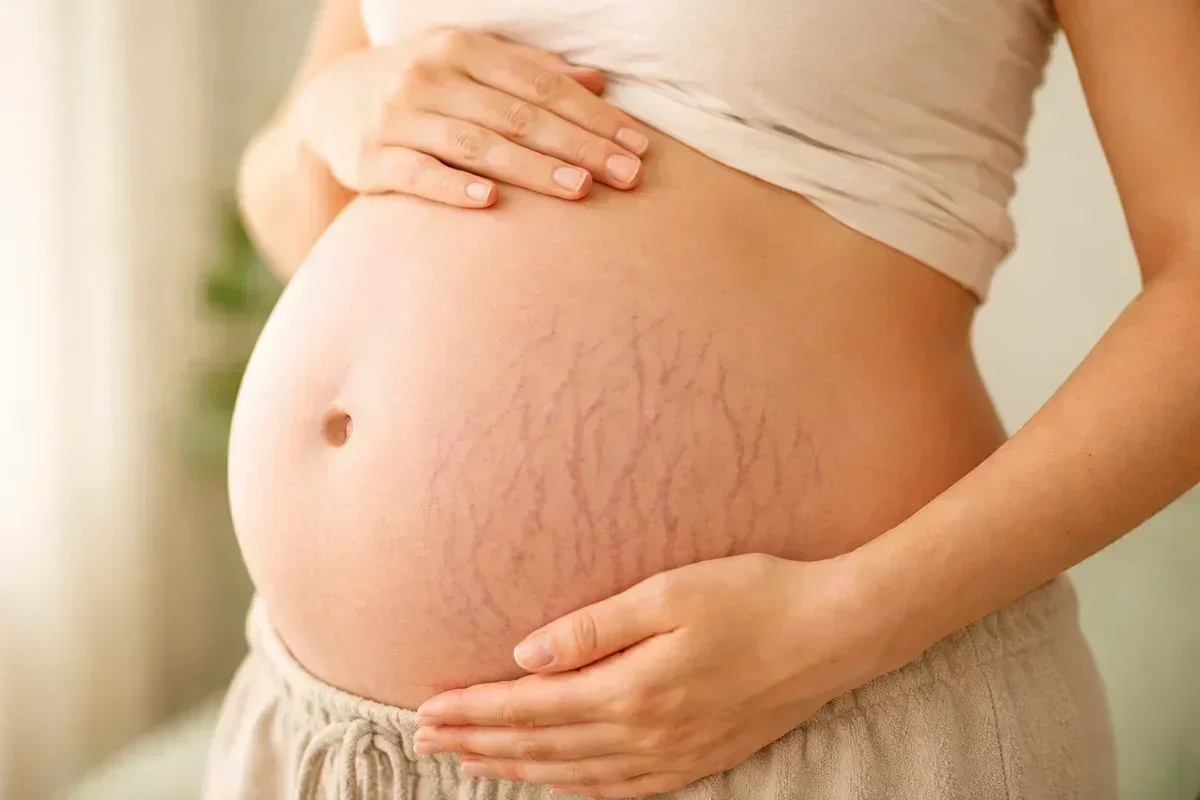
Let's get straight to the point: there is no high-quality evidence that creams, oils, or lotions prevent pregnancy stretch marks. Not Bio-Oil. Not cocoa butter. Not the £45 "miracle" serum your friend swears by.
This is not a popular thing to say, especially when the pregnancy skincare industry is worth billions. But the evidence is clear, and if you are spending money on products marketed to prevent stretch marks during pregnancy, you deserve to know what the research actually shows.
I diligently applied cocoa butter every night from about 14 weeks. I still got stretch marks. I felt frustrated and, honestly, a bit cheated — because everything I had read said the cream would help. It didn't, because the biggest factor in whether you get stretch marks is not what you put on your skin. It is what is happening underneath it.
Quick answer: Stretch marks are common in pregnancy, affecting up to 8 in 10 women according to the NHS. The main risk factors are genetics, age, and weight gain — not skincare. A Cochrane review found no high-quality evidence that any topical preparation prevents stretch marks during pregnancy.
What Actually Causes Stretch Marks?
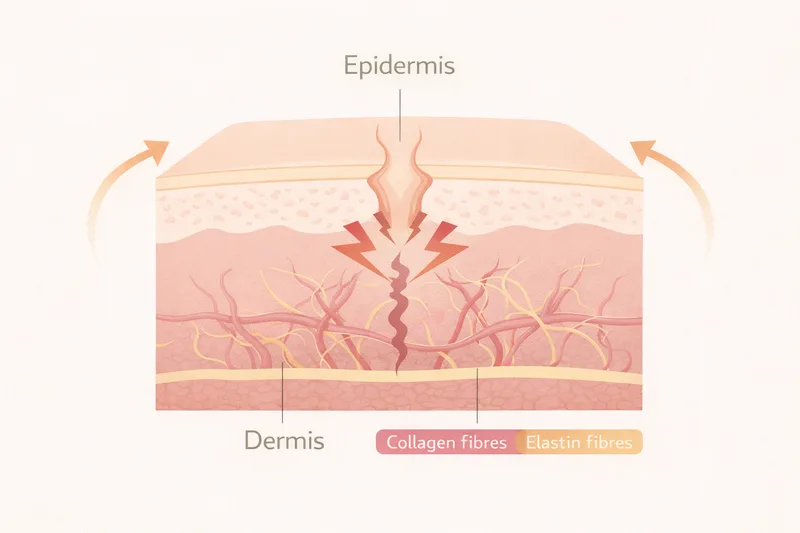
Stretch marks — known medically as striae gravidarum — develop when the skin stretches quickly and the deeper support structure of the skin is affected. They typically appear as red, purple, or pink lines initially, then gradually fade over time to become paler, silvery, or skin-coloured.
According to a review published in the International Journal of Dermatology, the exact mechanism is not fully understood, but it is thought to involve a combination of mechanical stretching and hormonal changes. Pregnancy hormones — including oestrogen, relaxin, and cortisol — may reduce the adhesiveness between collagen fibres and weaken the structural support of the skin, making the skin more vulnerable to stretch mark formation during rapid growth.
Stretch marks most commonly appear on the abdomen, but they can also develop on the breasts, hips, thighs, and buttocks. They often become more noticeable as pregnancy progresses, especially as the bump grows.
What Are the Real Risk Factors?
This is where the evidence gets clear. Multiple studies have identified the same consistent risk factors for pregnancy stretch marks:
Family history. If your mother got stretch marks during pregnancy, you are significantly more likely to get them too. According to Farahnik et al. (2017), family history of stretch marks is one of the strongest predictors.
Younger age. Women under 30 — and especially under 20 — are more likely to develop stretch marks. A large study of 800 women found that 84% of women under 20 developed stretch marks, compared to 24% of women over 30. This may be because younger skin has a different collagen structure that is more susceptible to tearing.
Higher pre-pregnancy weight and weight gain. Greater weight gain during pregnancy is consistently associated with stretch marks. This is likely related to the degree of skin stretching involved.
Larger baby. Higher birth weight has been associated with more severe stretch marks in several studies.
Previous stretch marks. If you already have stretch marks on your breasts, hips, or thighs from puberty or previous weight changes, you may be more likely to develop them during pregnancy.
What these risk factors have in common is that most of them are outside your control. You cannot change your genetics, your age, or — within healthy limits — how much your baby weighs.
Myth vs Fact
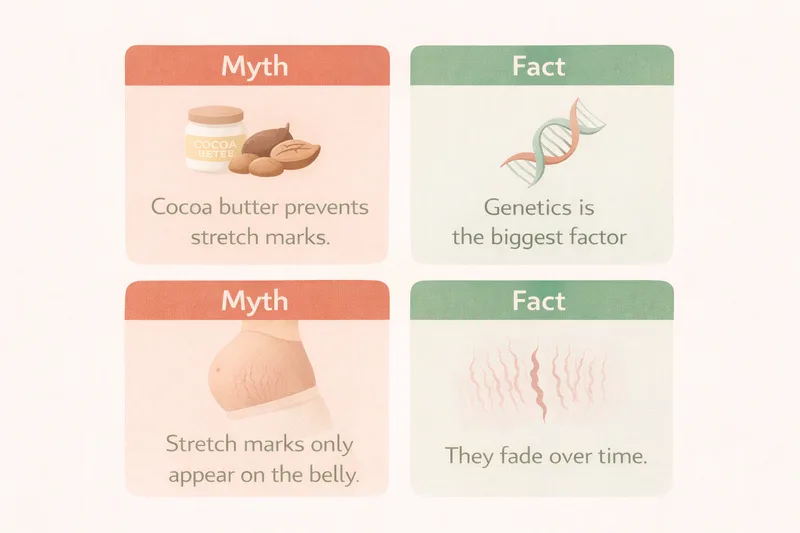
Myth: Cocoa butter prevents stretch marks. Fact: A randomised controlled trial specifically testing cocoa butter lotion against a placebo found no difference in the development of stretch marks. The Cochrane review included this study and concluded that there is no high-quality evidence that any topical preparation prevents stretch marks during pregnancy.
Myth: Bio-Oil or vitamin E oil will stop them forming. Fact: Current evidence does not show high-quality proof that oils, creams, or lotions prevent pregnancy stretch marks. The Cochrane review assessed six trials involving 800 women and found no statistically significant difference between active topical treatments and placebos.
Myth: If you moisturise enough, you won't get them. Fact: Moisturising may help your skin feel more comfortable and reduce itching as it stretches, which is a valid reason to use it. But moisturising does not prevent the structural tearing of collagen in the dermis that causes stretch marks. The process happens deeper than any cream can reach.
Myth: Stretch marks only appear on the belly. Fact: They can develop anywhere the skin stretches rapidly. According to Farahnik et al. (2017), 24% of women in one study developed stretch marks on their thighs or breasts in addition to the abdomen.
Myth: Stretch marks are permanent and never fade. Fact: Fresh stretch marks (striae rubra) are red or purple and can look quite dramatic. Over time — usually months to years — they typically fade to become much paler (striae alba). They may not disappear completely, but they do become significantly less noticeable for most women.
Myth: You can prevent them if you control your weight gain. Fact: While excessive weight gain is a risk factor, healthy weight gain during pregnancy is both normal and necessary. Trying to restrict weight gain to avoid stretch marks could be harmful to you and your baby. The biggest predictor remains genetics, not weight.
So Is There Anything You Can Do?
Honestly? Not much that is proven. But here is what is reasonable:
Keep your skin hydrated. Not because it prevents stretch marks, but because well-moisturised skin is more comfortable. As your skin stretches, it can become dry and itchy, and a good unscented moisturiser or oil can help with that. Use whatever feels good and does not irritate your skin.
Gain weight at a healthy rate. Follow your midwife's guidance on healthy weight gain during pregnancy. Rapid or excessive weight gain may increase stretching, but this is about overall health — not cosmetic prevention.
Stay hydrated. Drinking enough water supports overall skin health, though there is no evidence that hydration alone prevents stretch marks.
Be realistic about expectations. If your mother got stretch marks, you probably will too. That is not a failing — it is genetics. Most women get them, and they fade significantly over time.
What About Treatments After Pregnancy?
Once stretch marks have developed, some treatments may improve their appearance — though none will remove them completely. According to Farahnik et al. (2017), treatments that have shown some evidence of improvement include topical tretinoin (prescription retinoid, not safe during pregnancy or breastfeeding) and laser treatments such as non-ablative fractional lasers.
These are cosmetic treatments and are not available on the NHS for stretch marks. If you are considering them, speak to a qualified dermatologist after your pregnancy and any breastfeeding period has ended.
The Bigger Picture
Stretch marks are one of the most common physical changes of pregnancy. They affect the majority of women. They are not a sign that you did anything wrong, that you failed to look after your skin, or that you should have bought a more expensive cream.
The pregnancy skincare industry profits from making women feel that stretch marks are preventable — and that the right product will stop them. The evidence does not support that claim. What it does support is that stretch marks are largely determined by factors outside your control, and that they fade naturally over time.
Your body grew a human. It is allowed to have the marks to show for it.
This article is for general information only and does not replace advice from your midwife, GP, or dermatologist. If you have concerns about skin changes during pregnancy, speak to your healthcare provider.
This article was written in April 2026. We regularly review our content against the latest evidence to help ensure accuracy. This article references the Cochrane Review: Topical Preparations for Preventing Stretch Marks in Pregnancy (Brennan M, Young G, Devane D, 2012), NHS: Stretch Marks in Pregnancy, Farahnik B et al. (2017). Striae gravidarum: Risk factors, prevention, and management. International Journal of Women's Dermatology, and Picard D et al. (2015). Incidence and risk factors for striae gravidarum. Journal of the American Academy of Dermatology. If you have concerns about skin changes during pregnancy, please speak to your midwife or GP.