

Everyone calls the second trimester the honeymoon phase. The sickness fades, the energy comes back, and you're supposed to start enjoying your pregnancy. The books say so. The forums say so. Your mum probably says so.
So why are you still lying awake at 2am, heart racing, running through every possible thing that could go wrong?
I remember this clearly. I had got through the exhausting first trimester, the 12-week scan was fine, and everyone around me was saying "you must be feeling so much better now." I was — physically. But the worry hadn't gone anywhere. If anything, it had just shifted from "will this pregnancy survive?" to "will the baby be okay?" and "am I going to be a good enough mum?"
If that sounds familiar, this article is for you. Pregnancy anxiety is far more common than most people realise, and the second trimester is no exception.
Quick answer: Anxiety during pregnancy is common and not a sign of weakness. According to NICE, an estimated 13% of women experience anxiety during pregnancy, and it may be higher than figures for depression. If anxiety is affecting your daily life, speak to your midwife or GP — support is available through the NHS.
How Common Is Anxiety in Pregnancy?
More common than most people think. According to NHS England, perinatal mental illness affects up to 27% of new and expectant mothers and covers a wide range of conditions. A NICE-referenced NHS source notes that around 13% of women experience anxiety during pregnancy — which may actually be higher than the rates for perinatal depression.
Yet anxiety in pregnancy gets far less attention than postnatal depression. Many women are aware that they might feel low after the baby is born, but fewer are prepared for the possibility that anxiety might take hold during pregnancy itself — sometimes from very early on.
According to a report referenced by NICE, around 1 in 4 women experience mental health problems during pregnancy or in the first year after birth. And only about half of cases are detected — which means many women are experiencing anxiety without knowing it is a recognised condition, and without receiving the support that is available.
Why Does Anxiety Persist in the Second Trimester?
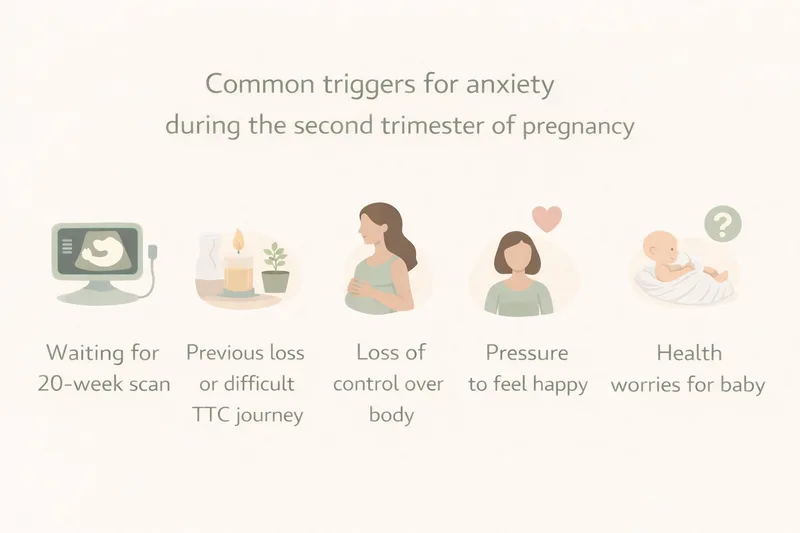
There is a common expectation that once you pass the first trimester, the worry should lift. For some women it does. But for many, the anxiety simply changes shape rather than going away.
The 20-week scan looms. For many women, the anomaly scan is a source of significant anxiety. Even though most scans show that the baby is developing normally, the knowledge that it is specifically designed to check for abnormalities can be unsettling.
A difficult journey to get here. If you experienced a long or stressful trying to conceive journey, fertility treatment, or previous pregnancy loss, the anxiety of early pregnancy may not simply switch off at 12 or 13 weeks. The fear of something going wrong can persist well into the second and even third trimester.
Loss of control over your body. Pregnancy involves significant physical changes that you cannot control. For some women, this loss of autonomy can trigger or worsen feelings of anxiety — particularly if they have a history of anxiety or a need for control in other areas of their life.
Pressure to feel happy. There is an unspoken expectation that pregnant women should feel grateful, excited, and content. If you feel anxious, frightened, or overwhelmed instead, you may also feel guilty for not feeling the "right" way — and that guilt can make the anxiety worse.
Health worries that feel relentless. Every twinge, every change, every Google search can feed a cycle of worry. "Is the baby okay?" "Is this pain normal?" "Why haven't I felt the baby move today?" These questions are common, but when they become constant and difficult to set aside, they may point to something more than ordinary pregnancy worry.
When Is Anxiety More Than Just Worry?
Everyone worries during pregnancy to some degree. A certain level of concern for your baby's health is natural and expected. But there is a difference between occasional worry and anxiety that starts to interfere with your daily life.
According to Mind, perinatal anxiety may involve persistent worry that feels difficult or impossible to control, physical symptoms such as a racing heart, tight chest, difficulty breathing, or feeling on edge, difficulty sleeping — not because of physical discomfort but because your mind will not switch off, avoidance of situations, places, or activities because of anxiety, intrusive or unwanted thoughts about something bad happening to you or your baby, and a feeling of disconnection from yourself or the world around you.
If any of this sounds familiar, it does not mean you are failing at pregnancy. It means you may benefit from support — and that support is available.
The Guilt Cycle
One of the most difficult aspects of pregnancy anxiety is the guilt that often accompanies it.
You know you are supposed to be enjoying this. You know other women would love to be in your position. You feel guilty for worrying when your scan came back fine, when the baby is healthy, when everything is objectively going well. And that guilt feeds the anxiety, because now you are anxious about being anxious.
This cycle is incredibly common, and it is important to name it. Feeling anxious during pregnancy is not a choice. It is not a character flaw. It is not ingratitude. According to the Maternal Mental Health Alliance, having a mental health condition at any time in life is not your fault — and many people feel tired, worried, or low during pregnancy or after birth, regardless of external circumstances.
What Can Help?
There is no single fix for pregnancy anxiety, but there are things that may help — and professional support is available if you need it.
Talk to your midwife. Mental health should be part of routine antenatal care. NICE says women should be asked about their emotional wellbeing at each routine antenatal and postnatal contact, and your midwife can help assess what support you may need. It can be harder to bring up mental health if you see a different midwife at each appointment, but anything you share is recorded in your notes so your care team can support you consistently.
NHS talking therapies. You can self-refer for NHS talking therapies (formerly IAPT) without needing a GP referral. Cognitive behavioural therapy (CBT) is one of the most commonly offered approaches for anxiety, and NICE recommends it as an option for persistent anxiety during pregnancy and the postnatal period. You can find your local service at nhs.uk/talk.
Specialist perinatal mental health services. If your anxiety is more severe or complex, your midwife or GP can refer you to a specialist perinatal mental health team. According to NHS England, all areas in England now have access to specialist perinatal mental health services.
Physical activity. Even gentle exercise — walking, swimming, prenatal yoga — can help reduce anxiety. Movement can lower stress hormones and improve mood, and it gives you something active to focus on. Always check with your midwife before starting a new activity during pregnancy.
Medication. If your anxiety is severe, your GP or specialist may discuss medication with you. Some women assume that no medication is safe during pregnancy, but according to NICE guideline CG192, there are options that can be considered depending on the severity of the condition, and the benefits and risks can be weighed together with your doctor. You should never stop or start medication during pregnancy without speaking to your healthcare team first.
Mindfulness and breathing techniques. These are not a cure for clinical anxiety, but evidence suggests they can help manage symptoms. Simple breathing exercises — breathing in for 4, holding for 4, breathing out for 6 — can calm the nervous system in moments of acute anxiety.
Talking to someone you trust. A partner, friend, family member, or another parent who has been through a similar experience can make an enormous difference. Sometimes simply naming the anxiety out loud reduces its power.
What Your Partner Can Do
If you are reading this as a partner, there are things you can do to help. Be present. Listen without trying to fix things. Do not dismiss the worry with "but the scan was fine" or "everything's going to be okay" — she knows that rationally, but anxiety is not rational.
Ask how she is feeling at antenatal appointments, or offer to bring it up with the midwife if she finds it difficult. Encourage her to access support if she needs it. And recognise that this is not about you — but your support matters more than you might realise.
Where to Get Help
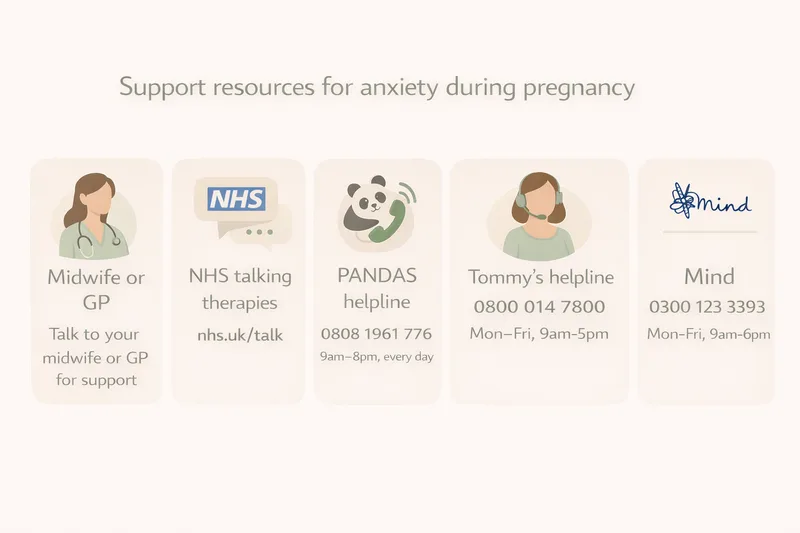
If you are experiencing anxiety during pregnancy, here are some places you can turn to:
Your midwife or GP — mental health is a core part of antenatal care and they can refer you to appropriate support.
NHS talking therapies — self-refer at nhs.uk/talk or ask your GP.
PANDAS Foundation — free helpline for anyone experiencing perinatal mental illness: 0808 1961 776 (9am–8pm, every day).
Tommy's — pregnancy helpline staffed by midwives: 0800 014 7800 (Mon–Fri, 9am–5pm).
Mind — information and support for perinatal anxiety, including a helpline: 0300 123 3393.
Maternal Mental Health Alliance — information on perinatal mental health conditions and where to find help.
If you are in crisis or feel you cannot keep yourself safe, contact your GP urgently, call 111, go to your nearest A&E, or call the Samaritans on 116 123 (free, 24 hours, every day).
The Bottom Line
The second trimester is not always the honeymoon phase that people make it out to be. For many women, anxiety persists — or even intensifies — during this stage of pregnancy. If that is your experience, you are not alone, you are not failing, and you are not ungrateful.
Pregnancy anxiety is a recognised condition, it is more common than most people realise, and there is effective support available. Talking to your midwife is the first step. You do not have to wait until things get worse before asking for help.
You are growing a human. It is okay to find that overwhelming sometimes.
This article is for general information only and does not replace advice from your midwife, GP, or mental health professional. If you are struggling with anxiety during pregnancy, please speak to your maternity team — support is available and you do not have to manage this alone.
This article was written in April 2026. We regularly review our content against the latest NHS and NICE guidelines to help ensure accuracy. This article references NICE guideline CG192: Antenatal and Postnatal Mental Health (published December 2014, last updated February 2020), NHS England: Perinatal Mental Health, Mind: Perinatal Anxiety, Maternal Mental Health Alliance, PANDAS Foundation, and Tommy's. If you are struggling with your mental health during pregnancy, please speak to your midwife, GP, or contact one of the support services listed above.