

You have been waiting for weeks. Every twinge makes you wonder. Every trip to the toilet makes you check. And at 3am when something feels different, the only question in your head is: is this it?
Labour does not always announce itself the way it does on television — no dramatic rush to the car, no sudden gush of water in the supermarket. For most women, it starts gradually, and the hardest part is working out whether what you are feeling is the real thing or just another false alarm.
I remember the night my labour started. I had been having on-and-off cramps all day but kept telling myself "it's probably nothing." By midnight the cramps had a rhythm. By 2am I could not talk through them. We called the maternity unit and they said to come in. It had been happening for hours before either of us was sure.
This guide will walk you through the real signs of labour, what to do at each stage, and the clear points at which you should pick up the phone.
Quick answer: The main signs that labour is starting are regular contractions that get longer, stronger, and closer together; a show (the mucus plug coming away); and your waters breaking. The NHS advises calling your midwife when contractions are regular, lasting at least 60 seconds, and coming every 5 minutes — or sooner if you are worried.
The Three Main Signs
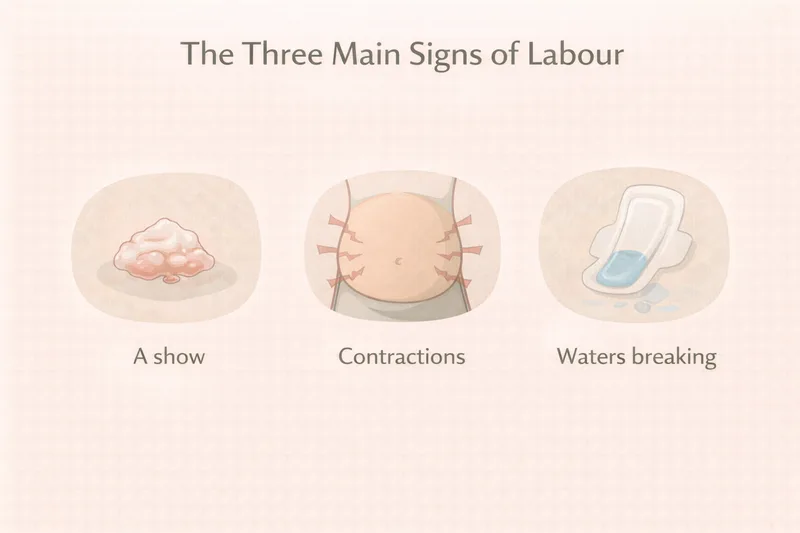
According to the NHS, the main signs that labour may be starting are contractions, a show, and your waters breaking. Not everyone experiences all three, and they can happen in any order.
Contractions
This is usually the most recognisable sign. When you have a contraction, your womb tightens and then relaxes. According to the NHS, for some people contractions may feel like extreme period pains. You may feel them across your abdomen, in your lower back, or both.
Early contractions are often irregular — they may come and go, with long gaps in between. As labour progresses, they tend to become longer, stronger, and more frequent. The NHS notes that during a contraction, if you put your hand on your abdomen, you will feel it getting harder. When the muscles relax, the pain fades and the hardness eases.
The key distinction from Braxton Hicks is pattern. Real labour contractions build over time and do not stop when you change position, rest, or have a bath. If the tightenings keep coming and getting stronger regardless of what you do, it is likely the real thing.
A Show
During pregnancy, a plug of thick mucus sits in your cervix, helping to seal the entrance to your womb. As your cervix begins to soften and open, this mucus plug may come away. The NHS describes it as a sticky, jelly-like substance that may be pink because it contains a small amount of blood. It may come away in one blob or in several pieces.
A show indicates that the cervix is starting to change — but it does not mean labour is imminent. It may happen days or even weeks before contractions begin. Some women do not notice a show at all, and that is also normal.
If you see what looks like a show, you do not need to call your midwife unless you are concerned. However, if you are losing more blood than a small amount — particularly bright red blood — phone your maternity unit straight away, as this may indicate something that needs checking.
Waters Breaking
Your baby grows inside a bag of fluid called the amniotic sac. When the sac breaks, the fluid drains out through your vagina. This is your waters breaking.
According to the NHS, if your waters break naturally, you may feel a slow trickle or a sudden gush of fluid that you cannot control. Amniotic fluid is usually clear and pale. It can sometimes be difficult to tell whether it is amniotic fluid or urine — if you are not sure, put on a pad and check after 30 minutes.
If your waters break, call your midwife — even if you are not yet having contractions. Use a pad (not a tampon) so your midwife can check the colour of the fluid. The NHS notes that it is usual to go into labour within 24 hours of your waters breaking. If labour does not start within that time, you will usually be offered an induction because of the increased risk of infection without the protective amniotic fluid.
Call your maternity unit immediately if your waters are green, brown, or heavily blood-stained — this may indicate that your baby has passed meconium (their first bowel movement) and may need urgent assessment.
Other Signs That Labour May Be Approaching
Some women notice other changes in the days or hours before labour starts:
A sudden burst of energy. Some women experience a "nesting instinct" — an urge to clean, organise, and prepare. This does not happen to everyone, but if you find yourself scrubbing the kitchen at 11pm, your body may be telling you something.
Backache or a heavy aching feeling. According to the NHS, you may experience persistent lower backache or a heavy, aching sensation as the baby's head presses down.
An urge to go to the toilet. The pressure of the baby's head on your bowel can make you feel like you need to empty your bowels. Some women experience loose stools or diarrhoea shortly before labour starts.
Feeling different. This is vague, but many women report simply feeling that something has changed — a sense that things are beginning, even if they cannot put their finger on exactly what. Trust your instincts.
The Latent Phase: Why Labour Can Stop and Start
One of the most confusing things about labour is that it often does not progress in a straight line. The early part of labour — called the latent phase — can last hours or even days, and it is completely normal for contractions to start and then stop again.
According to the NHS, you will probably be advised to stay at home during this phase. If you go to the hospital, they may suggest you go back home — this is not a dismissal. Research suggests that you are more likely to progress well in familiar, comfortable surroundings where you can relax.
During the latent phase, try to rest when you can, eat light meals, stay hydrated, use a warm bath or hot water bottle for comfort, try relaxation and breathing techniques, and move around gently between contractions. If contractions stop, use the time to sleep if possible. They will start again when your body is ready.
When to Call Your Midwife
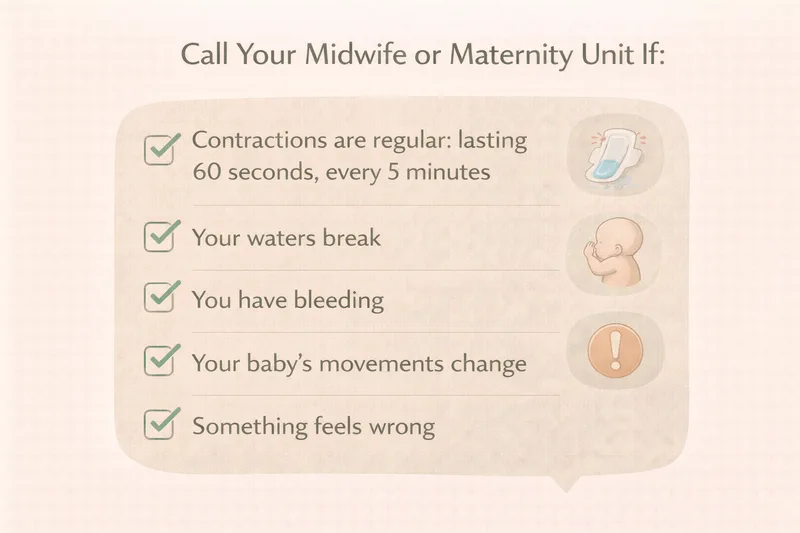
The NHS advises contacting your midwife or maternity unit when your contractions have a regular pattern, last at least 60 seconds, and are coming every 5 minutes — or sooner if you think labour has started, are unsure, or are worried about anything.
Call immediately if:
Your waters break — regardless of whether you are having contractions. Your waters are green, brown, or blood-stained. You have vaginal bleeding that is more than a small amount of blood-tinged mucus. Your baby's movements are reduced or have changed. You are less than 37 weeks pregnant and think you may be in labour. Something does not feel right — trust your instincts.
You will never be wasting your midwife's time by calling. They assess situations like this every day, and they would far rather hear from you than have you sitting at home unsure.
What to Do While You Wait
If your midwife has advised you to stay at home during early labour, here are some practical things that may help:
Keep timing contractions. Note how long each one lasts and the gap between them. There are apps that can help, or your partner can time them on a phone.
Stay upright and mobile. Being upright and moving around — walking, swaying, leaning forward on a ball or the back of a chair — can help labour progress and may ease pain.
Use warmth. A warm bath, shower, or hot water bottle on your lower back or abdomen can be soothing.
Eat and drink. Light snacks and regular sips of water or isotonic drinks will help maintain your energy. Labour is physically demanding, and your body needs fuel.
Alert your birth partner. Make sure they know what is happening and are ready to support you — whether that means coming home, driving you to the hospital, or just being on standby.
The Bottom Line
Labour usually starts gradually, not dramatically. For most women, the first signs are contractions that slowly build, a mucus plug coming away, or waters breaking — sometimes all three, sometimes just one.
The key is pattern. If contractions are getting longer, stronger, and more regular over time, labour is likely underway. If you are unsure, call your midwife. And if something feels wrong, call immediately — your instincts matter.
Every labour is different. Yours will not look like anyone else's, and that is completely normal. The important thing is knowing the signs, knowing when to call, and knowing that your maternity team is there to support you through every stage.
This article is for general information only and does not replace advice from your midwife or maternity unit. If you think you may be in labour, or if you are unsure about what you are experiencing, contact your midwife or maternity unit at any time.
This article was written in April 2026. We regularly review our content against the latest NHS guidelines to help ensure accuracy. This article references NHS: Signs That Labour Has Begun. If you think you may be in labour or are unsure about what you are experiencing, please contact your midwife or maternity unit at any time.